
Eastern black carpenter ant
Camponotus pennsylvanicus · Carpenter ants
A large black ant that nests in damp or decaying wood and can cause structural damage if left unchecked.
!Is the eastern black carpenter ant dangerous?
Only mildly. Eastern black carpenter ants do not have a functional stinger but will bite with their mandibles and may spray formic acid, which can cause local skin irritation or a burning sensation. Allergic reactions to ant bites or to formic acid are uncommon but possible; seek medical care for severe swelling or signs of allergy.
Pets
Bites can irritate small pets; typically not life-threatening. Large infestations in kennels or bird enclosures can stress animals. If a pet shows an allergic reaction, contact a veterinarian.
📖Overview
Camponotus pennsylvanicus is a widespread North American carpenter ant species common in forests and around buildings. Workers excavate galleries in wood to make nests but do not eat the wood; they remove it as frass. They are social, form perennial colonies with a single queen, and forage for sweets, honeydew and protein. Colonies can become pests when they move into homes or other structures.
🔍How to identify a eastern black carpenter ant
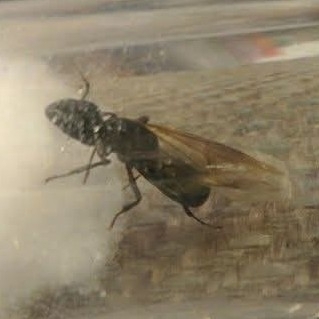
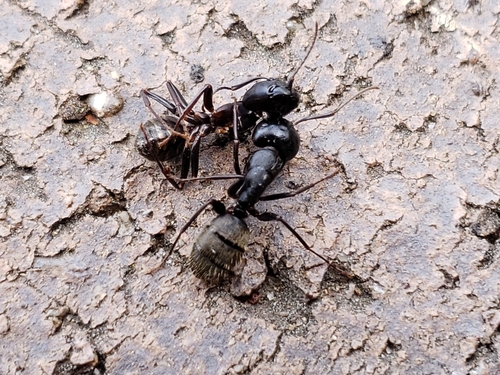
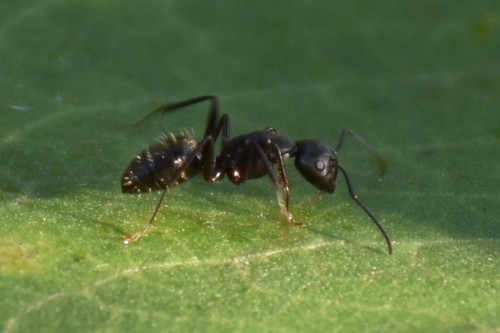
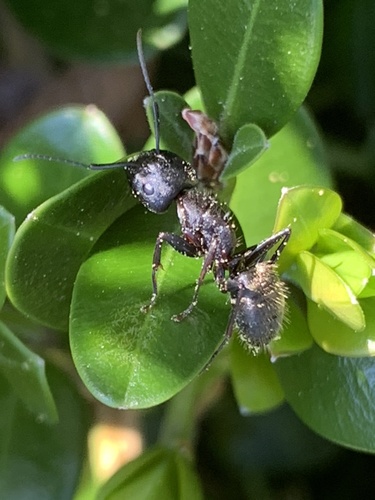
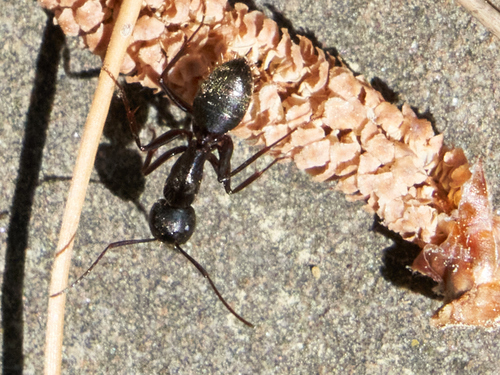
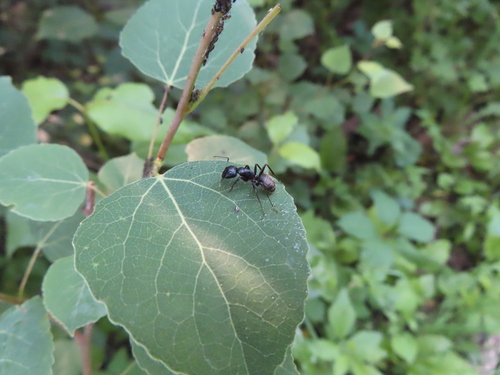
Workers are large, smooth-bodied ants entirely or mostly black; major workers (soldiers) have noticeably larger heads and powerful mandibles. They lack a stinger; when threatened they bite and often spray formic acid from their abdomen. Antennae are elbowed and the petiole (waist) has a single node typical of Camponotus.
- Large black workers 6-13 mm long; major workers have noticeably large heads.
- Single petiole node (waist) and smoothly rounded thorax profile typical of Camponotus.
- Excavated galleries in damp or decaying wood with coarse sawdust-like frass (wood fibers, not fecal pellets).
Lookalikes
Black garden ant Lasius niger
Smaller (3-5 mm), slimmer, and nests in soil rather than excavated wood; worker caste lacks large majors.
Florida carpenter ant Camponotus floridanus
Similar size and habits, but has a reddish-orange head and thorax with a black abdomen and occurs mainly in the southeastern US, especially Florida.
↻Life cycle
Egg
Tiny, pearly white eggs laid by the queen inside the nest; development time varies with temperature and colony conditions.
Larva
Legless, grub-like larvae are fed by workers with liquid and solid food; larvae are cared for in protected brood chambers.
Pupa
Pupae are initially white and resemble adults; metamorphosis occurs inside the nest within cocoons.
Adult (worker, queen, male)
Wingless workers maintain the nest and forage; queens are wingless in established nests and reproduce; winged males and new queens appear seasonally for mating flights.
🍃Diet and predators
Young eat
Fed by workers on a mix of protein sources (insects, arthropod prey) and carbohydrate-rich secretions
Adults eat
Feed mainly on liquids: honeydew from aphids, plant nectar, and household sweets; workers also scavenge protein
Predators of the young
Woodpeckers, other insectivorous birds, predatory beetles and parasitic wasps
Predators of adults
Spiders, birds (especially woodpeckers), black bears, other predatory ants and some small mammals
🌱Effect on plants and gardens
Carpenter ants do not eat wood but excavate it to make nests; they can accelerate decay by nesting in already-damaged or moisture-affected wood and thereby harm structures or dead trees.
How to get rid of eastern black carpenter ants
Locate and eliminate moisture sources and decaying wood; remove and replace infested structural timber. For active nests outside, baiting with protein- and sugar-based insecticidal baits carried back to the colony is effective. Dusts or liquid insecticides applied directly into galleries can work but are best performed by licensed pest professionals for structural infestations. Seal entry points and trim tree branches that contact buildings to reduce access.
📍Where and when to find it
In forests in dead trees, stumps and logs; in buildings, in damp or decayed structural wood, wall voids and hollow doors. Foraging workers are found on tree trunks, along foundations, and indoors near food sources.
Best time
Spring through early fall; foraging peaks in warm months, often at dusk and during warm nights.
Observation tips
Listen for faint rustling in walls, inspect attic and crawlspace wood for smooth galleries and frass, and follow worker trails back to nest openings to locate colonies.
✨Fun facts
- Carpenter ants do not eat wood; they remove it to create smooth galleries and carry it out as frass.
- A single mature colony can contain thousands of workers and can live for many years under favorable conditions.
?Frequently asked questions
Do carpenter ants bite?
Yes, workers bite with strong mandibles. They do not have a functional stinger but may spray formic acid, which can irritate the skin.
Are Eastern black carpenter ants dangerous?
They are not venomous or generally dangerous to people, but large infestations can cause structural damage by excavating wood.
Why are carpenter ants in my house?
They are attracted to moist or decaying wood, so leaks, damp basements, or rotting timbers often invite nesting. Also they forage indoors for sweets and proteins.
How do I get rid of carpenter ants?
Fix moisture problems and remove infested wood. Use baits that workers will carry to the nest, and consider professional pest control for established structural colonies.
How can I tell if I have a carpenter ant colony in my home?
Look for large black workers, noisy activity at dusk/dawn, discarded frass near wood joints, and sawdust-like piles around crevices or vents.
📷Photos of the eastern black carpenter ant
More bees, wasps & ants
This guide was written with AI assistance and fact-checked, last updated 2026-10-09. Identification from photos is never certain: don't handle insects you can't identify, and get medical advice for bites, stings or allergic reactions.