
Virginian tiger moth
Spilosoma virginica · Tiger moths
A common North American tiger moth with white or pale cream wings and a fuzzy, variable-coloured caterpillar often called a woolly bear.
!Is the virginian tiger moth dangerous?
Only mildly. Adults are harmless and do not bite or sting. Larval hairs can cause mild mechanical irritation or a rash (contact dermatitis) in sensitive people; remove hairs by washing skin and avoid rubbing. If a severe reaction occurs, seek medical advice.
Pets
Caterpillar hairs can irritate pets' skin or mouth if handled or chewed; generally not life-threatening but monitor pets and contact a veterinarian if symptoms (excessive drooling, vomiting, swelling) appear.
📖Overview
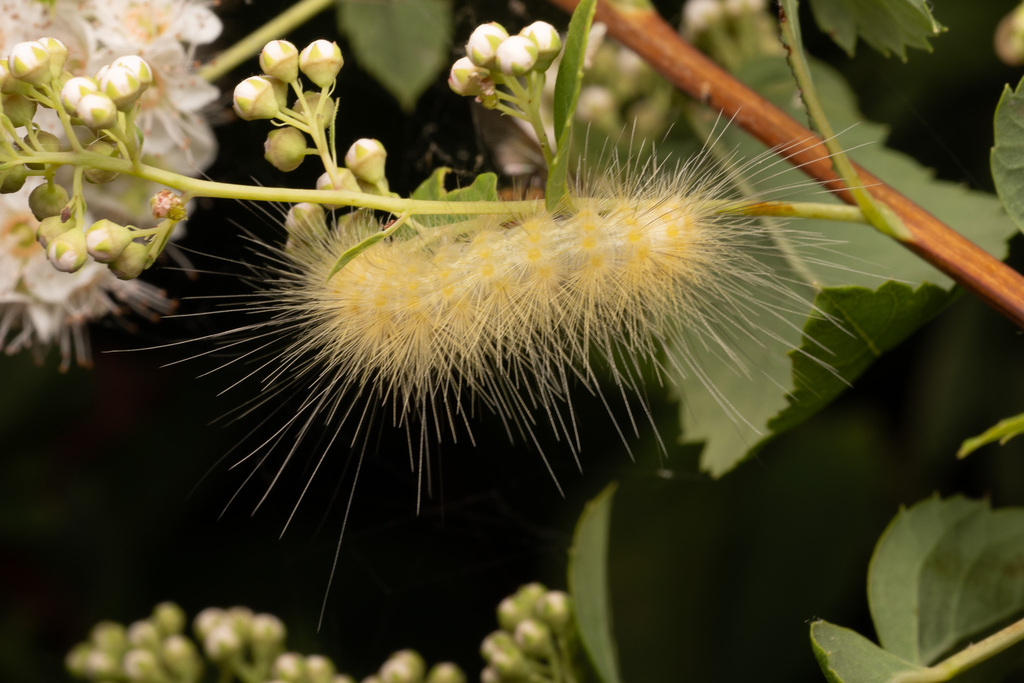
Spilosoma virginica is a widespread moth in the tiger moth group found across much of North America. Adults are pale, medium-sized moths that fly in spring and summer; there may be multiple generations per year in warmer regions. The caterpillars are densely hairy and variable in colour — commonly orange, brown or black — and are often seen feeding on a wide variety of garden and wild plants.
This species is not dangerous to humans, though the caterpillar's hairs can cause mild skin irritation in sensitive people. Populations occasionally reach outbreak levels and can defoliate ornamental plants or crops, but they are usually not long-lasting pests and are kept in check by predators and parasitoids.
🔍How to identify a virginian tiger moth
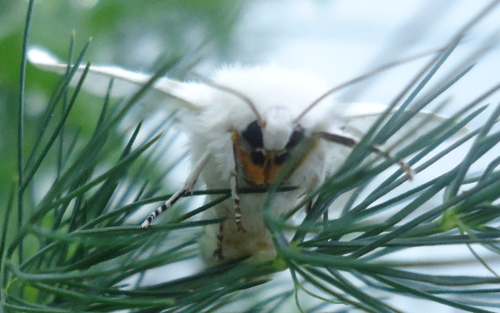
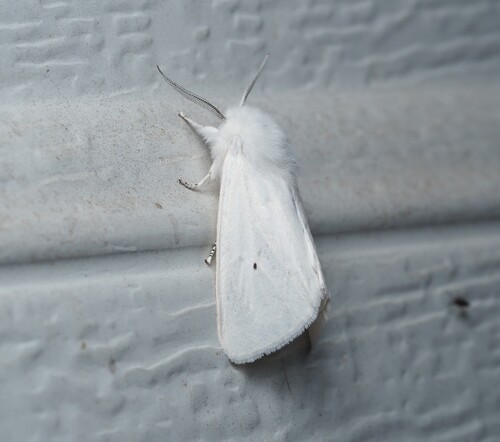
Adults are moths with creamy white to pale yellow wings; forewings and hindwings are mostly plain with a few small black dots. The body is white, but the abdomen is yellow to orange on top with rows of black spots. Wingspan typically about 30-50 mm. Caterpillars (larvae) are very hairy (woolly) and variable in colour: they may be orange, rusty brown, black, or a mix; hairs are long and dense, giving a fuzzy 'woollybear' appearance. Pupae are in a loosely woven silk cocoon mixed with larval hairs, usually in soil or leaf litter.
- Adults: white moth with a 30-50 mm wingspan, a few small black dots on the wings, and a yellow-orange abdomen with rows of black spots.
- Larvae: very hairy 'woollybear' caterpillar, colour variable from orange/rust to black and densely covered in long setae.
- Cocoon: loose silk cocoon incorporating larval hairs in soil or leaf litter.
- Flight: nocturnal and commonly attracted to porch and street lights in summer.
Lookalikes
Salt marsh moth Estigmene acrea
Estigmene acrea adults often have more distinct black spotting on the wings; larvae (also 'woollybears') tend to be more uniformly orange-red or black depending on form.
Isabella tiger moth (woolly bear) Pyrrharctia isabella
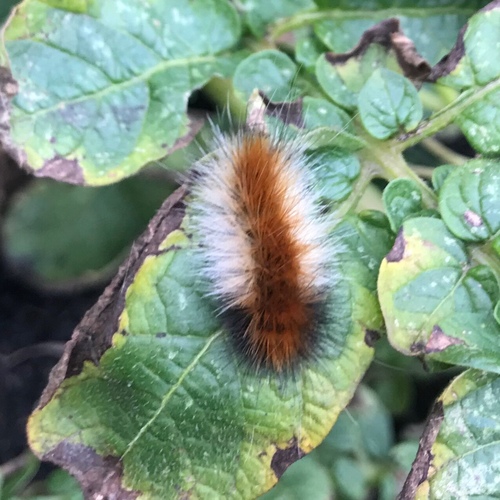
Pyrrharctia isabella caterpillar typically has distinct black end bands with a broad reddish-brown middle band; Spilosoma virginica larvae are more variable and often more uniformly coloured.
↻Life cycle
Egg
Females lay clusters of eggs on host plant leaves; eggs hatch in about 4-10 days depending on temperature.
Larva (woollybear caterpillar)
Larvae pass through several instars over a few weeks, feeding on leaves and growing dense hairs; they are the main feeding stage and most commonly noticed.
Pupa (cocoon)
Larvae spin a loose silk cocoon mixed with their hairs in soil or leaf litter and pupate for one to several weeks.
Adult moth
Adults emerge, mate, and the females lay eggs. Adults live around 1-2 weeks and are nocturnal and attracted to lights.
🍃Diet and predators
Young eat
Generalist herbivore: leaves of many herbaceous plants, garden vegetables, ornamentals and some trees and shrubs.
Adults eat
Adults feed little or not at all; if they feed, they may take nectar from flowers.
Predators of the young
Birds, predatory insects, ants, and parasitic wasps and flies (parasitoids).
Predators of adults
Bats, night-flying birds and predatory insects; adults' white coloration may help avoid detection at night.
🌱Effect on plants and gardens
Larvae are polyphagous and feed on many herbaceous plants and some woody hosts (garden vegetables, ornamentals, weeds and tree seedlings). Heavy local outbreaks can cause noticeable defoliation but widespread, long-term damage is uncommon.
How to get rid of virginian tiger moths
Hand-pick and remove caterpillars if numbers are small (wear gloves to avoid skin contact). For larger infestations, wash plants with a strong jet of water to dislodge larvae or use Bacillus thuringiensis kurstaki (Bt) targeted at lepidopteran larvae. Encourage natural enemies such as birds and parasitic wasps. Chemical insecticides are effective but use them sparingly and follow label directions to protect beneficial insects.
📍Where and when to find it
Adults: at night near porch lights, streetlights or near flowering plants. Larvae: on leaves of a wide variety of herbaceous plants and some woody hosts; check low vegetation and garden plants.
Best time
Spring through fall; night is best for adults (use lights), daytime for finding caterpillars on host plants.
Observation tips
To photograph adults, use a light sheet at night or check lighted walls. For caterpillars, look on the undersides of leaves and along stems; wear gloves if handling.
✨Fun facts
- The hairy caterpillars are commonly called 'woollybears' and have a folklore reputation for predicting winter severity, but this is not supported by science.
- Virginian tiger moths can have several generations per year in warm regions, so caterpillars and adults may be seen across much of the growing season.
- The caterpillar's hairs are defensive: they deter some predators and can carry irritants that discourage handling.
?Frequently asked questions
Do Virginian tiger moths bite or sting?
No. Adults do not bite or sting. Caterpillars do not sting but their hairs can cause mild skin irritation in some people.
Why is this moth in my house?
Adults are attracted to artificial lights at night and may fly in through open doors or windows. Caterpillars sometimes wander in search of pupation sites.
Are the caterpillars poisonous to pets?
They are not known to be poisonous, but the hairs can irritate a pet's mouth or skin if bitten or licked. Monitor your pet and consult a veterinarian for severe symptoms.
How do I get rid of them from my garden?
For small numbers, hand-pick caterpillars wearing gloves and destroy them or relocate them. Large infestations can be treated with Bt (Bacillus thuringiensis kurstaki) or hosed off plants. Encourage birds and parasitoids to reduce populations naturally.
Where does the caterpillar pupate?
It pupates in a loose silk cocoon mixed with its hairs, usually in soil, leaf litter or hidden at the base of plants.
📷Photos of the virginian tiger moth
More butterflies & moths
This guide was written with AI assistance and fact-checked, last updated 2026-10-10. Identification from photos is never certain: don't handle insects you can't identify, and get medical advice for bites, stings or allergic reactions. More about the virginian tiger moth: iNaturalist, Wikipedia.