
Silver-washed fritillary
Argynnis paphia · Fritillary butterflies
A large, fast-flying orange fritillary of woodlands, recognized by its silver-striped underwings and violet-feeding caterpillars.
!Is the silver-washed fritillary dangerous?
No. Harmless to humans. Does not bite or sting. No known toxic effects; handle gently if needed to avoid damaging wings.
Pets
Harmless to pets. Not toxic if eaten, though any insect can cause mild stomach upset if consumed by a pet.
📖Overview
The silver-washed fritillary is a widespread woodland butterfly of the Palearctic region. Adults fly strongly along sunlit rides and glades in deciduous and mixed woods. Females patrol lower vegetation to lay eggs singly, often on tree trunks or vegetation near colonies of violets. The species is univoltine (one generation per year) in most of its range and overwinters as a tiny, unfed caterpillar hidden in bark crevices.
It is ecologically associated with violet species (Viola) that feed the caterpillars, while adults visit a range of nectar sources such as bramble, thistles and knapweeds. Populations are stable in many areas but have declined locally where woodland structure or violet availability has been lost; good coppice and ride management benefits this species.
🔍How to identify a silver-washed fritillary
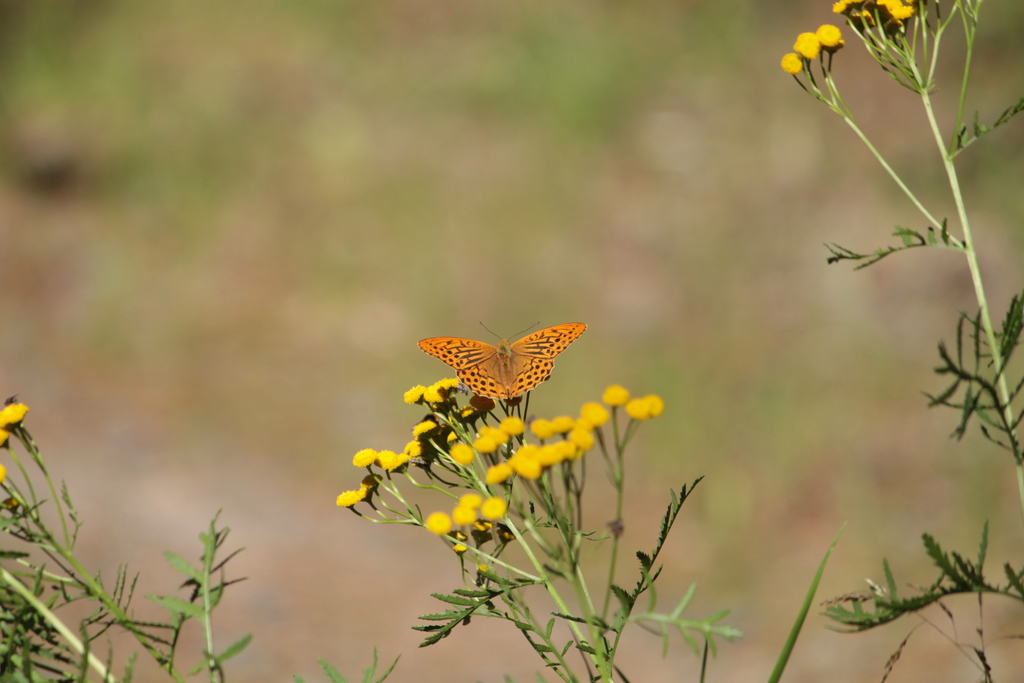
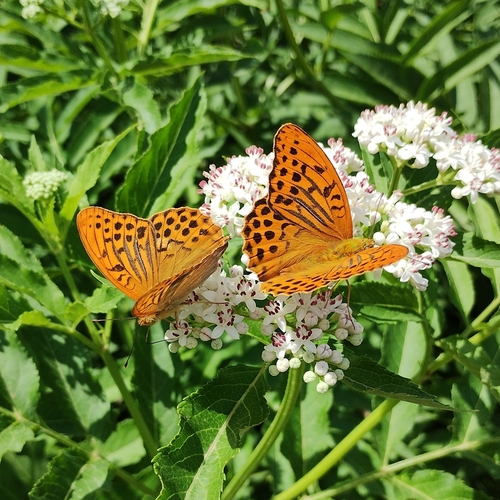
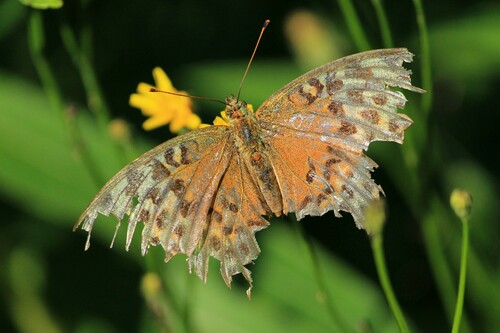
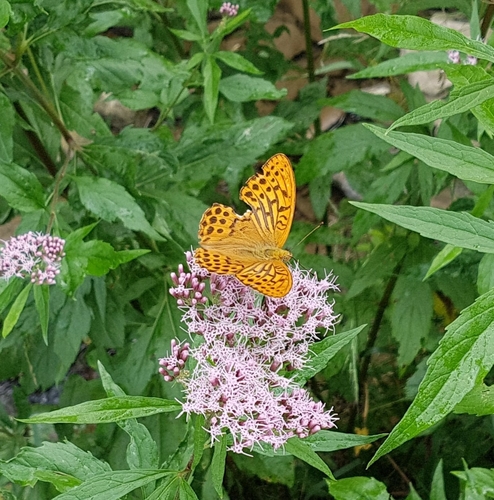
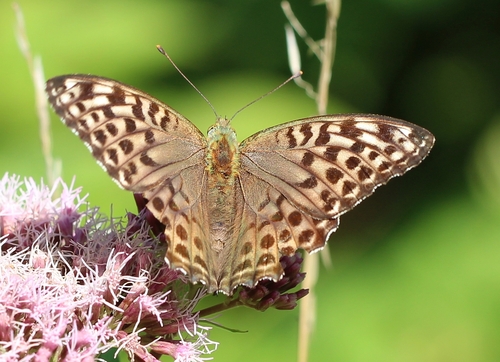
Adults are large fritillaries with bright orange upperwings marked with bold black spots. The male usually appears more uniformly orange; the female is often paler with broader and darker markings. The key identification feature is the underside of the hindwing: broad silvery-green streaks or bands give a 'silver-washed' effect. Wingspan typically 60-80 mm. The forewing shape is rounded and the flight is fast and direct.
- Large orange fritillary with bold black spots on upperwings and rounded forewing tips
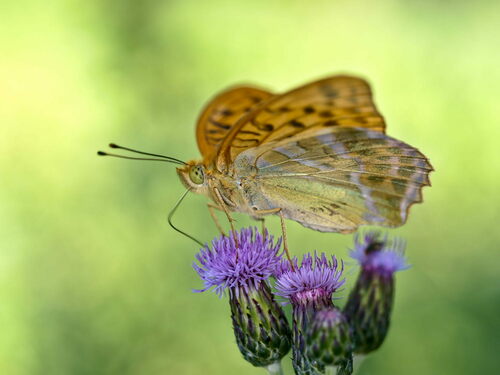
- Underside hindwing shows broad silvery-green streaks or bands — the 'silver wash' is diagnostic
- Females often paler with heavier dark markings; males more uniformly orange
- Found flying strongly in woodland rides and glades rather than open meadows
Lookalikes
Dark green fritillary Argynnis aglaja (Speyeria aglaja)
Underside has more rounded silver spots rather than broad silver-green streaks; overall markings and habitat (more open grassland) differ.
High brown fritillary Argynnis adippe
High brown has different underside patterning with less extensive silver-green wash and a more patchy arrangement of spots; tends to prefer sunny clearings and south-facing slopes.
↻Life cycle
Egg
Females lay single eggs in bark crevices on tree trunks (often oak) near violets. Eggs hatch in about 2-3 weeks depending on temperature.
Larva (caterpillar)
Spiny, dark-brown caterpillars with yellow stripes. Newly hatched caterpillars overwinter unfed in bark crevices, then descend in spring to feed on violet leaves through several instars.
Pupa (chrysalis)
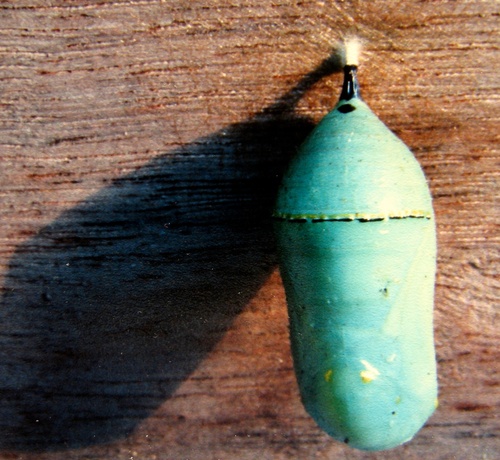
The chrysalis hangs from twigs or low vegetation; it is cryptic and lasts a few weeks before the adult emerges in early summer.
Adult (butterfly)
Adults emerge in summer, feed on nectar, mate and the females lay eggs to start the next generation.
🍃Diet and predators
Young eat
Leaves of violet species (Viola spp.)
Adults eat
Nectar from bramble, thistles, knapweeds and other woodland flowers; occasionally tree sap or honeydew
Predators of the young
Birds, predatory insects, parasitoid wasps and spiders
Predators of adults
Birds (e.g. flycatchers), dragonflies and other aerial predators
🌱Effect on plants and gardens
Caterpillars feed on violets (Viola species). Adults visit nectar sources such as bramble, knapweed and thistles, and thus act as pollinators.
📍Where and when to find it
Adults: sunlit rides, glades and woodland edges feeding on nectar. Eggs and females: low vegetation and tree trunks near violet colonies. Caterpillars: on or near host violets, often hidden in leaf litter.
Best time
June to August in most of its range; warm, sunny afternoons are best for observing flight and feeding.
Observation tips
Walk slowly along woodland rides, focus on sunny sheltered glades, and photograph the undersides by waiting for the butterfly to settle with wings closed to capture the silver bands.
✨Fun facts
- The name 'silver-washed' refers to the metallic-silver to greenish bands on the underside of the hindwing.
- Females fly lower than males when searching for egg-laying sites, often quartering vegetation to find violets.
- It is one of the larger and most noticeable fritillaries in European woodlands.
?Frequently asked questions
Is the silver-washed fritillary dangerous?
No. It is harmless to people and pets; it neither bites nor stings.
Do silver-washed fritillary caterpillars eat garden plants?
They feed mainly on wild violets. They are not a garden pest for most cultivated plants.
Why is a silver-washed fritillary in my garden?
If your garden has sheltered sunny spots, nectar flowers (bramble, thistles) and violets nearby, adults may visit to feed or lay eggs.
How can I attract silver-washed fritillaries?
Provide native nectar plants (bramble, thistle, knapweed), maintain sunny rides or sheltered flower-rich edges, and allow patches of violets for caterpillars.
How do I get rid of them?
They are beneficial pollinators and not pests—control is unnecessary. If they are unwanted, avoid killing them; modify habitat (remove nearby violets) will discourage breeding but is not recommended for conservation.
When and where is the best time to see them?
Look in deciduous woodland rides and glades on warm, sunny days from June to August. Early to mid-afternoon often has the most activity.
📷Photos of the silver-washed fritillary
More butterflies & moths
This guide was written with AI assistance and fact-checked, last updated 2026-10-10. Identification from photos is never certain: don't handle insects you can't identify, and get medical advice for bites, stings or allergic reactions. More about the silver-washed fritillary: iNaturalist, Wikipedia.