
Old World swallowtail
Papilio machaon · Swallowtail butterflies
Large, yellow-and-black swallowtail butterfly found across the Holarctic; caterpillars feed on Apiaceae and adults are frequent garden visitors.
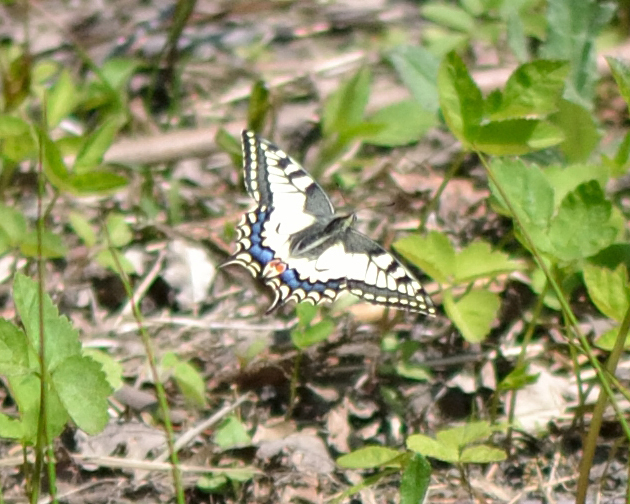
!Is the old World swallowtail dangerous?
No. Harmless to people: adults do not bite or sting. Caterpillars are not poisonous to touch; some caterpillars of other species can irritate skin, but P. machaon is not known to cause problems.
Pets
Not dangerous to pets. Neither the butterflies nor the caterpillars are known to be toxic to dogs or cats.
📖Overview
Papilio machaon is a widespread swallowtail butterfly native to much of Europe, temperate Asia and parts of North America (through closely related subspecies). It occupies a wide range of open habitats including meadows, river valleys, coastal marshes and garden edges. Adults are strong fliers and are commonly seen visiting flowers for nectar. The caterpillars feed mainly on plants in the carrot family (Apiaceae) and pupate in a chrysalis attached to vegetation or structures.
There are several regional subspecies and forms that differ slightly in size and wing pattern; for example Papilio machaon britannicus is a restricted subspecies from the UK. Overall P. machaon is well studied and familiar to naturalists because of its size, bold markings and frequent occurrence in flower-rich habitats.
🔍How to identify an old World swallowtail
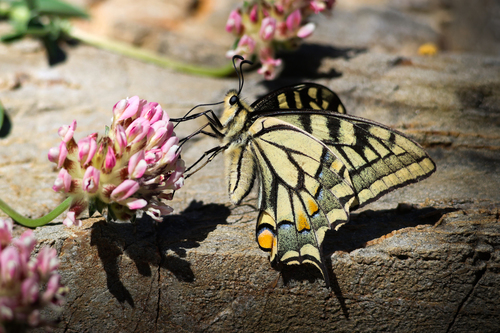
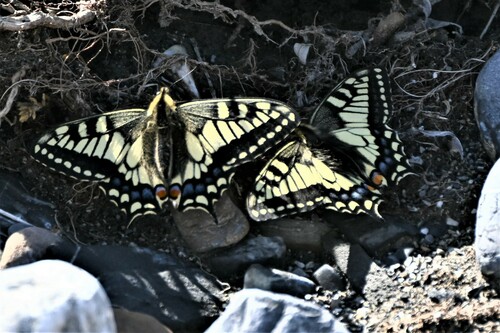
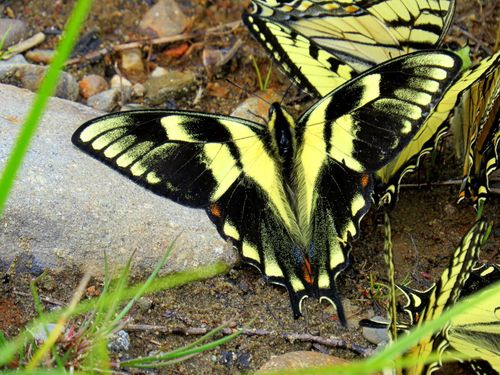
Adult Old World swallowtails have a distinctive yellow background with bold black veins and marginal bands. Each hindwing bears a tail-like projection (the 'swallowtail') and a row of blue-scaled spots near the margin; a red or orange eyespot is present on each hindwing close to the rear margin. Forewings are triangular with black edging and spots. Sexual dimorphism is slight; females may be a bit larger and sometimes show heavier black markings.
- Large yellow butterfly with bold black veins and marginal black banding on forewings
- Hindwings bear a tail-like extension and a line of blue spots plus a red-orange eyespot near the rear margin
- Distinctive swallowtail shape — look for the tails on the hindwings
Lookalikes
Black swallowtail Papilio polyxenes
Black swallowtail has a darker ground colour (more black) and different pattern of blue/red scaling; P. polyxenes often lacks the large yellow field seen in P. machaon.
Scarce swallowtail Iphiclides podalirius
Scarce swallowtail has narrower, paler yellow wings with long pointed tails and diagonal black stripes rather than the bold venation of P. machaon.
↻Life cycle
Egg
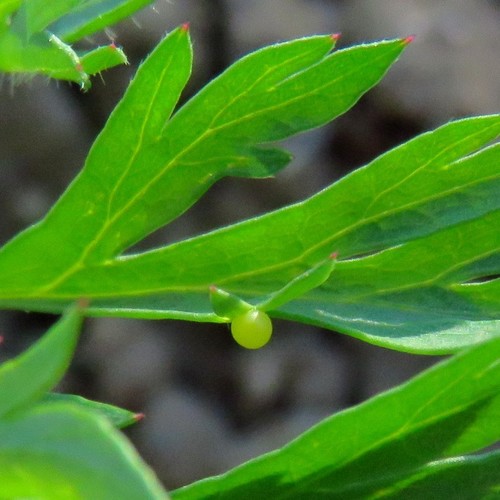
Round eggs laid singly on leaves of host plants (Apiaceae). Eggs hatch in about a week depending on temperature.
Larva (caterpillar)
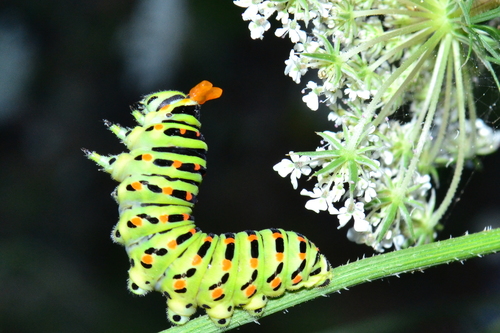
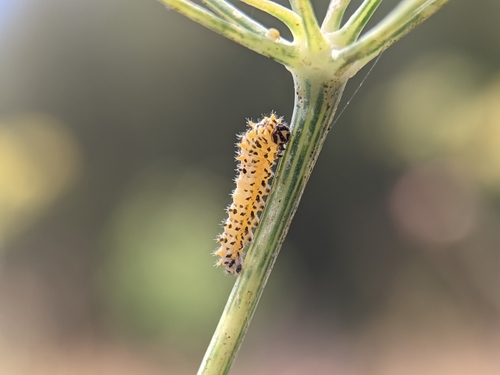
Green and later patterned caterpillars that feed on host foliage; they grow through several instars and can be conspicuous on umbelliferous plants.
Pupa (chrysalis)
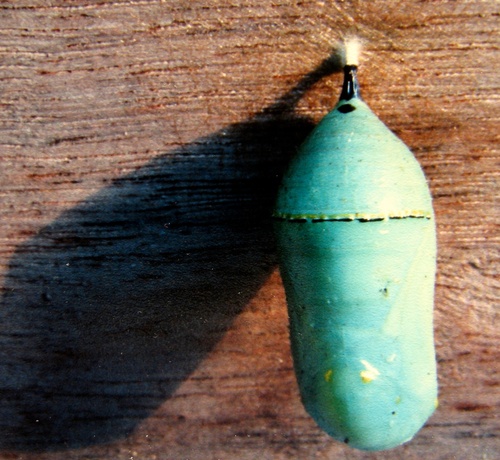
Chrysalis attaches to stems, fences or rocks; may overwinter in some populations or pupate and emerge the same season.
Adult (butterfly)
Flying, nectar-feeding butterfly with characteristic yellow/black pattern and tails on the hindwings.
🍃Diet and predators
Young eat
Leaves of Apiaceae (carrot family) such as fennel (Foeniculum), cow parsley (Anthriscus), wild carrot (Daucus) and related plants.
Adults eat
Nectar from a wide variety of flowers including thistles, knapweeds, clovers, thymes and garden flowers.
Predators of the young
Birds, predatory insects (wasps, ants), parasitic wasps and flies.
Predators of adults
Birds, dragonflies and other aerial predators; adults use flight and warning coloration to reduce predation.
🌱Effect on plants and gardens
Larvae feed mainly on Apiaceae (carrot family) such as fennel, parsley, carrot, dill and cow parsley. Adults visit many nectar-bearing flowers and act as pollinators.
📍Where and when to find it
Adults: visiting flowers in meadows, gardens, field margins and wetlands. Larvae: on leaves of Apiaceae host plants. Pupae: attached to stems, fences or sheltered structures.
Best time
Best seen in spring and summer months (local flight periods vary). Observe on warm, sunny days when butterflies are active, typically mid-morning to late afternoon.
Observation tips
Use a low shutter speed or continuous shooting to capture flight; approach slowly and photograph feeding adults or caterpillars on host plants for close-up detail.
✨Fun facts
- Papilio machaon was named after Machaon, a healer in Greek mythology.
- The swallowtail 'tails' may help deflect attacks from predators away from the body toward expendable wing parts.
- Several regional subspecies have evolved; some island or marsh populations can show distinctive colour or size differences.
?Frequently asked questions
Are Old World swallowtails dangerous?
No. They do not sting or bite and are harmless to people and pets.
Do Old World swallowtail caterpillars damage garden plants?
They feed on plants in the carrot family and can defoliate individual plants, but they are rarely a significant garden pest and are often tolerated for their conservation and pollination value.
Why is a swallowtail in my garden?
If you have flowering plants for nectar and host plants in the Apiaceae (e.g. fennel, parsley, carrot family) your garden provides food for both adults and caterpillars.
How can I attract Old World swallowtails?
Plant native umbellifers (fennel, parsley, cow parsley) for caterpillars and a variety of nectar-rich flowers; provide sunny, sheltered spots.
How do I get rid of swallowtail caterpillars?
Because they are beneficial pollinators and generally not harmful at population levels, consider handpicking and relocating a few larvae if necessary rather than using insecticides. Insecticides will also harm beneficial insects.
📷Photos of the old World swallowtail
More butterflies & moths
This guide was written with AI assistance and fact-checked, last updated 2026-10-10. Identification from photos is never certain: don't handle insects you can't identify, and get medical advice for bites, stings or allergic reactions. More about the old World swallowtail: iNaturalist, Wikipedia.