
Variegated fritillary
Euptoieta claudia · Fritillary butterflies
An orange-and-brown North American butterfly that uses a wide range of host plants and is commonly seen in open, sunny habitats.
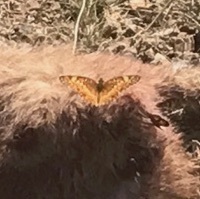
!Is the variegated fritillary dangerous?
No. Harmless to people. Adults do not bite or sting. Handle gently if necessary to avoid damaging wings.
Pets
Not toxic to pets. A curious pet might catch a butterfly, which can injure the insect but typically causes no harm to the animal.
📖Overview
The variegated fritillary is a medium-sized butterfly widespread across much of North America and into Central America. It is a generalist compared with many fritillaries: adults visit a range of nectar flowers and larvae feed on multiple plant families. The species often produces several broods per year in warm regions and is commonly found in open, disturbed and sunny sites such as fields, roadsides and gardens. It is not considered dangerous to people.
🔍How to identify a variegated fritillary
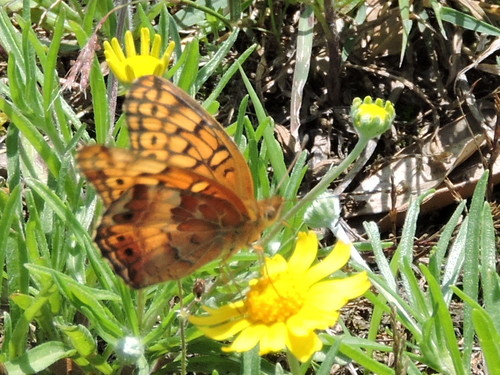
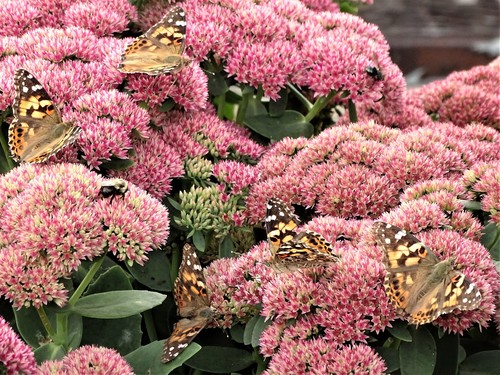
Upperwings are bright orange with dark brown to black markings and small submarginal spots; the underside of the hindwing is a mottled mix of orange, brown and cream, giving a 'variegated' look. The wing margins are scalloped. Males and females are similar. Wingspan typically ranges from about 45 mm to 75 mm.
- Bright orange upperwings with bold dark markings and scalloped wing margins
- Mottled underside of hindwing with a mix of orange, brown and cream (the 'variegated' look)
- Smaller submarginal spots and less-silvery underside compared with some other fritillaries
Lookalikes
Great spangled fritillary Speyeria cybele
Great spangled fritillary is larger, has more silver spots on the underside of the hindwing and stronger, more regular silvering than the variegated fritillary.
Pearl crescent Phyciodes tharos
Pearl crescent is smaller and has a more checkered pattern on the underside; variegated fritillary is more uniformly orange with broader wings.
↻Life cycle
Egg
Females lay small round eggs singly on or near host plants. Eggs hatch in about 1 week depending on temperature.
Larva (caterpillar)
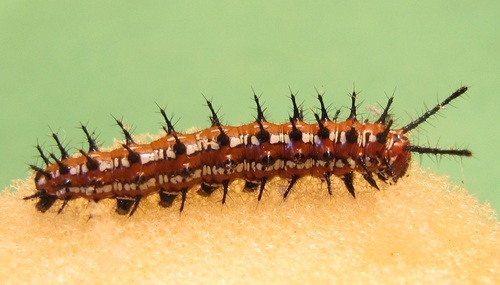
Caterpillars are spiny and feed on host leaves; they go through several instars over 2-3 weeks in warm conditions.
Pupa (chrysalis)
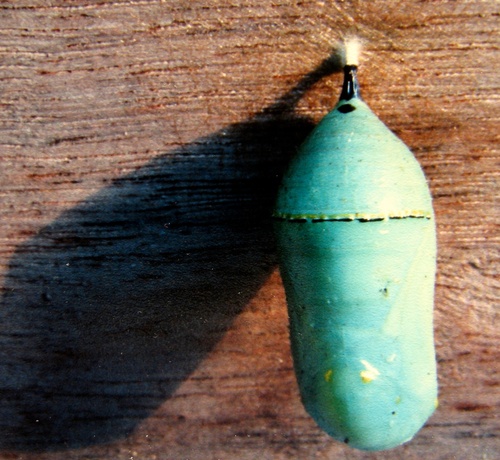
Pupation occurs attached to vegetation; the chrysalis stage lasts about 1-3 weeks before the adult emerges, timing varies with temperature and season.
Adult (butterfly)
Adults feed on nectar, mate and lay eggs; multiple broods are common in a single year in warm regions.
🍃Diet and predators
Young eat
Leaves of various host plants (Viola, Passiflora, Plantago, and others)
Adults eat
Nectar from a wide range of flowering plants (asters, thistles, milkweeds and many garden flowers)
Predators of the young
Wasps, ants, spiders and predatory insects
Predators of adults
Birds, spiders, dragonflies and predatory insects
🌱Effect on plants and gardens
Larvae feed on a wide range of host plants including violets (Viola), passionflowers (Passiflora), plantains (Plantago) and several others; adults visit many nectar sources and can help pollinate flowers.
📍Where and when to find it
Adults: on nectar flowers in sunny open habitats and gardens. Eggs and larvae: on the leaves of host plants such as violets, plantains and passionflower.
Best time
Spring through fall depending on region; warm, sunny days from late morning to mid-afternoon are best for observing adults.
Observation tips
Look along field edges, roadsides and open gardens with abundant flowers. Use a telephoto or a gentle approach—butterflies are easily disturbed by sudden movement.
✨Fun facts
- Unlike some fritillaries that specialize on violets, the variegated fritillary is a generalist and uses many different host plants.
- Its chrysalis is shiny pearly white with black markings and gold-tipped bumps, one of the most ornate chrysalises of any North American butterfly.
- Because it tolerates disturbed habitats, this butterfly is often one of the first to colonize old fields and roadside habitats.
?Frequently asked questions
Do variegated fritillaries bite?
No. They do not bite or sting and are harmless to people.
Why is a variegated fritillary in my garden?
Your garden likely has nectar flowers the adults feed on and possibly host plants for caterpillars (violets, plantain, passionflower or others). Gardens in sunny, open spots attract them.
Are variegated fritillaries endangered?
No. They are widespread and adaptable; they are not generally considered threatened.
How can I attract variegated fritillaries?
Plant a variety of nectar flowers (asters, coneflowers, milkweeds) and include some larval host plants such as violets, plantain or passionflower. Provide sunny, sheltered spots.
How do I get rid of variegated fritillaries if they are eating my plants?
They are rarely major pests. For small numbers, handpick caterpillars or remove host plants. In ornamental settings consider floating row covers for young plants. Chemical control is rarely necessary and also harms beneficial insects.
📷Photos of the variegated fritillary



More butterflies & moths
This guide was written with AI assistance and fact-checked, last updated 2026-10-10. Identification from photos is never certain: don't handle insects you can't identify, and get medical advice for bites, stings or allergic reactions. More about the variegated fritillary: iNaturalist, Wikipedia.