
Black swallowtail
Papilio polyxenes · Swallowtail butterflies
A common North American swallowtail butterfly whose caterpillars feed mainly on carrot-family plants and adults are frequent garden visitors.
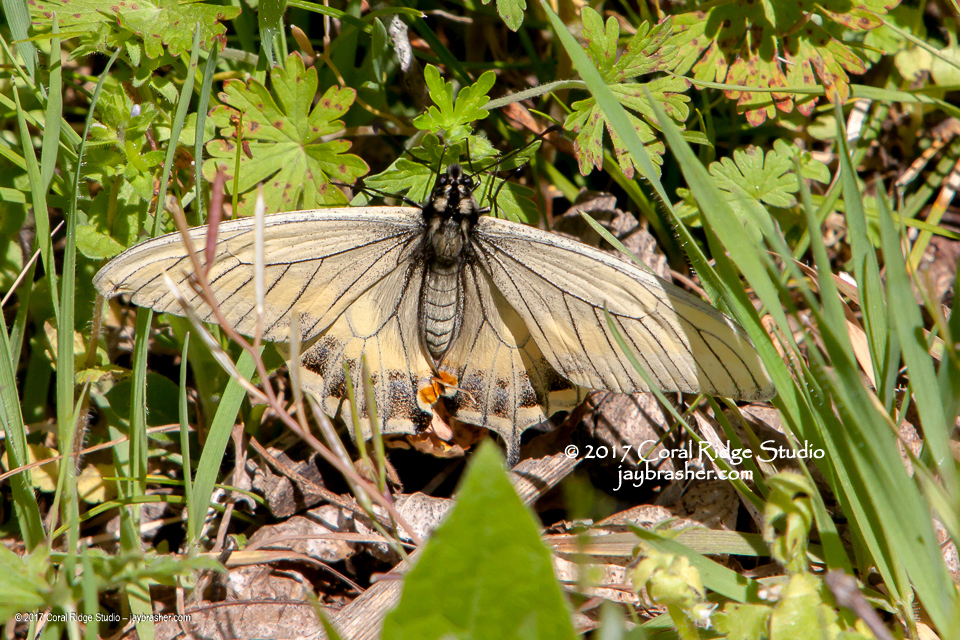
!Is the black swallowtail dangerous?
No. Adults do not bite or sting and are harmless. Caterpillars do not pose a medical threat, but handling may cause mild skin irritation in extremely rare cases due to plant sap or scales; wash hands after handling.
Pets
Not toxic to pets. Large numbers of caterpillars eating garden plants could upset small animals if consumed, but there is no known venom or toxin risk to dogs or cats.
📖Overview
Papilio polyxenes is a widespread North American swallowtail butterfly found from southern Canada through much of the United States (mostly east of the Rocky Mountains and in the Southwest) and south through Mexico and Central America. Adults are strong fliers, visit flowers for nectar, and are commonly seen in gardens, fields and roadsides. The species lays eggs on plants in the Apiaceae (carrot) family and occasionally on rue and other citrus-family plants, making the caterpillars familiar to gardeners.
There are several regional subspecies and seasonal forms; males and females differ subtly in wing pattern and size. The species is not dangerous to people. Caterpillars can be important herbivores on garden herbs and vegetables but rarely cause severe damage on mature plants.
🔍How to identify a black swallowtail
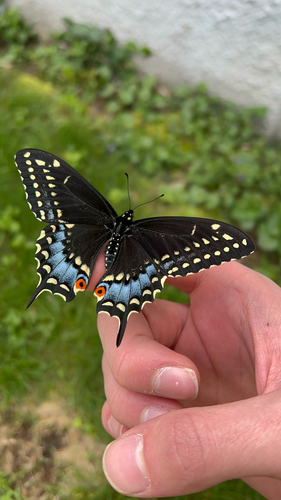
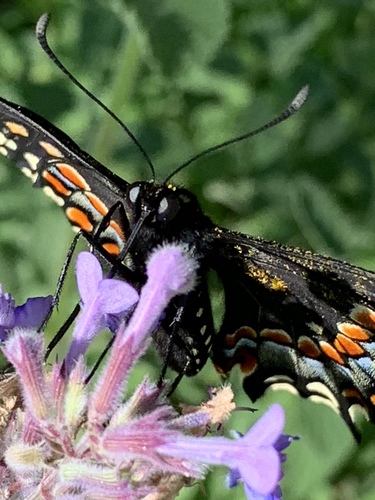
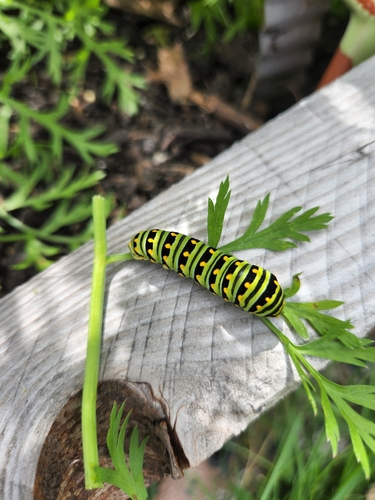
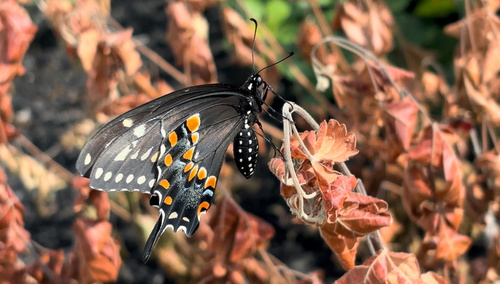
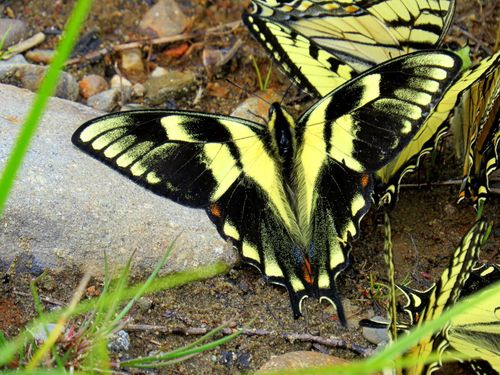
Adult wings are mainly black with rows of yellow spots forming a band across both wings. Males typically show a stronger yellow band; females often have more extensive blue scaling on the hindwing. Hindwings end in the characteristic swallowtail 'tails.' The hindwing also carries a row of orange spots near the margin and a blue submarginal band in many individuals. Caterpillars (larvae) have two main colour forms depending on instar: early instars are dark with white banding and later instars are green with black banding and orange spots, mimicking bird droppings when young and leaves when older. Pupae (chrysalides) are mottled brown or green, resembling sticks or leaf stems.
- Black wings with a band of yellow spots across forewing; hindwings have blue scaling and orange submarginal spots
- Distinctive swallowtail 'tails' on the hindwings
- Caterpillars are initially dark and white-banded (bird-dropping mimic), later becoming green with black bands and orange spots
- Wingspan typically 6.5-10 cm
Lookalikes
Eastern tiger swallowtail Papilio glaucus
Tiger swallowtail usually has a yellow ground colour with black tiger stripes; the dark form of the female is mostly black but still shows faint 'shadow' stripes and lacks the rows of yellow spots on the body that black swallowtails have.
Pipevine swallowtail Battus philenor
Pipevine swallowtail has iridescent blue hindwings and lacks the yellow band pattern; caterpillars and host plants differ (pipevines vs Apiaceae).
Spicebush swallowtail Papilio troilus
Spicebush swallowtail has a bluish-green wash on the hindwing, pale spots that are smaller and paler than the black swallowtail's yellow band, and an orange spot on the hindwing's leading edge; its caterpillars feed on spicebush and sassafras (Lauraceae).
↻Life cycle
Egg
Tiny round, pale yellow eggs laid singly on the upper or lower surfaces of host plant leaves; hatch in 4-10 days depending on temperature.
Larva (caterpillar)
Several instars: early instars resemble bird droppings; later instars are green with black bands and orange spots. Larvae feed actively on host foliage over 2-4 weeks.
Pupa (chrysalis)
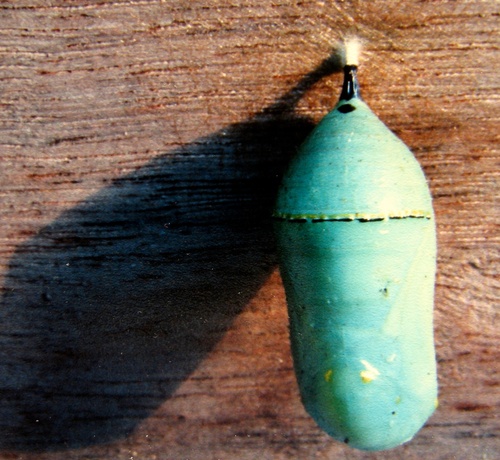
Pupae are attached to stems or structures by a silk girdle and are green or brown, camouflaged as leaf stems; pupation lasts 10-20 days for summer broods, longer if overwintering as a pupa.
Adult (butterfly)
Adults emerge, mate and seek nectar; females locate host plants to lay eggs. Multiple broods occur in warm regions.
🍃Diet and predators
Young eat
Leaves of Apiaceae plants (parsley, carrot, dill, fennel, Queen Anne's lace) and occasionally rue and other Rutaceae
Adults eat
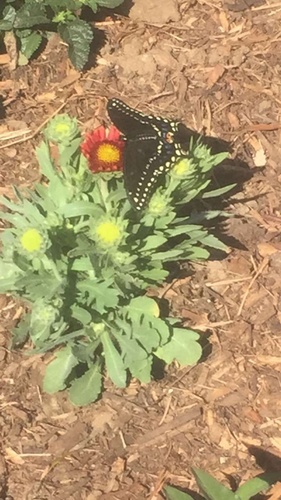
Nectar from a wide variety of flowering plants such as milkweed, thistles, clover, phlox and butterfly bushes
Predators of the young
Birds, predatory insects, parasitic wasps and flies that lay eggs in or on caterpillars
Predators of adults
Birds, spiders, mantids and dragonflies; adults also suffer mortality from weather and parasites
🌱Effect on plants and gardens
Larvae feed mainly on Apiaceae family plants (e.g., parsley, carrot, dill, fennel, Queen Anne's lace) and occasionally on rue and other citrus-family plants (Rutaceae); heavy feeding can defoliate small or seedling herb crops but usually does not kill mature plants.
How to get rid of black swallowtails
For minor infestations, handpick caterpillars into a jar and relocate them away from valuable crops or encourage natural enemies (parasitic wasps, birds). Use row covers to protect seedlings. If chemical control is necessary, use targeted Bacillus thuringiensis var. kurstaki (Btk) labeled for caterpillars and follow label instructions; avoid broad-spectrum insecticides that kill pollinators.
📍Where and when to find it
Adults visit flowers in gardens, meadows and roadsides. Look for eggs and caterpillars on parsley, dill, fennel, carrot, Queen Anne's lace and sometimes citrus. Pupae are attached to stems, fences or buildings.
Best time
Spring through fall; multiple broods in warm regions. Best observed on sunny days when adults are feeding.
Observation tips
Plant host herbs and nectar flowers close together to attract adults; approach slowly and use a telephoto lens or macro from a short distance for photos. Check undersides of leaves for eggs.
✨Fun facts
- The caterpillars have an eversible orange, forked organ called an osmeterium behind the head that releases a foul smell to deter predators.
- Young caterpillars mimic bird droppings as a defense; older caterpillars switch to green cryptic coloration.
- Black swallowtails are frequent garden visitors and are easy to attract by planting parsley, dill or fennel as host plants and nectar flowers.
?Frequently asked questions
Do black swallowtails bite or sting?
No. Adults do not bite or sting. Caterpillars do not sting or bite people; they may emit a foul smell if disturbed but are not dangerous.
Why is a black swallowtail in my garden?
They are attracted by nectar flowers and by host plants in the carrot family (parsley, dill, fennel, carrot) where females lay eggs for their caterpillars.
Are black swallowtails harmful to my garden herbs?
Caterpillars eat leaves of herbs like parsley and dill and can defoliate small or young plants, but damage is usually limited and plants often recover.
How can I get rid of black swallowtail caterpillars?
For small numbers, handpick and relocate them. Use physical barriers like row covers for seedlings or apply Bacillus thuringiensis var. kurstaki (Btk) if necessary. Avoid broad insecticides to protect pollinators.
Are black swallowtails endangered?
No. Papilio polyxenes is common and widespread across much of North America and is not generally considered threatened.
📷Photos of the black swallowtail
More butterflies & moths
This guide was written with AI assistance and fact-checked, last updated 2026-10-10. Identification from photos is never certain: don't handle insects you can't identify, and get medical advice for bites, stings or allergic reactions. More about the black swallowtail: iNaturalist, Wikipedia.