
Isabella tiger moth
Pyrrharctia isabella · Tiger and lichen moths
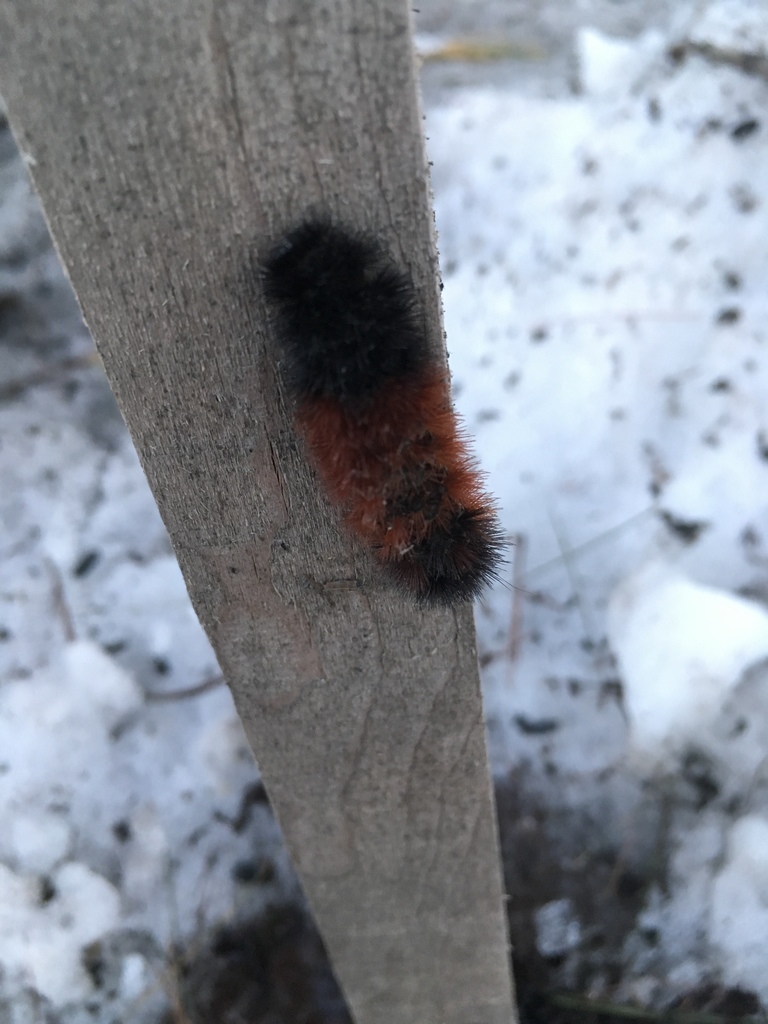
A common North American moth whose dark-and-orange 'woolly bear' caterpillar is famous in folklore and easily recognized by its dense bristly hairs.
!Is the isabella tiger moth dangerous?
Only mildly. Adults are harmless. The caterpillar's hairs can cause mild skin irritation or local rash in sensitive people if handled; they do not sting or inject venom. If you have a reaction, wash the area with soap and water and avoid rubbing. Seek medical care for severe allergic reactions.
Pets
Hairs may irritate mouths or skin of curious pets; ingestion can cause mild vomiting or oral irritation. Most cases are minor; consult a veterinarian if symptoms persist.
📖Overview
Pyrrharctia isabella is a medium-sized moth native to much of North America. The species is best known for its larval form, the woolly bear caterpillar, which is furry and banded with black and reddish-brown. Adults are nocturnal and short-lived; they fly in summer and early fall and are attracted to lights. The caterpillars are generalist feeders on low plants and are commonly seen crossing roads and sidewalks in autumn. The species is widespread and common; it is not considered dangerous to people.
🔍How to identify a isabella tiger moth
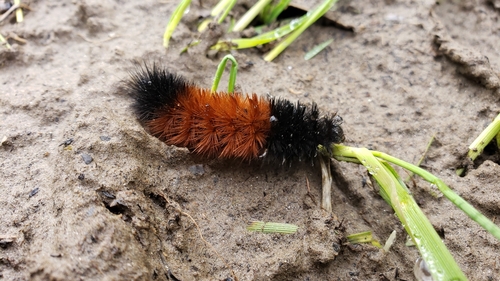
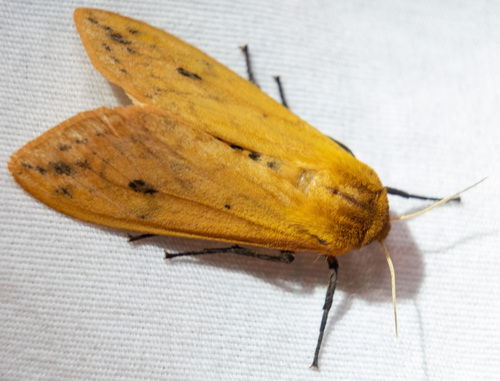
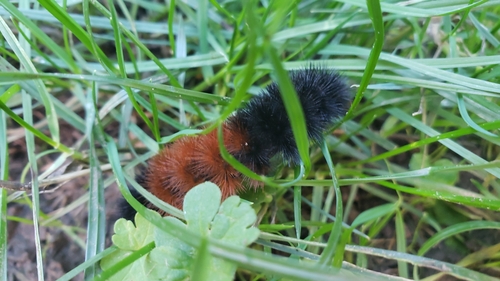
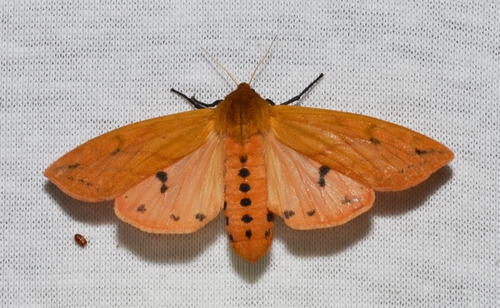
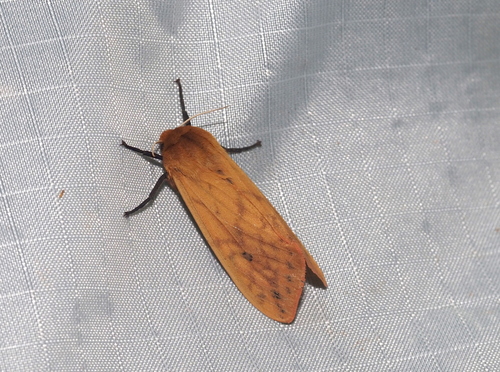
Adult Isabella tiger moths have a wingspan about 45-65 mm. Forewings are usually pale orange to yellowish-orange with variable darker markings; hindwings are orange to pale orange. The body is hairy and pale orange. The larva ('woolly bear') is densely covered in stiff hairs (setae) with distinct black bands at each end and a broad rusty-brown or reddish-brown band in the middle. The exact width of the middle band varies among individuals and populations.
- Woolly bear caterpillar: dense bristly hairs with black ends and a reddish-brown middle band.
- Adult moth: pale orange forewings with variable darker markings and orange hindwings; wingspan about 45-65 mm.
- Location and season: common in North America, especially late summer and autumn for caterpillars.
Lookalikes
Yellow woolly bear (Virginian tiger moth) Spilosoma virginica
Spilosoma virginica caterpillars are uniformly coloured (often yellowish to orange-brown) with longer, softer hairs and no black-brown-black banding; adults are white with a few small black dots.
Garden tiger moth Arctia caja
Adult Arctia caja is boldly patterned with chocolate-brown and white forewings and orange hindwings with blue-black spots; its caterpillar is a long-haired, mostly black woolly bear without the neat black-brown-black banding.
↻Life cycle
Egg
Females lay small clusters of eggs on host plants in summer; eggs hatch in a few days to weeks depending on temperature.
Larva (woolly bear caterpillar)
The hairy caterpillar feeds on many plants, grows through several instars and is often seen in late summer and autumn. It overwinters as larvae in leaf litter and resume feeding in spring.
Pupa (cocoon)
Larvae spin a loose, silk-lined cocoon incorporating hairs and leaf debris where they pupate for days to weeks before emerging as adults.
Adult (moth)
Adults are nocturnal, do not feed heavily, and focus on mating and egg-laying during their short lives.
🍃Diet and predators
Young eat
Generalist herbivore: low herbaceous plants, weeds, grasses and garden plants.
Adults eat
Adults feed little or not at all; if they feed, they sip nectar from flowers.
Predators of the young
Birds, small mammals, parasitic wasps and flies; the hairs offer some protection and can deter some predators.
Predators of adults
Bats, night-flying insectivores and predatory insects.
🌱Effect on plants and gardens
Woolly bear caterpillars are generalist feeders on a wide variety of low-growing plants, weeds and garden plants (dandelion, plantain, grasses, clover, goldenrod and many others). They rarely cause serious damage.
📍Where and when to find it
Look for woolly bear caterpillars on low plants, weeds, along roadsides and garden edges in late summer and autumn. Adults are attracted to porch and street lights at night.
Best time
Late summer to early autumn for caterpillars; summer to early fall nights for adults.
Observation tips
Photograph the caterpillar from the side to show banding. If you must handle a caterpillar, use gloves or a leaf to avoid skin irritation.
✨Fun facts
- The woolly bear caterpillar folklore says the width of the brown middle band predicts winter severity; scientists find no reliable long-term predictive power.
- Woolly bear caterpillars often curl into a tight ball when disturbed, protecting their softer underside.
- Woolly bears overwinter as caterpillars and are freeze-tolerant: they produce a natural antifreeze (glycerol) that lets them survive being frozen solid.
?Frequently asked questions
Do woolly bear caterpillars predict the winter?
No reliable scientific evidence supports the folklore that the width of the brown band predicts winter severity; band width varies with species, age and recent feeding history.
Do Isabella tiger moths bite or sting?
No. Adults do not bite or sting. Caterpillars do not sting but their hairs can cause mild skin irritation in some people.
Why is a woolly bear in my house?
Caterpillars wandering indoors are often searching for a sheltered place to overwinter or pupate; late-summer and autumn are common times for indoor sightings.
How can I get rid of woolly bear caterpillars in my garden?
Handpick and relocate them away from valued plants, encourage natural predators, or use targeted biological controls (Bacillus thuringiensis) if necessary. Chemical pesticides are rarely needed for small numbers.
Are Isabella tiger moths endangered?
No. Pyrrharctia isabella is widespread and common across its range and currently not considered threatened.
📷Photos of the isabella tiger moth
More butterflies & moths
This guide was written with AI assistance and fact-checked, last updated 2026-10-09. Identification from photos is never certain: don't handle insects you can't identify, and get medical advice for bites, stings or allergic reactions.