
Rosy maple moth
Dryocampa rubicunda · Silk moths
A small, brightly colored silk moth whose pink-and-yellow adults are common around maples in eastern North America.
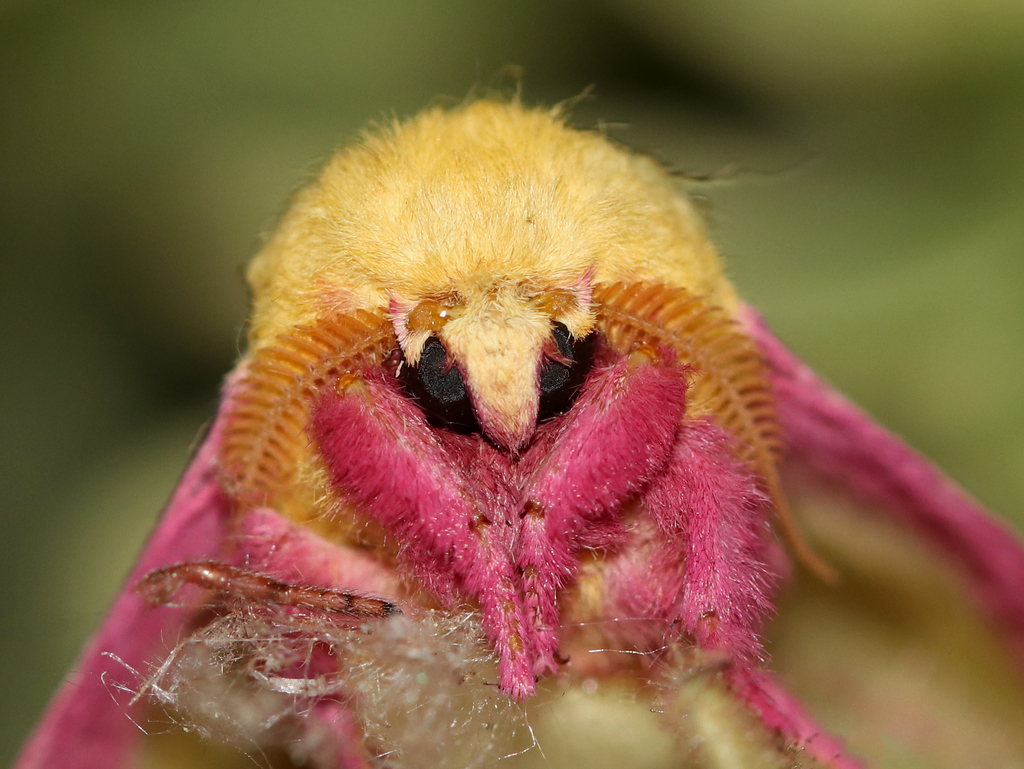
!Is the rosy maple moth dangerous?
No. Adults do not bite or sting and are harmless to people. Caterpillars do not have medically significant venom; contact may rarely cause mild skin irritation in very sensitive people, but this is uncommon. No known transmission of disease.
Pets
Not toxic to pets. Large numbers of caterpillars could upset stomachs if eaten by dogs or cats, but serious poisoning is not reported.
📖Overview
Dryocampa rubicunda is a small, showy silk moth found across much of eastern North America. Adults are short-lived and do not feed; their primary role is reproduction. The caterpillars, known as greenstriped mapleworms, feed on the leaves of maple and occasionally other deciduous trees and can cause noticeable defoliation in outbreak years. Rosy maple moths are most often seen at night or attracted to lights near wooded yards and street trees.
🔍How to identify a rosy maple moth
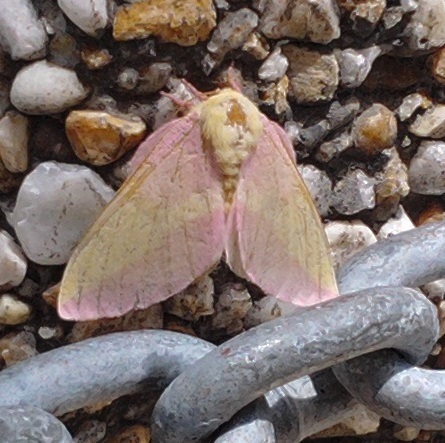
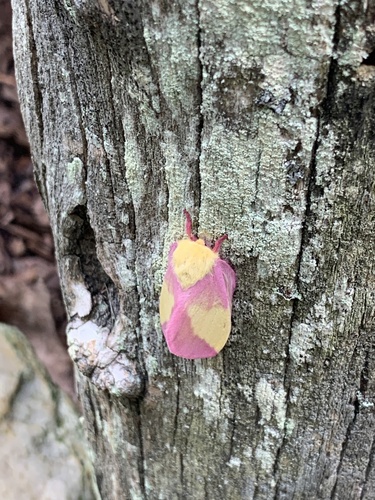
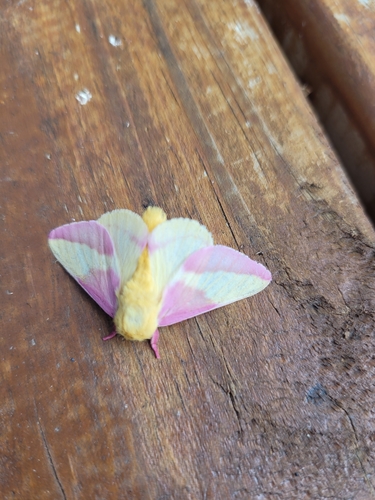
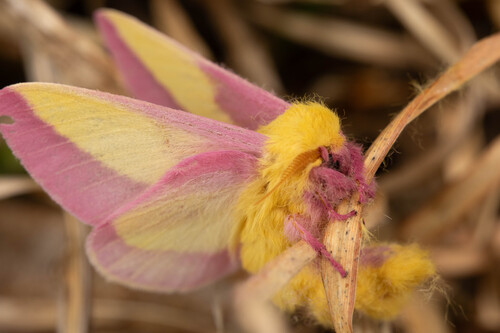
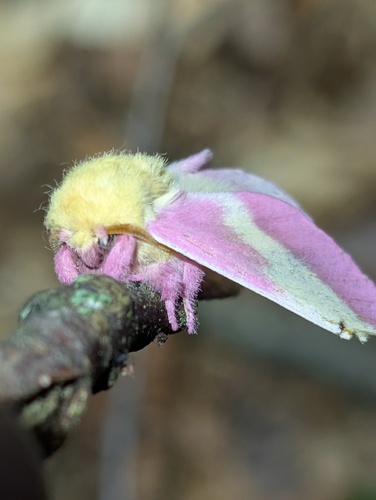
Adults are compact moths with stout bodies and broad, rounded wings showing vivid pink and yellow color. Forewings and hindwings have irregular patches of pink and yellow; males are somewhat smaller than females and have feathery antennae. The body is fuzzy (covered in setae) giving a plush appearance. Caterpillars are elongated, pale green with dark green and yellowish lengthwise stripes, a reddish-brown head and two long black horns behind the head; their short spines do not sting.
- Adults: small, rounded wings with vivid pink and pale yellow patterning; fuzzy, stout body
- Males smaller with feathery antennae; females have broader abdomens
- Caterpillars are greenish with lighter longitudinal stripes; found feeding on maple leaves
- No functional mouthparts in adults means you will not see feeding behavior
Lookalikes
Imperial moth Eacles imperialis
Much larger (wingspan about 8-17 cm), yellow with purplish-brown spotting; not pink-and-yellow like Dryocampa rubicunda
Luna moth Actias luna
Much larger, pale green with long hindwing tails and not pink-yellow colored
↻Life cycle
Egg
Females lay clusters of eggs on the undersides of leaves or on small twigs of host trees. Eggs hatch in about 1-2 weeks depending on temperature.
Larva (caterpillar)
Caterpillars feed on host leaves and go through several instars over 3-6 weeks. Young caterpillars feed in groups and older ones feed alone; color can vary but many are green with lighter stripes.
Pupa
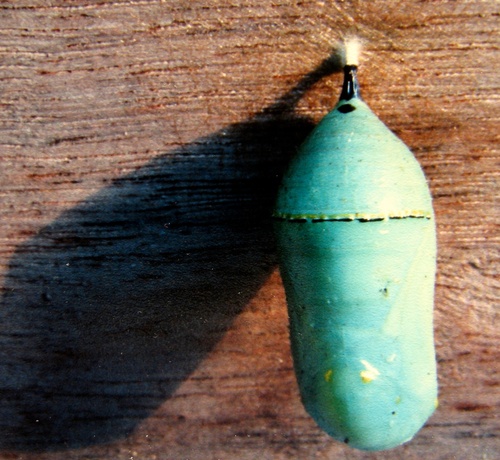
Mature caterpillars pupate in soil or leaf litter in a shallow chamber or loose cocoon; the pupal stage lasts a few weeks in summer, and pupae of the last generation overwinter.
Adult (moth)
Adults emerge to mate; they do not feed and live about a week while mating and laying eggs.
🍃Diet and predators
Young eat
Leaves of maple trees (Acer spp.), sometimes oak, birch and other deciduous species
Adults eat
Do not feed (non-feeding adults)
Predators of the young
Birds, predatory insects (wasps, ants), parasitic flies and wasps
Predators of adults
Bats, night-flying birds, spiders
🌱Effect on plants and gardens
Larvae feed primarily on maple species (Acer), sometimes on oak, birch or other deciduous trees; single caterpillars cause little damage, but large outbreaks can cause noticeable defoliation. Healthy mature trees usually recover.
How to get rid of rosy maple moths
For isolated trees, handpick caterpillars and destroy them or drop into soapy water. For larger infestations use biological controls such as Bacillus thuringiensis kurstaki (Btk) applied to foliage when young caterpillars are present. Encourage natural enemies (birds, parasitic wasps). Chemical insecticides are effective but usually unnecessary on mature trees and should be a last resort; follow label directions and local regulations.
📍Where and when to find it
Adults near porch or street lights, especially in areas with maple trees; caterpillars on the leaves and branches of maples and sometimes other deciduous trees.
Best time
Spring and summer months; adults are nocturnal and most easily observed at night when attracted to lights.
Observation tips
Use a porch light or white sheet to attract adults at night. For caterpillars, inspect maple foliage during the day; look on undersides of leaves and along branches.
✨Fun facts
- The rosy maple moth's bright colors make it one of the most recognizable small moths in eastern North America.
- Adults lack functional mouthparts and live only long enough to mate and lay eggs.
- Its caterpillar, the greenstriped mapleworm, is named for the dark green and pale stripes running along its body.
?Frequently asked questions
Are rosy maple moths dangerous?
No. Adults do not bite or sting and are harmless. Caterpillars are not known to be venomous; they rarely cause mild skin irritation in sensitive individuals.
Do rosy maple moths bite or sting?
No. Neither adults nor caterpillars have a sting. Caterpillars have fine hairs that can occasionally irritate sensitive skin but do not inject venom.
Why is a rosy maple moth in my house?
Adults are attracted to lights and may fly into houses at night or through open windows. They do not infest homes and will not reproduce indoors.
How do I get rid of rosy maple moth caterpillars from my maple tree?
For small numbers, handpick caterpillars and dispose of them. For larger outbreaks, apply Bacillus thuringiensis kurstaki (Btk) to foliage when caterpillars are young, or consult an arborist for treatment options.
Where do rosy maple moths live?
They live in deciduous woodlands, yards and urban areas across eastern North America where maple trees are present.
Will rosy maple moths kill my maple tree?
Occasional defoliation by caterpillars rarely kills a healthy mature maple. Repeated severe defoliation over several years can weaken trees, so monitor and manage outbreaks if they recur.
📷Photos of the rosy maple moth
More butterflies & moths
This guide was written with AI assistance and fact-checked, last updated 2026-10-09. Identification from photos is never certain: don't handle insects you can't identify, and get medical advice for bites, stings or allergic reactions.