
Luna moth
Actias luna · Silk moths
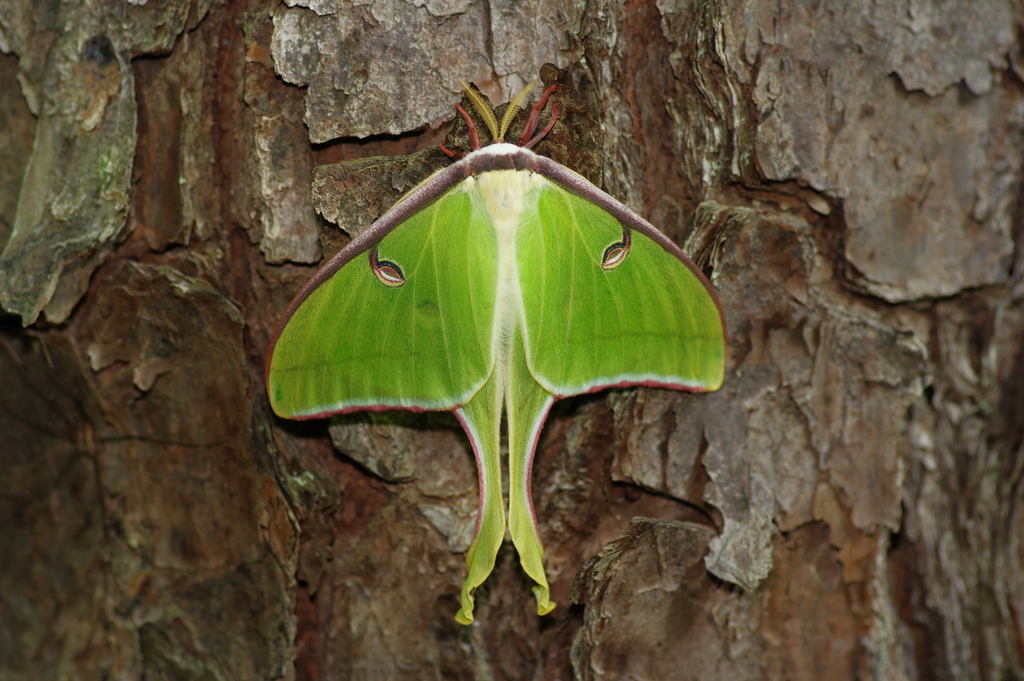
A large, pale-green North American silk moth with long tail streamers; adults do not feed and live only about a week.
!Is the luna moth dangerous?
No. Adults do not bite or sting and are harmless to people. Caterpillars are not known to be venomous; handling many caterpillars can cause mild skin irritation in sensitive individuals, though Luna moth caterpillars are not commonly reported to cause problems. If skin irritation occurs, wash with soap and water and avoid further contact.
Pets
Not toxic to pets. Large caterpillars could be an occasional choking hazard if a pet ate one, and ingestion might cause mild stomach upset, but Luna moths are not poisonous to cats or dogs.
📖Overview
The Luna moth (Actias luna) is a striking silk moth native to eastern North America. Adults are nocturnal and are most often seen drawn to lights at night. The species is well known for its pale-green wings with long hindwing tails and conspicuous eyespots. Larvae feed on the leaves of several deciduous trees; pupation takes place in a silken cocoon and adults emerge to mate but do not feed.
Luna moths are harmless to people: adults lack functional mouthparts and do not bite or sting. They are an important part of forest food webs as prey for bats, birds and parasitic insects, and their caterpillars can defoliate small branches locally but are not considered significant pests to healthy trees.
🔍How to identify a luna moth
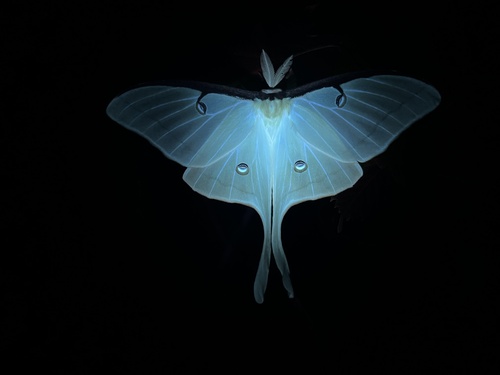
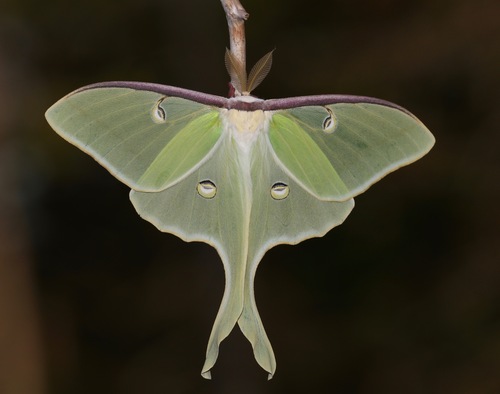
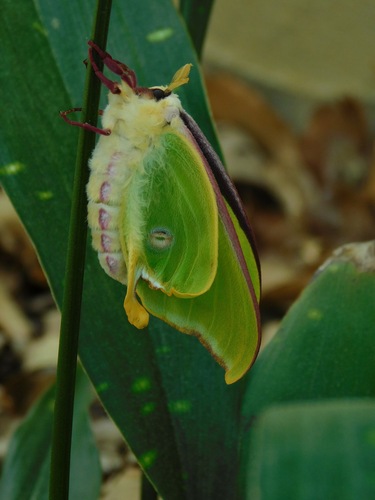
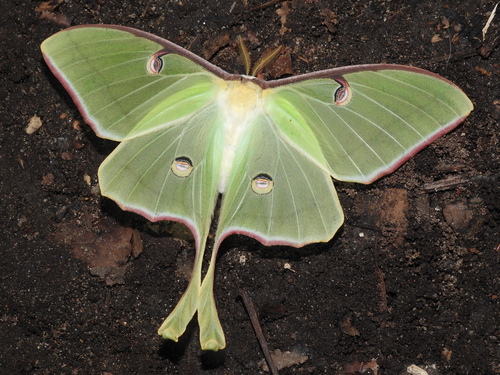
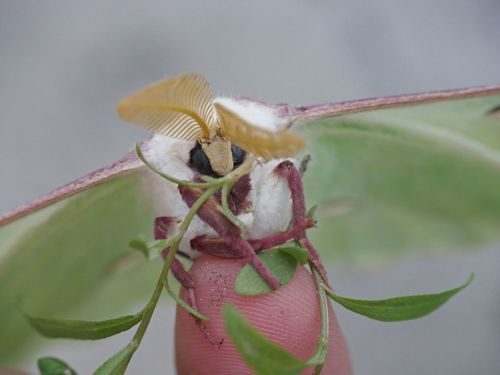
Adult Luna moths have large, broad wings that are pale green with a powdery texture and sometimes a slight yellowish tint near the body. Each forewing and hindwing has a translucent eyespot with concentric rings; the hindwings bear long, tapering tail streamers. The body is stout and furry, usually creamy white to yellowish. Males have broader, feathery antennae than females, used to detect female pheromones.
- Pale green wings with translucent eyespots on each wing
- Long, tapering tail streamers on the hindwings
- Powdery, slightly scalloped wing margins and creamy-yellow body
- Males have feathery (bipectinate) antennae; females have thinner, less feathery antennae
Lookalikes
Polyphemus moth Antheraea polyphemus
Polyphemus is larger, more brownish and has large round eyespots without the long hindwing tail streamers of the Luna moth.
Cecropia moth Hyalophora cecropia
Cecropia is reddish-brown with white bands and large wing lobes; it lacks Luna's pale-green color and long tails.
↻Life cycle
Egg
Females lay small, pale eggs singly or in small groups on the underside of host tree leaves; eggs hatch in about 1-2 weeks depending on temperature.
Larva (caterpillar)
Caterpillars are green and segmented with small tubercles and a line of yellowish stripes; they pass through several instars while feeding on host leaves for several weeks.
Pupa (cocoon)
Caterpillars spin a silken cocoon often attached to leaves or hidden in leaf litter; pupation lasts from several weeks to overwintering as a pupa depending on brood timing.
Adult (moth)
Adults emerge, expand wings and mate. Females release pheromones to attract males; after mating females lay eggs and the adults die within about a week.
🍃Diet and predators
Young eat
Leaves of deciduous trees: hickory, walnut, sweetgum, birch, sumac, persimmon, alder and others
Adults eat
Do not feed; adults lack functional mouthparts and rely on stored energy from the caterpillar stage
Predators of the young
Birds, predatory insects (paper wasps, predatory flies) and parasitic wasps and flies
Predators of adults
Bats (echolocation predators), night-flying birds and occasionally predatory insects
🌱Effect on plants and gardens
Caterpillars feed on leaves of a variety of deciduous trees: hickory, walnut, sweetgum, birch, sumac, persimmon, alder and others. Heavy local feeding can defoliate small branches but usually does not seriously damage mature trees.
📍Where and when to find it
Adults: at night near porch lights, woodland edges and near host trees. Caterpillars: on leaves of host trees. Pupae: inside cocoons attached to foliage or in leaf litter.
Best time
Late spring to midsummer for most of their range; night-time to see adults. Exact months vary by latitude (southern populations may have earlier and extra broods).
Observation tips
Use a white sheet and a bright light to attract night-flying moths; be gentle when handling—support the wings and avoid touching the scale-covered surfaces as scales rub off easily.
✨Fun facts
- Luna moths are among the largest moths in North America and are an iconic example of a non-feeding adult insect.
- The long tail streamers on the hindwings help deflect bat attacks by disrupting echolocation, improving the moth's chance to escape.
- Because adults do not eat, their only purpose is reproduction: they emerge, mate, lay eggs and die within about a week.
?Frequently asked questions
Are Luna moths poisonous?
No. Luna moths are not poisonous to people or pets. They do not have venom and adults do not bite or sting.
Do Luna moths eat?
Adult Luna moths do not eat; their mouthparts are reduced. Caterpillars feed on leaves of various deciduous trees.
Why is a Luna moth in my house?
Adults are nocturnal and are strongly attracted to lights; they may fly indoors through open windows or doors at night. They are harmless and can be gently released outdoors.
Do Luna moth caterpillars sting?
Luna moth caterpillars are not known to sting. Some people with sensitive skin can get mild irritation from handling caterpillars; wash skin if irritation occurs.
How can I attract Luna moths to my yard?
Planting native host trees (hickory, walnut, sweetgum, birch, persimmon, sumac) and using a white light or sheet at night can attract adults in areas where they occur. Avoid pesticides.
📷Photos of the luna moth
More butterflies & moths
This guide was written with AI assistance and fact-checked, last updated 2026-10-09. Identification from photos is never certain: don't handle insects you can't identify, and get medical advice for bites, stings or allergic reactions.