
Polyphemus moth
Antheraea polyphemus · Silk moths
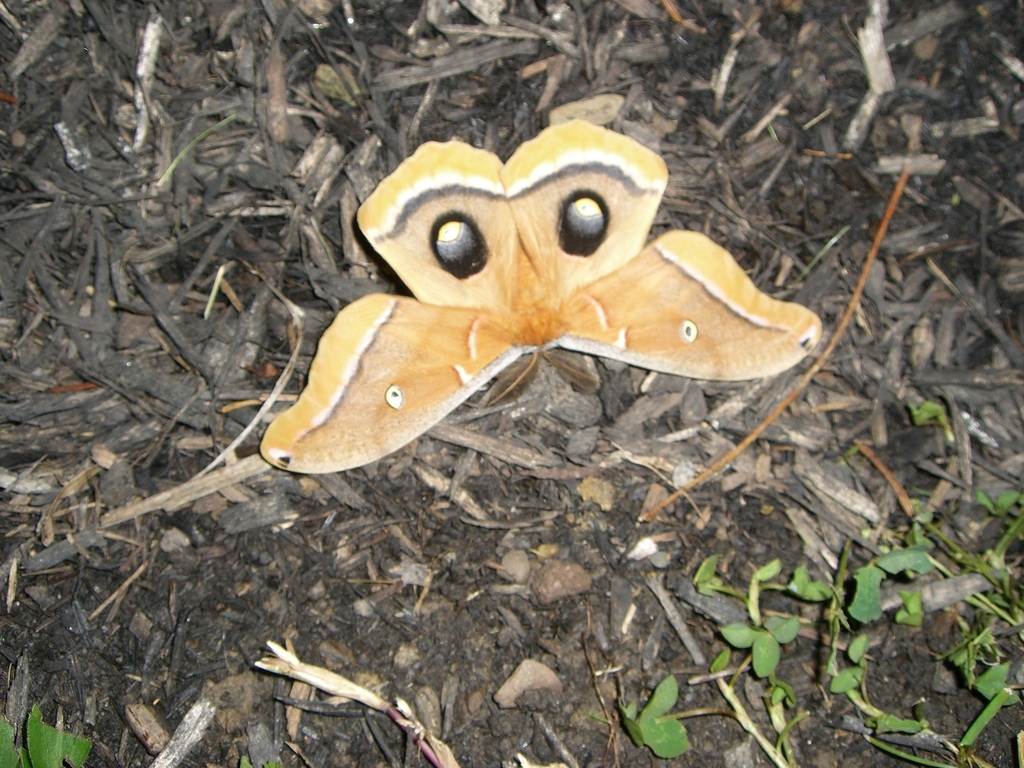
A large North American silk moth with prominent round eyespots on each hindwing and a wingspan of about 11-15 cm.
!Is the Polyphemus moth dangerous?
No. Polyphemus moths do not bite or sting. They are harmless to people. Handle gently if necessary; adults have fragile scales that rub off easily.
Pets
Not toxic to pets. Caterpillars are not known to be dangerous, but some pets may be bothered by hairs if they mouth the caterpillar; monitor and consult a veterinarian if ingestion causes concern.
📖Overview
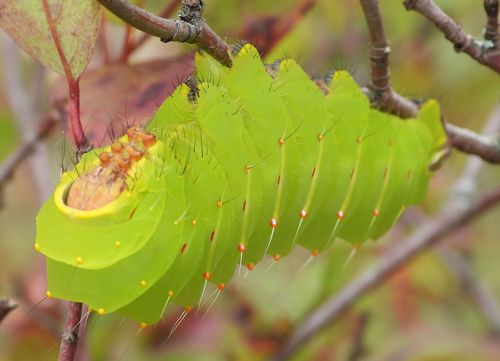
The Polyphemus moth (Antheraea polyphemus) is a large silk moth native to North America. Adults do not feed and live only long enough to mate and lay eggs. Caterpillars are green, stout and can defoliate small branches when present in large numbers, but outbreaks are infrequent and normally do not cause lasting tree damage. Adults are nocturnal and commonly attracted to lights in spring and early summer.
This species is widespread across much of the United States and southern Canada wherever host trees occur. It is not considered threatened and populations are stable overall, although local numbers vary year to year based on weather and predators.
🔍How to identify a Polyphemus moth
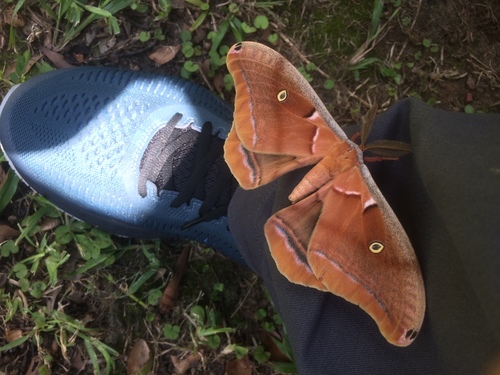
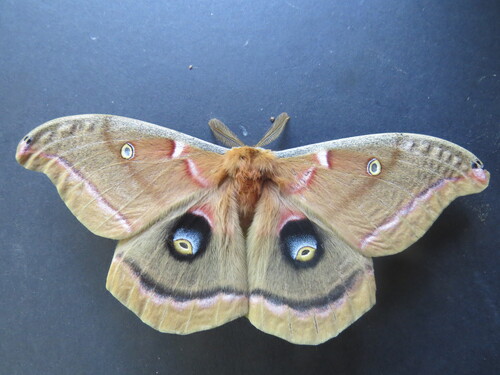
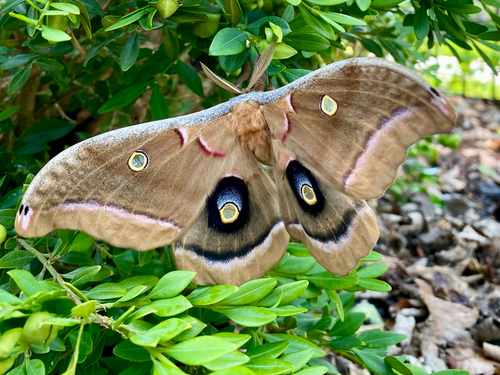
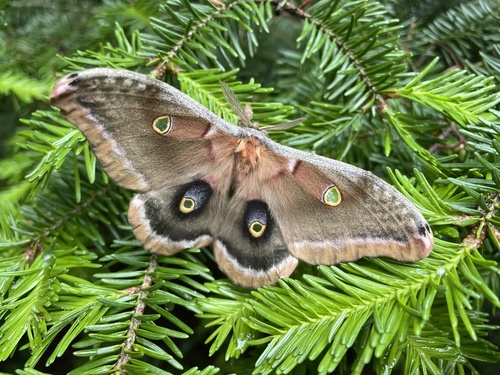
Adult Polyphemus moths are large and robust with broad, rounded wings. Wingspan typically 11-15 cm. Forewings and hindwings are shades of brown and tan with wavy lines and a distinctive large, circular eyespot on each hindwing: the eyespot has a clear, window-like center ringed with yellow, then blue and black. Males have feathered (bipectinate) antennae used to detect female pheromones; females have slightly thinner antennae. The body is furry and stout, matching the wing tones.
- Very large wingspan (11-15 cm) with broad, rounded wings
- Distinctive large circular eyespot on each hindwing with a clear center ringed with yellow, blue and black
- Overall reddish-brown to tan coloration with wavy crosslines across wings
- Males with notably feathered antennae; females with thinner antennae
Lookalikes
Cecropia moth Hyalophora cecropia
Cecropia is larger, has more reddish and white bands and crescent-shaped markings near the wing edges rather than the single large eyespot of Polyphemus.
Luna moth Actias luna
Luna is pale green with long tail-like hindwing extensions and smaller translucent spots, lacking the Polyphemus eyespot and brown tones.
Imperial moth Eacles imperialis
Imperial moth has yellow and purple mottling and a different wing shape and pattern; no large round blue-centered eyespots like Polyphemus.
↻Life cycle
Egg
Females lay pale eggs singly or in small groups on host-tree leaves; eggs hatch in about 10-14 days depending on temperature.
Larva (caterpillar)
Green, banded caterpillars grow through several instars and can reach 7-8 cm long. They feed actively on host tree leaves for several weeks.
Pupa (cocoon)
Mature caterpillars spin papery cocoons among leaves or in bark crevices and pupate inside. The pupal stage lasts until the following spring for overwintering broods, or several weeks for summer broods.
Adult (moth)
Adults emerge with large wings, do not feed, mate within a few days and females lay eggs to start the next generation.
🍃Diet and predators
Young eat
Leaves of many deciduous trees and shrubs (oak, maple, birch, willow, cherry, apple, hawthorn, etc.)
Adults eat
Do not feed (no functional mouthparts)
Predators of the young
Birds, small mammals, parasitic wasps and flies, predatory insects
Predators of adults
Bats, birds and nocturnal predators; adults are short-lived which limits predation period
🌱Effect on plants and gardens
Caterpillars feed on leaves of many deciduous trees and shrubs including oak, maple, birch, willow, cherry, apple, hawthorn and others. Heavy local defoliation can occur in outbreak years but trees usually recover.
📍Where and when to find it
Eggs and caterpillars on the leaves and branches of host trees (oak, maple, birch, willow, etc.); adults flying at night around porch lights or in wooded edges.
Best time
Late spring to early summer; night-time for adults, daytime for finding caterpillars on foliage.
Observation tips
Turn off nearby lights to attract adults away from buildings; photograph adults from above to show the eyespot and wing pattern; search host trees for large green caterpillars during the day.
✨Fun facts
- The eyespots may help deter predators by mimicking large eyes or drawing attacks away from the body.
- Adult Polyphemus moths have no functional mouthparts and rely entirely on fat stores built up during the caterpillar stage.
- The species is named after Polyphemus, the one-eyed giant of Greek mythology, referring to the moth's large single eyespot on each hindwing.
?Frequently asked questions
Are Polyphemus moths dangerous?
No. They do not bite or sting and are harmless to people.
Do Polyphemus moth caterpillars eat garden trees?
Yes, caterpillars feed on the leaves of many common trees and shrubs. Small numbers cause little harm; heavy defoliation is rare and trees usually recover.
Why is a Polyphemus moth in my house?
Adults are strongly attracted to lights at night. They sometimes fly indoors through open windows or doors attracted by indoor or porch lights.
How can I get rid of a Polyphemus moth or caterpillar?
Adults are best released outdoors if unharmed. For caterpillars on yard trees, hand-picking is effective. Chemical control is rarely necessary; if used, follow local guidelines and consider nonchemical options first.
When will I see Polyphemus moths?
In most of their range adults appear in late spring to early summer. Timing varies by latitude and local climate; they are nocturnal.
📷Photos of the Polyphemus moth
More butterflies & moths
This guide was written with AI assistance and fact-checked, last updated 2026-10-10. Identification from photos is never certain: don't handle insects you can't identify, and get medical advice for bites, stings or allergic reactions. More about the Polyphemus moth: iNaturalist, Wikipedia.