
Imperial moth
Eacles imperialis · Giant silk moths
Large, showy North American silk moth with yellow to orange wings marked by purple-brown blotches; adults do not feed and live only a few days.

!Is the imperial moth dangerous?
No. Imperial moths and their caterpillars are not venomous. Caterpillars have small spines and tubercles that may cause mild skin irritation in very sensitive people, but they do not sting. Handle gently or avoid touching if you have sensitive skin; wash the area with soap and water if irritation occurs.
Pets
Generally harmless to pets. Large caterpillars could cause mild mouth or throat irritation if chewed by curious pets; monitor and discourage pets from eating them.
📖Overview
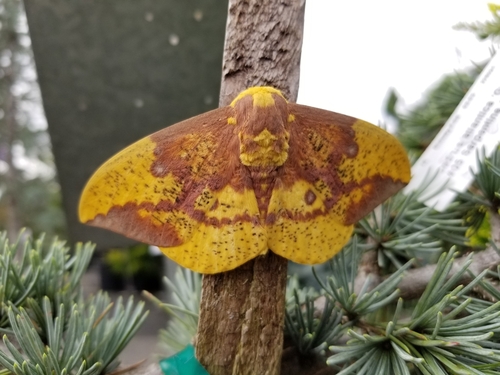
The imperial moth (Eacles imperialis) is a large silk moth in the family Saturniidae found across much of eastern North America and parts of Mexico and Central America. Adults are mainly active at night and are attracted to lights. The species has several regional color forms, ranging from pale yellow to deep orange or brown, usually with contrasting purplish-brown blotches and wavy lines on the wings.
Larvae feed on the leaves of a wide variety of hardwood and conifer trees (see diet) and can be found on trees and shrubs in woodlands, suburban areas and along forest edges. Mature caterpillars burrow into the soil to pupate without spinning a cocoon. Adults have reduced mouthparts and do not feed; their sole purpose is reproduction, so adult life is short (about a week or less).
🔍How to identify an imperial moth
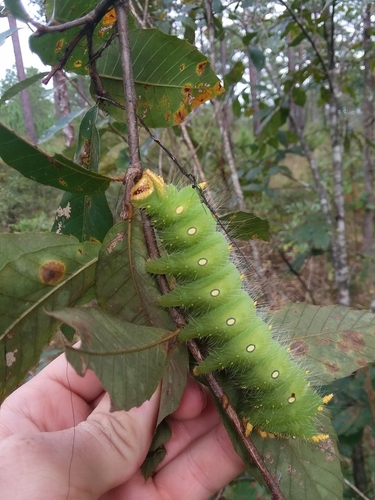
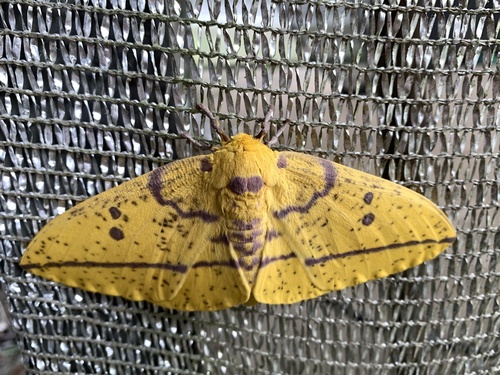
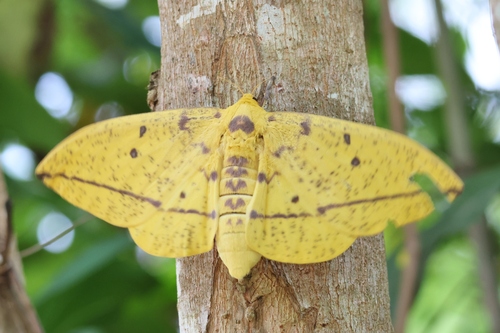
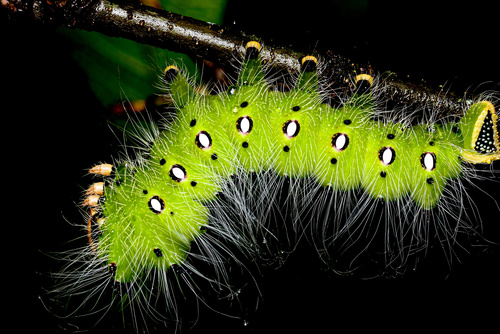
Adult imperial moths are large and robust. Forewings and hindwings are broadly rounded. Ground colour is yellow, with variable amounts of purplish-brown, pinkish-brown or orange-brown blotching and speckling, and a small dark-ringed discal spot on each wing; some northern and Texas forms are heavily brown. Males are usually more heavily marked and have more feathery (bipectinate) antennae than females. Caterpillars are large and either green or brown/orange, with long whitish hairs, small paired thoracic horns and white spiracles. Pupae are dark brown and lie in a chamber in the soil without a cocoon.
- Large wingspan (typically 90-150 mm) with rounded fore- and hindwings.
- Ground colour yellow to orange with distinct purple-brown blotches and wavy crosslines.
- Small dark discal spot on each wing and males with feathery antennae.
- Caterpillars large, green or brown/orange, with long whitish hairs and short horns behind the head.
Lookalikes
Polyphemus moth Antheraea polyphemus
Polyphemus is tan to reddish-brown with a large eyespot containing a clear window on each hindwing, lacking the yellow ground colour and purple-brown blotches of the imperial moth.
Luna moth Actias luna
Luna moth is pale green with long hindwing tails and lacks the blotched pattern and yellow-orange tones of the imperial moth.
Io moth Automeris io
Io moths are smaller, and adults show a single large eyespot on each hindwing; their caterpillars are green with stinging spines, unlike the harmless imperial caterpillar.
↻Life cycle
Egg
Females lay small clusters of eggs on host plant foliage. Eggs hatch in about 1-2 weeks depending on temperature.
Larva (caterpillar)
Caterpillars pass through several instars, growing rapidly while feeding on leaves of trees and shrubs. Late instars are large and conspicuous.
Pupa
Mature caterpillars burrow into the soil and pupate in a chamber without a cocoon. In cold regions pupae overwinter.
Adult (moth)
Adults emerge, mate, and females lay eggs. Adults have reduced mouthparts and do not feed; they live only long enough to reproduce.
🍃Diet and predators
Young eat
Leaves of various trees and shrubs: oak, maple, pine, sweetgum, poplar, walnut and others (polyphagous).
Adults eat
Do not feed; adults have reduced mouthparts.
Predators of the young
Birds, small mammals, predatory insects, parasitic wasps and flies.
Predators of adults
Bats, nocturnal birds, and other predators of large night-flying moths; adults are short-lived which reduces predation window.
🌱Effect on plants and gardens
Caterpillars feed on a wide range of deciduous trees and some conifers, including oak, maple, pine, sweetgum, and walnut. Heavy local outbreaks are uncommon; feeding is usually not a serious threat to mature trees.
📍Where and when to find it
Look for caterpillars feeding on leaves of oaks, maples, pines and other trees; search tree foliage in summer. Adults are attracted to porch and security lights at night.
Best time
Best months vary by region but generally late spring to early autumn for adults; caterpillars are most visible in mid to late summer. Nighttime is best for photographing adults at lights.
Observation tips
Turn off unnecessary lights to reduce attractants, use a porch light briefly and watch at night, and photograph spread wings by gently coaxing an adult onto a light surface if needed. When handling caterpillars, wear gloves if you have sensitive skin.
✨Fun facts
- Adult imperial moths do not eat — their mouthparts are reduced and they survive only on energy stored as caterpillars.
- Color and pattern vary widely across the species' range; some regional forms can look almost entirely orange, pale yellow, or brown.
- Males use feathered antennae to detect female pheromones from large distances at night.
?Frequently asked questions
Are imperial moths dangerous?
No. They are not venomous and pose no significant threat to people or pets. Handle caterpillars gently or not at all if you are sensitive to skin irritation.
Do imperial moths bite or sting?
No. Adults do not bite or sting. Caterpillars have small tubercles and occasional tiny spines that can cause mild irritation in rare cases but they do not sting.
Why is an imperial moth in my house?
Adults are nocturnal and are strongly attracted to lights, which can bring them to houses. Caterpillars may be on nearby trees or shrubs and sometimes wander to foundations or porches when searching for pupation sites.
How can I get rid of imperial moth caterpillars in my yard?
Because populations rarely cause serious damage, handpicking large caterpillars from small trees or shrubs is effective and humane. Encourage natural predators and parasitic wasps. Chemical controls are rarely necessary; if used, follow label instructions and consider targeted options.
Where do imperial moths live and when can I see them?
They live in deciduous and mixed forests, woodlands and suburban areas with host trees across much of eastern North America. Depending on location, you can see caterpillars in summer and adults from spring through early autumn, with most activity at night.
📷Photos of the imperial moth
More butterflies & moths
This guide was written with AI assistance and fact-checked, last updated 2026-10-10. Identification from photos is never certain: don't handle insects you can't identify, and get medical advice for bites, stings or allergic reactions. More about the imperial moth: iNaturalist, Wikipedia.