
Little wood satyr
Megisto cymela · Satyrs and wood-nymphs
A small, brown woodland butterfly of eastern North America that prefers shady edges and grassy openings.

!Is the little wood satyr dangerous?
No. Harmless to people. Adults do not bite or sting and caterpillars are not known to be dangerous. Handle gently; like other butterflies they can be injured by rough handling.
Pets
Not toxic to pets. Unlikely to be of interest to pets except as an occasional insect consumed by dogs or cats.
📖Overview
Megisto cymela, the little wood satyr, is a small satyrine butterfly found across much of eastern and central North America. It is typically associated with shady woodlands, forest edges, streamside thickets and adjacent grassy clearings. Adults are weak, fluttering fliers often seen low to the ground.
The species lays eggs on grasses; caterpillars feed on various native and introduced grasses. Adults feed on flower nectar, sap, and decaying fruit. There is typically one brood in the cooler northern parts of the range and two or more broods farther south.
🔍How to identify a little wood satyr
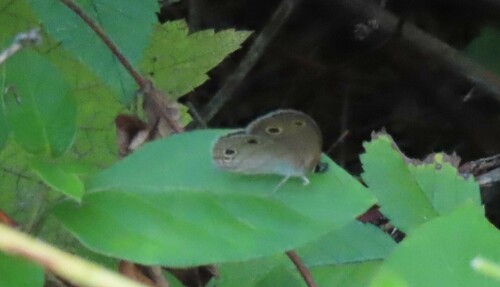
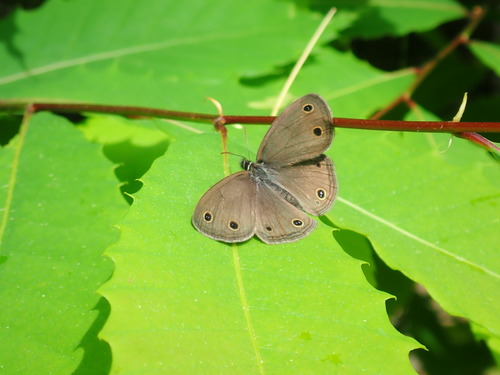
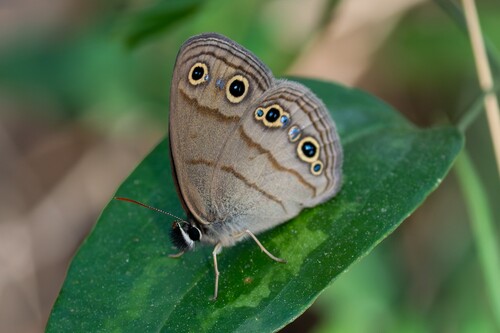
Wings are rounded and plain brown. Each wing usually has two conspicuous black eyespots ringed in yellow on both the upper and lower surfaces. The underside of the wings is paler brown, crossed by two dark lines, and also bears small silver-pupilled eyespots. Wingspan is small compared with other wood-nymphs.
- Small rounded brown wings with two yellow-ringed black eyespots on each wing, visible from above and below.
- Underside paler brown with two dark lines crossing both wings; eyespots are smaller and fewer than in larger wood-nymphs.
- Habitually flies low and close to shaded grassy ground; often seen along woodland paths.
Lookalikes
Common wood-nymph Cercyonis pegala
Common wood-nymph is larger with more prominent eyespots (usually two large eyespots on the forewing) and less delicate pale banding.
Northern pearly-eye Enodia anthedon
Pearly-eyes have a different pattern of eyespots and usually a darker, less contrasting band; they also prefer very shaded woodland interiors.
Carolina satyr Hermeuptychia sosybius
Smaller (about 30-38 mm), with no eyespots on the upperside; the underside has a row of many small eyespots on each wing. Found mainly in the southeastern United States.
↻Life cycle
Egg
Females deposit single eggs on grass blades or stems. Eggs hatch in days to weeks depending on temperature.
Larva (caterpillar)
Light brown to greenish caterpillars feed on grasses; they hide in foliage and at the base of grass tussocks and overwinter as partly grown larvae.
Pupa (chrysalis)
Pupa is attached to low vegetation or leaf litter. Pupation lasts about one to a few weeks.
Adult (butterfly)
Adults are small, brown butterflies that feed on nectar, sap and decaying fruit and are active near ground-level vegetation.
🍃Diet and predators
Young eat
Leaves of grasses (various native and introduced grass species).
Adults eat
Nectar from low flowers, tree sap, rotting fruit and other sugary liquids.
Predators of the young
Predatory insects, parasitic wasps, birds and small mammals that forage in grasses.
Predators of adults
Birds, spiders, mantids and other insectivores; adults rely on camouflage and low flight to avoid predators.
🌱Effect on plants and gardens
Larvae feed on various grasses (native and introduced), but damage is minimal and not of agricultural concern.
📍Where and when to find it
Look along shaded woodland paths, grassy edges, streamside thickets and clearings. Adults patrol low over grass; caterpillars are in grass clumps and at the base of stems.
Best time
Spring through early autumn; mid-morning to late afternoon on warm days but often in shade.
Observation tips
Walk slowly along shaded trails and photograph at low angles. Overripe fruit or sap bait can attract adults for closer views.
✨Fun facts
- Despite the name 'wood satyr', they are often most easily seen at woodland edges and in grassy trails rather than deep forest interior.
- Adults sometimes feed on tree sap and overripe fruit more than on flowers, making them common at fallen-fruit baits.
?Frequently asked questions
Are little wood satyrs harmful or poisonous?
No. They are harmless to people and pets and do not sting or bite.
Do little wood satyrs bite?
No. Adults do not bite; caterpillars feed on grasses and are not known to bite humans.
Why is a little wood satyr in my yard?
Your yard probably has suitable habitat: shaded edges, grassy patches or nearby woodland. They use grasses for their larvae and shaded nectar sources for adults.
How can I attract little wood satyrs?
Keep a patch of native grasses and allow some shaded, grassy edges near trees or shrubs. Overripe fruit, flowering low plants and sap flows also attract adults.
How do I get rid of them?
They are not pests and usually do not require control. If you need fewer butterflies in a specific area, reduce tall grasses and remove sheltered grassy tussocks where larvae hide.
Where do little wood satyrs live?
They live in wooded regions and adjacent grassy openings across eastern and central North America, from southern Canada through much of the United States.
📷Photos of the little wood satyr


More butterflies & moths
This guide was written with AI assistance and fact-checked, last updated 2026-10-10. Identification from photos is never certain: don't handle insects you can't identify, and get medical advice for bites, stings or allergic reactions. More about the little wood satyr: iNaturalist, Wikipedia.