
Io moth
Automeris io · Silk moths
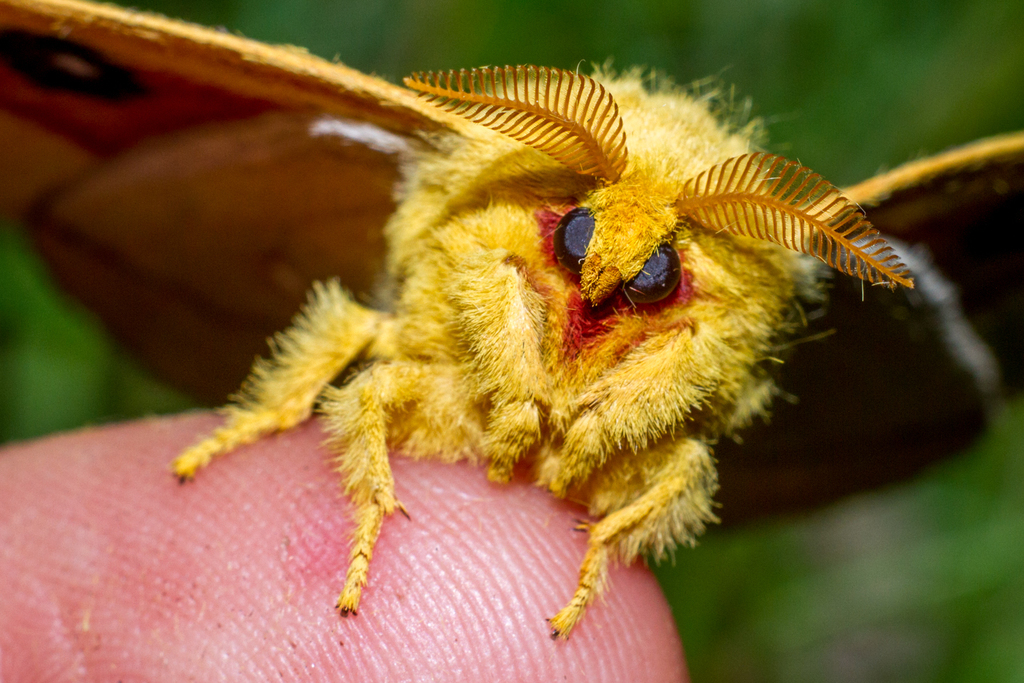
A striking North American silk moth whose caterpillars have venomous spines that cause painful stinging rashes in people.
!Is the Io moth dangerous?
Only mildly. Io moth caterpillars have urticating spines that inject irritant when they break the skin. Contact can cause immediate pain, burning, redness and an itchy rash that may last hours to days. Severe reactions are uncommon but those with allergic sensitivity can have stronger responses; seek medical care for breathing problems or severe swelling. First aid: remove spines (with adhesive tape), wash area with soap and water, apply cold compress and topical antihistamine or hydrocortisone for itching. Adults do not bite or sting.
Pets
Pets that handle or mouth the caterpillars may show drooling, pawing at the mouth, local swelling or vomiting; monitor and consult a veterinarian if symptoms are concerning.
📖Overview
Automeris io is a medium-sized silk moth native to much of eastern and central North America. Adults are best known for their dramatic hindwing eyespots used to startle predators; males and females differ in ground colour. The caterpillars are social in early instars and later solitary, feeding on a wide range of trees and shrubs and bearing urticating (stinging) spines that can deliver a painful sting to human skin. Adults are short-lived, do not feed significantly, and are primarily active at night.
🔍How to identify an Io moth
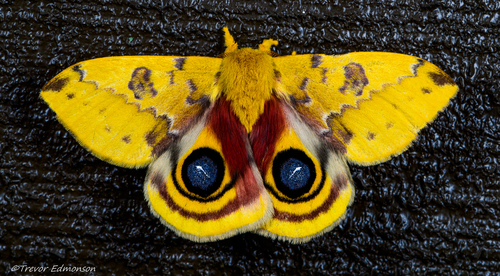
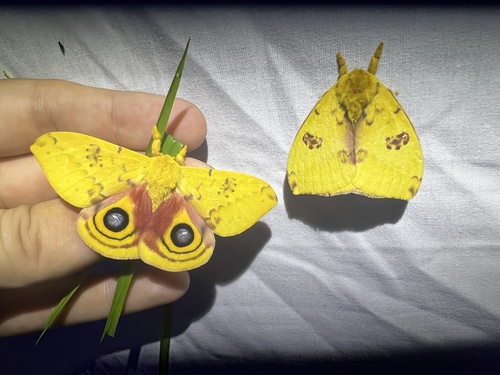
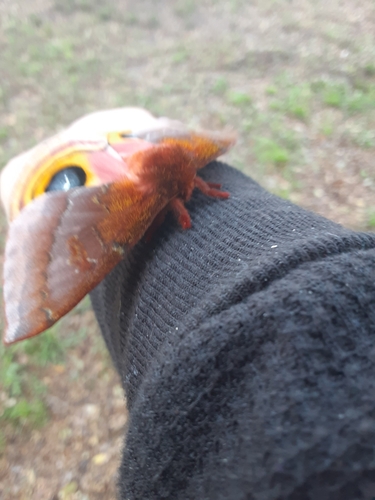
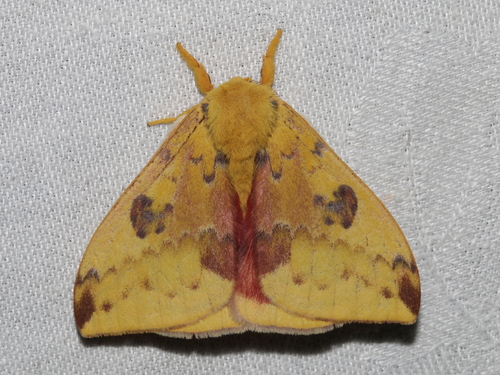
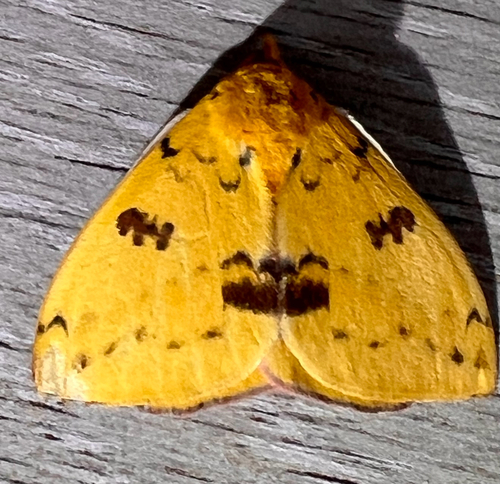
Adults have a stout, hairy body and a wingspan of about 50-80 mm. Forewings are plain or faintly patterned—males typically bright yellow and females reddish- to purplish-brown—while each hindwing bears a large, circular eyespot (black and blue center with a white mark, ringed by black) on a yellow background, with a reddish band near the edge. The caterpillar (larva) is bright green with branched, stinging spines and a red-and-white stripe along each side. Pupae form inside thin, papery brown cocoons spun in leaf litter or among low vegetation.
- Hindwings with a single large eyespot on each side: black-and-blue center with a white mark, on a yellow background
- Sexual dimorphism: males bright yellow, females reddish-brown on forewings
- Caterpillars bright green with branched stinging spines and a red-and-white stripe along each side
Lookalikes
Polyphemus moth Antheraea polyphemus
Larger (wingspan often 110-150 mm) with a translucent 'window' spot on each hindwing rather than the circular eyespot of Io moth.
Cecropia moth Hyalophora cecropia
Much larger and different wing shape and banding; cecropia lacks the Io moth's single central eyespot and has more complex red and white bands.
Other Automeris species Automeris spp.
Related Automeris species have similar eyespots; region and differences in wing ground colour and pattern, plus genitalia, are used for definitive ID.
↻Life cycle
Egg
Females lay clusters of small, round eggs on the underside of host plant leaves; eggs hatch in about 1-2 weeks depending on temperature.
Larva (caterpillar)
Larvae hatch gregarious in early instars and feed on host leaves, growing through several instars and developing urticating spines; this stage lasts a few weeks.
Pupa (cocoon)
Mature caterpillars spin a silken cocoon often mixed with leaves near the ground; pupation lasts weeks to months and may overwinter in colder areas.
Adult (moth)
Adults emerge to mate and lay eggs; they have reduced mouthparts and do not feed extensively, living about 1-2 weeks.
🍃Diet and predators
Young eat
Leaves of a wide variety of deciduous trees and shrubs (willow, maple, oak, cherry, apple, hawthorn, and many ornamentals)
Adults eat
Adults have reduced mouthparts and do not feed; they rely on stored energy from the larval stage.
Predators of the young
Birds, predatory insects and parasitic wasps and flies (which can attack egg clusters and caterpillars)
Predators of adults
Bats and nocturnal birds; eyespots may deter or delay predators
🌱Effect on plants and gardens
Caterpillars feed on many deciduous trees and shrubs including willows, maples, oaks, cherry, apple, hawthorn and various ornamental shrubs. Heavy local feeding can defoliate small trees but complete kill is uncommon.
How to get rid of Io moths
For isolated caterpillar groups, wear gloves and remove them by hand into soapy water or use sticky tape to lift spines off skin and surfaces. For larger infestations, encourage natural enemies (birds, predatory insects) or apply Bacillus thuringiensis kurstaki (Btk) to foliage while larvae are small. Chemical controls may be used as a last resort following label directions. Avoid bare-skin contact with caterpillars.
📍Where and when to find it
Look for caterpillars on host plant leaves in spring and early summer; adults come to light at night. Pupae and cocoons are found in leaf litter or low vegetation.
Best time
Best observed from spring through late summer; adults at night and caterpillars during daylight on host plants.
Observation tips
Use a light or sheet at night to attract adults. When photographing caterpillars, keep distance to avoid contact with stinging spines and wear gloves if handling is necessary.
✨Fun facts
- The Io moth's eyespots are a defensive display: sudden flashing of the spots can startle or temporarily frighten predators.
- Young Io caterpillars feed in groups and often travel in single-file processions between feeding sites.
- Despite their dramatic appearance, adult Io moths do not feed and live only long enough to reproduce.
?Frequently asked questions
Are Io moths poisonous to humans?
The caterpillars can sting — their spines inject an irritant that causes pain and a rash. Adults are harmless and do not sting or bite.
Do Io moth caterpillars bite?
They do not bite, but their stinging spines can break the skin and cause a painful reaction on contact.
Why is an Io moth in my house?
Adults are nocturnal and attracted to lights; they can fly into houses at night. Caterpillars enter structures only rarely.
How do I get rid of Io moth caterpillars in my yard?
Wear gloves and remove small groups by hand into soapy water or use biological control Btk when larvae are small. Encourage birds and natural predators; avoid direct skin contact.
Where do Io moths live?
They live in woodlands, edges, fields and gardens across eastern and central North America where host trees and shrubs are available.
📷Photos of the Io moth
More butterflies & moths
This guide was written with AI assistance and fact-checked, last updated 2026-10-10. Identification from photos is never certain: don't handle insects you can't identify, and get medical advice for bites, stings or allergic reactions. More about the Io moth: iNaturalist, Wikipedia.