
Six-spot burnet
Zygaena filipendulae · Burnet moths
A day-flying, metallic black and red moth common in meadows across Europe; warning-coloured and chemically defended against predators.
!Is the six-spot burnet dangerous?
Only mildly. Six-spot burnets are not venomous and do not bite or sting. They contain cyanogenic compounds that make them taste unpleasant; handling is not known to cause poisoning but avoid eating them. No special first aid is required for casual skin contact.
Pets
Not toxic in the sense of causing envenomation; however, the moths taste bad and might cause mild stomach upset if a pet eats many. Keep curious pets from eating wildlife if possible.
📖Overview
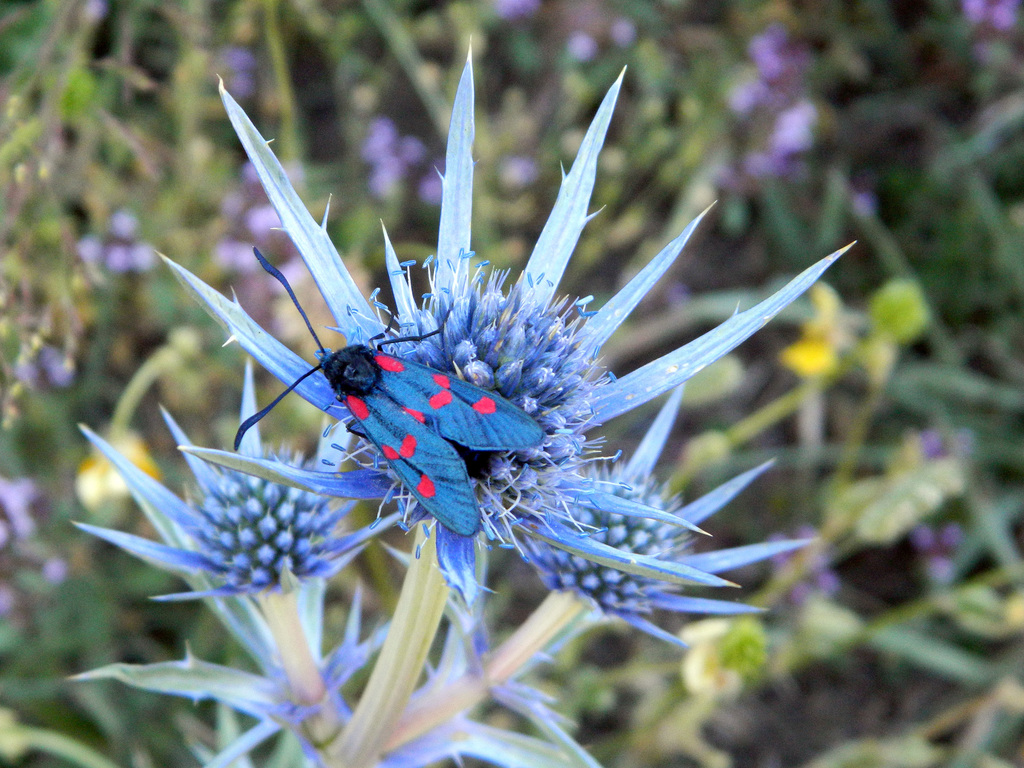
The six-spot burnet is a diurnal (day-flying) moth notable for its shiny, dark wings marked with six bright crimson spots. It is widespread in grasslands, meadows and coastal areas across much of Europe and parts of western Asia. Adults visit flowers for nectar and are often seen slow-flying in warm, sunny weather in summer. Larvae feed mainly on leguminous plants, especially bird's-foot trefoil. The species stores cyanogenic compounds that make it distasteful to predators; its red spots act as an aposematic warning.
🔍How to identify a six-spot burnet
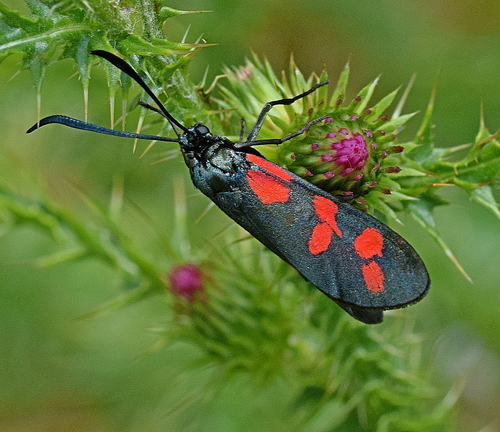
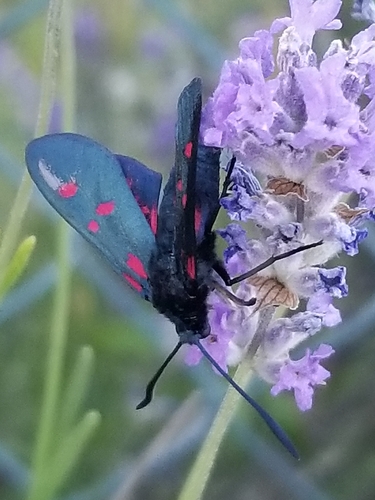
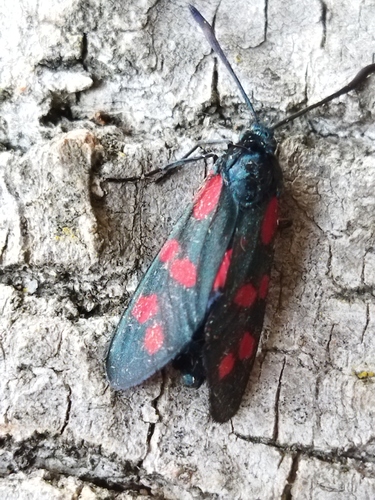
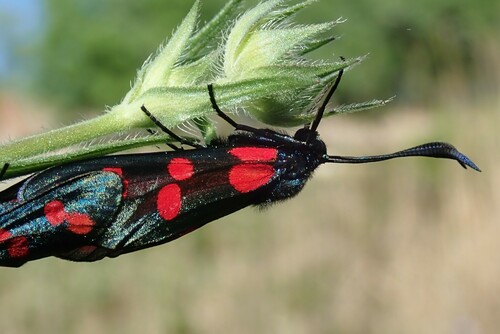
Adults have a metallic dark (black-green) forewing with six distinct red or crimson spots on each forewing and a crimson hindwing with a narrow dark border. The wings are narrow with a glossy sheen; the body is robust, hairy and dark. When at rest the wings are held roof-like over the body. Caterpillars are plump, hairy and greenish-yellow with rows of black spots along the body.
- Look for six distinct red spots on each forewing (spot number and size can vary slightly).
- Wings have a glossy, metallic dark background rather than matte brown; the red is bright crimson.
- Day-flying on warm sunny days, slow fluttering over flowers is characteristic.
- Caterpillars are plump, hairy and greenish-yellow with black spots, often found feeding on bird's-foot trefoil.
Lookalikes
Five-spot burnet Zygaena trifolii
Usually has five large red spots on each forewing instead of six; check spot count and pattern and regional species keys.
Narrow-bordered five-spot burnet Zygaena lonicerae
Typically five spots and a narrower wing border; smaller or differently shaped spots compared with Z. filipendulae.
Slender Scotch burnet Zygaena loti
Different spot arrangement and generally more restricted range and habitat; consult local guides for precise separation.
↻Life cycle
Egg
Eggs are laid singly or in small groups on the leaves of foodplants in summer; they hatch in about 1-2 weeks depending on temperature.
Larva (caterpillar)
Caterpillars feed on leguminous hostplants through late summer and autumn, then hibernate and feed again in spring before pupating.
Pupa (chrysalis)
Pupation occurs in a shiny, papery, yellowish cocoon attached high up on a grass stem; pupae develop for a few weeks before adults emerge in early to mid-summer.
Adult (moth)
Adults are diurnal, feed on nectar, mate and lay eggs during summer; they are often seen visiting scabious, knapweed and thistles.
🍃Diet and predators
Young eat
Leaves of bird's-foot trefoil (Lotus corniculatus), greater bird's-foot trefoil (Lotus pedunculatus) and related legumes.
Adults eat
Nectar from a range of flowers such as knapweeds, thistles, scabious and other meadow flowers.
Predators of the young
Small insectivorous birds, parasitic wasps and predatory insects; caterpillars' chemical defenses reduce predation.
Predators of adults
Birds and bats may attack, but the bright red spots and chemical defenses deter many predators; some specialized predators tolerate the toxins.
🌱Effect on plants and gardens
Larvae feed mainly on bird's-foot trefoil (Lotus corniculatus), occasionally other Lotus species and related legumes. Populations rarely cause significant damage to wild plants or crops.
📍Where and when to find it
Adults: flying and feeding on flowers in meadows, roadside verges and coastal grassland. Larvae: on leaves of bird's-foot trefoil.
Best time
Best seen June to August on warm, sunny days, typically during daytime hours.
Observation tips
Walk slowly through flower-rich patches in warm weather; use a camera with a fast shutter to freeze their slow flight. Look for resting moths on flowers or grasses mid-morning to late afternoon.
✨Fun facts
- Unlike most moths, six-spot burnets fly in bright sunshine and are often seen feeding on flowers like butterflies.
- They store cyanogenic compounds that can release hydrogen cyanide if the insect is crushed, which makes them taste bad to predators.
- Spot patterns vary between individuals and populations; the 'six-spot' appearance is a reliable field mark in most of its range.
?Frequently asked questions
Are six-spot burnets dangerous to people?
Only mildly — they do not bite or sting. They contain chemical defenses that make them unpleasant to eat, but casual handling is not hazardous.
Do six-spot burnets come into houses?
They prefer sunny meadows and flower-rich habitats and are not attracted to homes, though an individual may occasionally wander indoors through an open door.
How can I encourage six-spot burnets in my garden?
Leave patches of native legumes such as bird's-foot trefoil and plant nectar sources like knapweed, thistles and scabious. Avoid intensive mowing and pesticides.
Do they harm garden plants or crops?
No significant damage; caterpillars feed on wild legumes but are not known as agricultural pests.
Why are they red and black?
The bright red spots on a dark background serve as a warning (aposematism) to predators that the moths are chemically defended and taste bad.
📷Photos of the six-spot burnet
More butterflies & moths
This guide was written with AI assistance and fact-checked, last updated 2026-10-10. Identification from photos is never certain: don't handle insects you can't identify, and get medical advice for bites, stings or allergic reactions. More about the six-spot burnet: iNaturalist, Wikipedia.