
White-lined sphinx
Hyles lineata · Sphinx moths
A widespread, fast-flying hawk moth with a long proboscis; adults hover at flowers like hummingbirds and larvae feed on many garden plants.
!Is the white-lined sphinx dangerous?
No. Adults do not bite or sting and pose no toxic threat. Larvae are smooth, have no venom and are harmless to handle; the tail horn is soft and cannot sting. Wash hands if you handle one.
Pets
Not poisonous to pets. Large caterpillars may be eaten by curious pets and could cause mild digestive upset, but are not known to be toxic.
📖Overview
Hyles lineata is a common, widespread sphinx moth found across much of North America and parts of Central America. Adults are strong, fast fliers that visit nectar-rich flowers at dusk and during the day, often hovering like hummingbirds. Larvae are variable in colour and occur on a wide range of host plants; in some years they can be locally abundant and defoliate herbaceous plants but are usually not a major long-term pest. They occupy open habitats, gardens, roadsides and disturbed areas where host plants and flowers are available.
🔍How to identify a white-lined sphinx
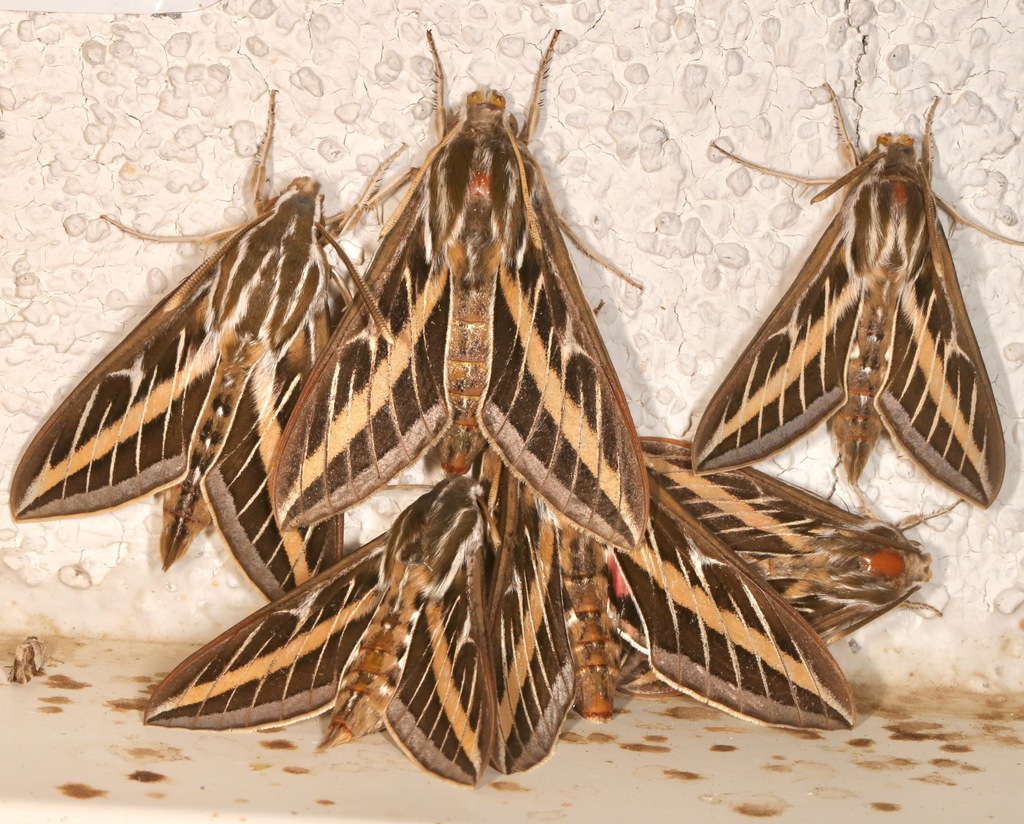
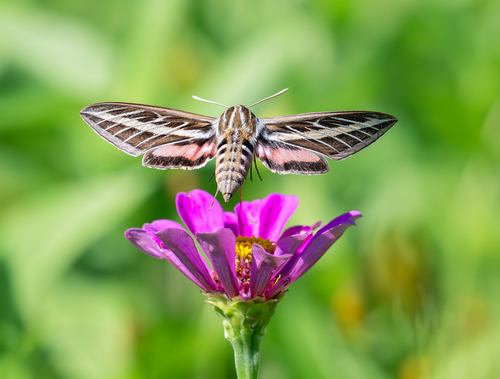
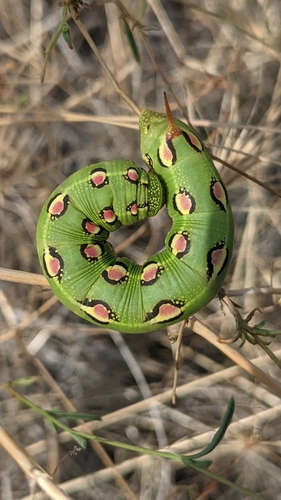
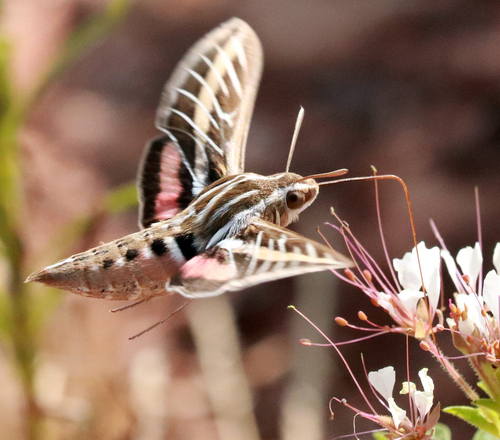
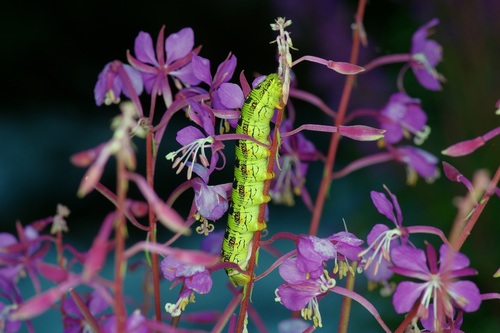
Adults have a streamlined body and narrow, pointed forewings. Forewings are olive-brown with a broad buff-white stripe from base to tip and the veins outlined in white; hindwings are pink with a black base and a broad dark outer margin. Wingspan typically 60-85 mm. The thorax has white lines along the sides and the abdomen has alternating black and white bars along the sides. Larvae (caterpillars) are smooth and highly variable in colour — green, yellow or black — usually with a row of spots along each side and a horn on the last segment (typical of sphinx moths).
- Forewings with prominent white lengthwise lines contrasting with brown or olive background.
- Pink hindwings with a black base and broad dark border, visible in flight.
- Streamlined body with black and white bars along the sides of the abdomen; wingspan 60-85 mm.
- Larvae have a characteristic rear 'horn' and extremely variable coloration; look for a row of spots along each side.
Lookalikes
Bedstraw hawk-moth Hyles gallii
Forewings are dark olive with a pale band but lack the white-lined veins of H. lineata; hindwing pattern is similar, so check the forewings.
Striped hawk-moth Hyles livornica
Very similar Old World relative found in Europe, Africa and Asia rather than the Americas; location is the easiest way to separate them.
↻Life cycle
Egg
Small, spherical eggs laid singly or in small clusters on host plant leaves; hatch in several days depending on temperature.
Larva (caterpillar)
Several instars with the typical sphinx horn on the last abdominal segment; larvae feed vigorously and grow for 2-5 weeks depending on temperature and food.
Pupa
Pupation occurs in loose soil or leaf litter in a chamber; pupal stage lasts a few weeks to several months depending on season and whether overwintering occurs.
Adult (moth)
Adults are strong fliers that seek nectar and mates; multiple generations per year are common in warm regions.
🍃Diet and predators
Young eat
Leaves of many herbaceous plants and some shrubs (willowherb, evening primrose, phlox, grape, purslane and others).
Adults eat
Nectar from a wide range of flowers; they hover while feeding and prefer tubular, fragrant blooms such as honeysuckle, petunia, phlox and penstemon.
Predators of the young
Birds, predatory insects, parasitic wasps and flies (tachinids), and small mammals.
Predators of adults
Bats, birds, and predatory insects; they evade predators with fast flight and nocturnal activity.
🌱Effect on plants and gardens
Larvae feed on a wide range of herbaceous plants and shrubs, including willowherbs, garden phlox, purslane, grape, evening primrose, and many cultivated plants. Heavy local outbreaks can defoliate individual plants but populations usually decline quickly.
How to get rid of white-lined sphinxes
Handpick and remove caterpillars from small gardens. Encourage natural predators (birds, parasitic wasps). For large infestations, treat with Bacillus thuringiensis kurstaki (Btk) on young caterpillars following label directions; chemical insecticides are usually unnecessary for isolated occurrences.
📍Where and when to find it
Adults at nectar-rich flowers (phlox, petunia, penstemon, honeysuckle); larvae on host plants such as evening primrose, willowherb, purslane and grape.
Best time
Spring to early fall; dusk and early evening are prime times, but daytime feeding is common on warm, sunny days.
Observation tips
Use a fast shutter or burst mode to photograph the hovering adults; for caterpillars, check underside of leaves and stems of known host plants. Approach quietly at dusk to avoid startling them.
✨Fun facts
- Adults hover at flowers and can be mistaken for small hummingbirds in daylight because of similar size and feeding behavior.
- Caterpillars come in many color forms, so backyard observers often think they are seeing different species when they are the same.
- White-lined sphinx is one of the most adaptable sphinx moths and can be active both by day and night.
?Frequently asked questions
Do white-lined sphinx moths bite?
No. Adults do not bite or sting. Caterpillars are not venomous and their tail horn is harmless.
Why is a white-lined sphinx moth in my house?
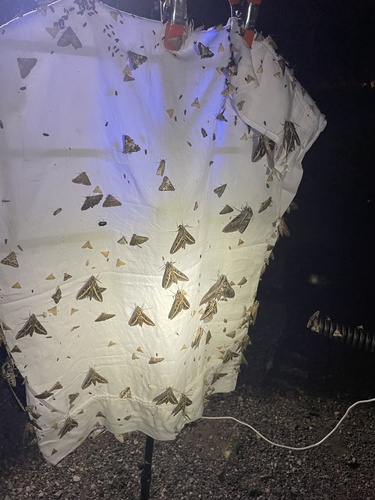
Adults are attracted to bright lights and flowering houseplants; they may accidentally fly indoors while searching for nectar or mates.
Are white-lined sphinx caterpillars harmful to garden plants?
They feed on many plants and can defoliate individual plants in heavy numbers, but outbreaks are usually temporary and most gardens recover.
How can I get rid of white-lined sphinx caterpillars?
For small numbers, handpick and relocate or destroy caterpillars. For larger infestations, use Btk when caterpillars are small or consult local extension recommendations; encourage natural predators.
When can I see white-lined sphinx moths?
From spring through early fall in most regions; they are most active at dusk and at night but often feed during the day.
📷Photos of the white-lined sphinx
More butterflies & moths
This guide was written with AI assistance and fact-checked, last updated 2026-10-10. Identification from photos is never certain: don't handle insects you can't identify, and get medical advice for bites, stings or allergic reactions. More about the white-lined sphinx: iNaturalist, Wikipedia.