
Tomato hornworm
Manduca quinquemaculata · Sphinx moths and hawk moths
Large green caterpillar that defoliates tomato, pepper, eggplant and potato plants; easy to spot and usually controlled by handpicking or natural enemies.
!Is the tomato hornworm dangerous?
No. Tomato hornworms do not sting or inject venom. The caterpillars may pinch if squeezed but are not dangerous. Handle gently or use gloves if removing from plants.
Pets
Not toxic to pets. However, pets that eat large numbers of caterpillars might vomit or have mild digestive upset; avoid letting pets eat them.
📖Overview
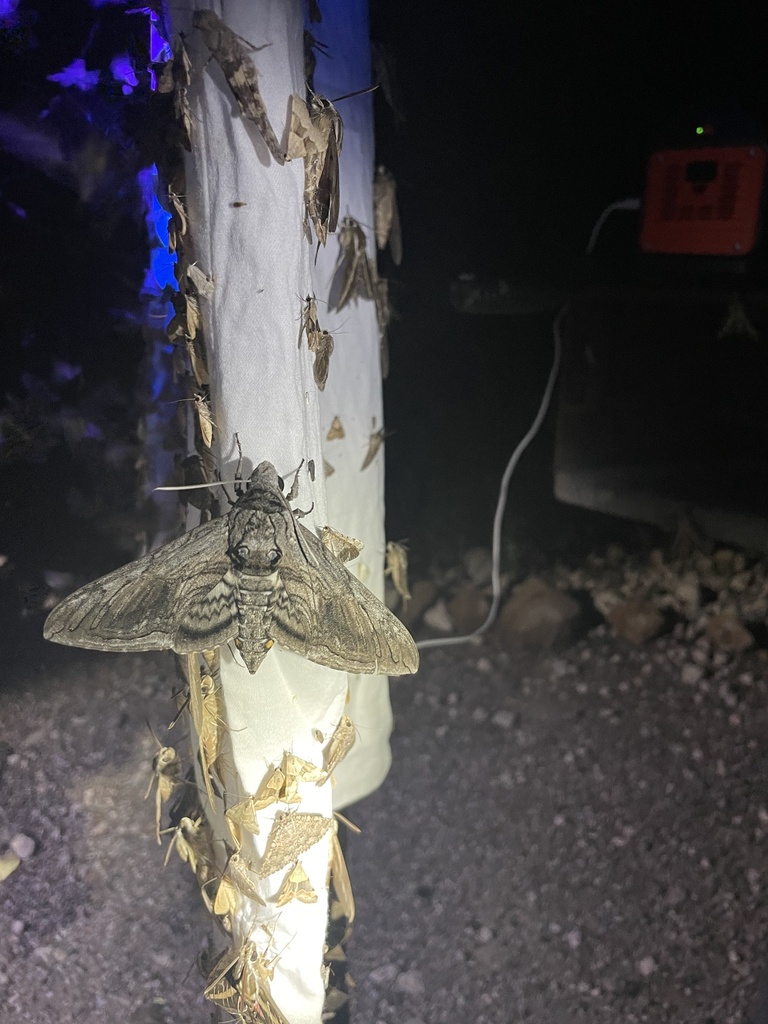
The tomato hornworm is the caterpillar (larval) stage of the hawk moth Manduca quinquemaculata. Larvae are among the most common and destructive chewing pests of tomato and other solanaceous plants in North America. They feed heavily on leaves, stems and sometimes fruit, but are solitary and easy to remove by hand. The adult is a large, fast-flying hawk moth that visits flowers at dusk and night.
🔍How to identify a tomato hornworm
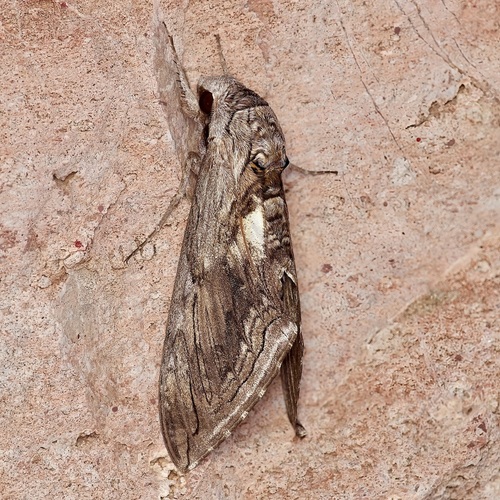
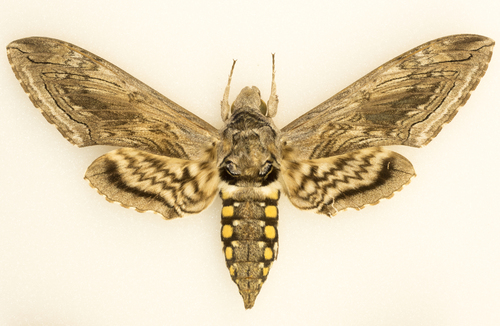
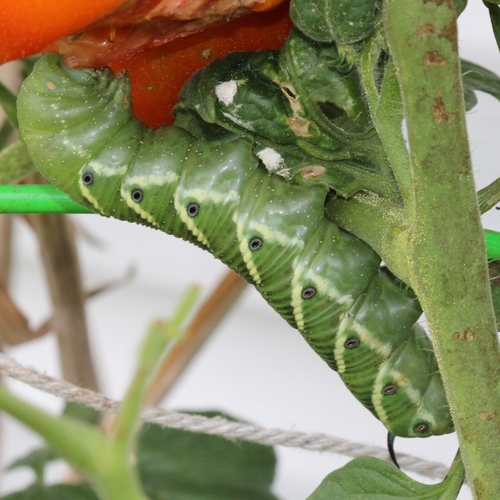
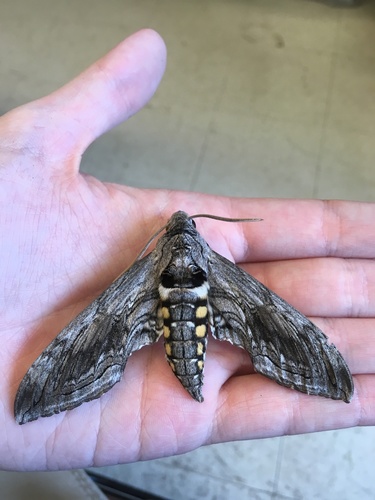
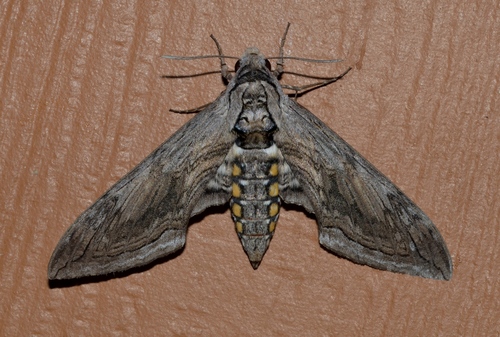
Larvae reach 7-10 cm long and are vivid green to bluish-green with eight V-shaped (chevron) white markings on each side and a distinctive pointed horn on the last abdominal segment. They are smooth-skinned and well-camouflaged against foliage. The adult moth has a streamlined body and narrow, swept-back wings in gray-brown tones; the species name refers to the five pairs of yellow-orange spots on the moth's abdomen.
- Large green caterpillar 70-100 mm long with smooth skin and eight white V-shaped (chevron) markings along each side.
- Distinctive pointed horn on the posterior end (not a stinger) — horn color typically dark to blackish.
- Presence of white, small, cocooned wasp pupae (clusters of tiny white cocoons) on the caterpillar indicates parasitism and should be left alone.
Lookalikes
Tobacco hornworm Manduca sexta
Tobacco hornworm has seven diagonal white stripes edged with black (instead of V-shaped marks) and usually a red horn; adult moths have six rather than five pairs of yellow abdominal spots.
Other sphinx moth caterpillars Various Sphingidae
Other hawk moth larvae may differ in stripe pattern, horn length or body shading; host plant and exact markings help identification.
↻Life cycle
Egg
Small, spherical greenish eggs are laid singly or in small groups on the underside of host plant leaves; incubation usually 3-7 days depending on temperature.
Larva (caterpillar)
Several instars of feeding caterpillar; grows quickly over 3-5 weeks, reaching 7-10 cm. Characteristic horn on the last abdominal segment.
Pupa
Larvae enter the soil and pupate in an earthen cell without a silk cocoon; pupation lasts from a few weeks to several months depending on season (overwintering possible in colder areas).
Adult moth
Nocturnal hawk moth that flies at dusk and night, feeds on nectar with a long proboscis, and mates to begin the next generation.
🍃Diet and predators
Young eat
Leaves, stems and occasionally fruit of solanaceous plants (tomato, pepper, eggplant, potato, tobacco and related weeds).
Adults eat
Nectar from night-blooming and dusk-flowering flowers.
Predators of the young
Parasitic braconid wasps (notably Cotesia species) that leave white cocoons on caterpillars, birds, predatory insects and small mammals.
Predators of adults
Bats, night-flying insectivorous birds and predatory insects.
🌱Effect on plants and gardens
Larvae feed on leaves, stems and sometimes fruit of tomatoes, peppers, eggplants, potatoes and related wild solanaceous plants, sometimes causing significant defoliation and reducing yield.
How to get rid of tomato hornworms
Handpick caterpillars early in the morning or evening and drop them into a bucket of soapy water. Encourage natural enemies (parasitic wasps, birds). Use Bacillus thuringiensis kurstaki (Bt) sprays on young larvae, or spinosad for more stubborn infestations. Floating row covers protect young plants but must be removed when plants flower to allow pollination. For heavy infestations, rotate crops and remove nearby volunteer solanaceous weeds. Chemical insecticides are effective but use as a last resort and follow label instructions.
📍Where and when to find it
Look for caterpillars on the upper and lower surfaces of leaves, along stems and among fruit trusses of tomato, pepper, eggplant and potato plants; eggs on undersides of leaves; adults visit nectar flowers at dusk.
Best time
Observe larvae from late spring through summer and into early fall in one or more generations depending on region; adults are best seen at dusk or at night around lights or nectar sources.
Observation tips
Check plants early morning or evening when caterpillars are feeding. Watch for missing leaves, dark droppings and stripped stems as signs. When photographing, show the horn and the diagonal markings for clear ID.
✨Fun facts
- The 'horn' on the caterpillar is harmless and not a stinger; it is a defensive-looking projection.
- Parasitic wasps that attack hornworms are beneficial to gardeners and often more effective than chemical control.
- Despite their size, hornworms are solitary feeders — you rarely find more than a few on a single plant unless the infestation is heavy.
?Frequently asked questions
Are tomato hornworms harmful to people?
No. They do not bite or sting and are not poisonous. Handle with care or remove them with gloves if you prefer not to touch them.
Do tomato hornworms eat my tomatoes?
Yes. They feed on leaves, stems and sometimes green fruit of tomato plants and can defoliate plants if not controlled.
How do I get rid of tomato hornworms?
Handpick and destroy them, encourage natural enemies (parasitic wasps, birds), use Bt (Bacillus thuringiensis) on small larvae, or apply spinosad if necessary. Use row covers early in the season to prevent egg-laying.
Will the hornworm sting me?
No. The horn is not a stinger; it is harmless. They may pinch if grabbed but are not venomous.
What are those white blobs on a hornworm?
They are the cocoons of parasitic wasp larvae (Cotesia species). A parasitized caterpillar will usually die when the wasps emerge, so gardeners often leave these alone.
📷Photos of the tomato hornworm
More butterflies & moths
This guide was written with AI assistance and fact-checked, last updated 2026-10-09. Identification from photos is never certain: don't handle insects you can't identify, and get medical advice for bites, stings or allergic reactions.