
Japanese beetle
Popillia japonica · Scarab beetles
A metallic green-and-copper scarab beetle whose adults skeletonize leaves and flowers while larvae (grubs) feed on turf roots, a major ornamental and turf pest in many temperate regions.
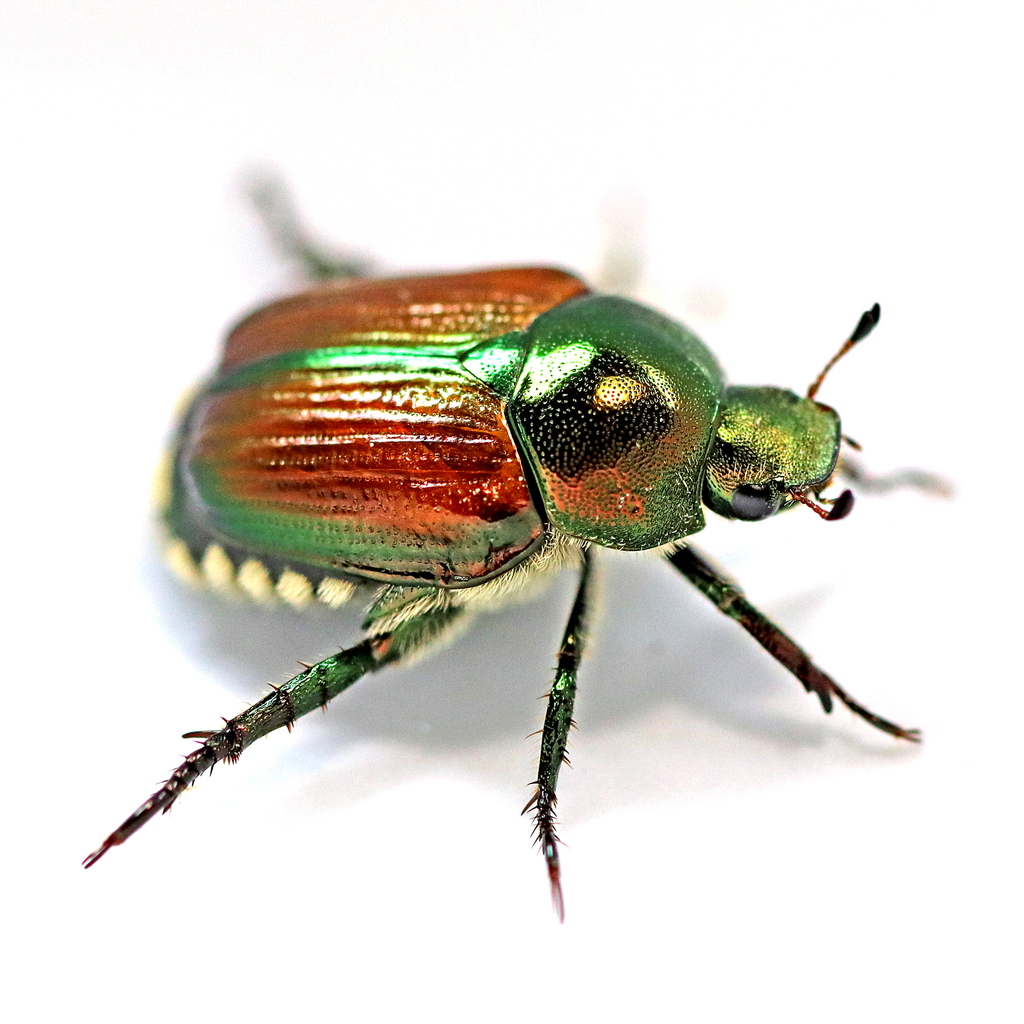
!Is the japanese beetle dangerous?
No. Japanese beetles are not poisonous and do not pose a medical threat. Adults may nibble if handled but do not bite or sting in a medically significant way. Handle gently or wear gloves if needed.
Pets
Not toxic to pets. Pets may eat individual beetles without serious effects, though eating large numbers could cause mild stomach upset.
📖Overview
Popillia japonica is a small scarab beetle native to Japan that has become an invasive pest in North America and parts of Europe. Adults feed on the foliage, flowers and fruit of hundreds of plant species, often producing characteristic 'skeletonized' leaves. The larval stage is a white grub that lives in soil and feeds on grass roots, causing brown patches in lawns. Life cycle is annual in most of its invaded range: eggs are laid in soil in mid to late summer, larvae develop through autumn and overwinter as third-instar grubs, pupate in late spring and adults emerge in early summer.
🔍How to identify a japanese beetle
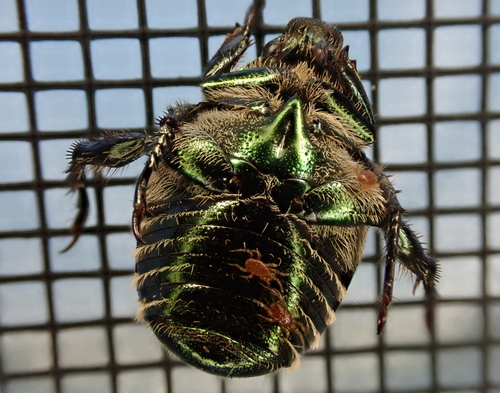
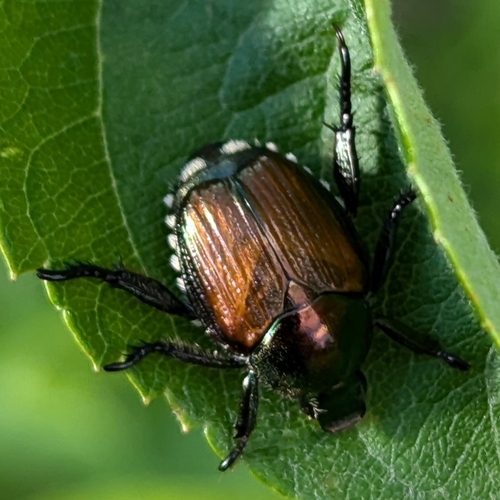
Adults are roughly 8-11 mm long with a metallic emerald-green head and thorax and shiny copper to bronze elytra (wing covers). Each side of the abdomen has five small tufts of white hairs, plus two more at the tip of the abdomen just behind the elytra; these 12 tufts are diagnostic. Larvae are C-shaped, cream-colored grubs with brown heads and three pairs of legs near the front; mature grubs reach about 25-30 mm.
- Adults 8-11 mm, metallic emerald-green head and thorax with coppery-brown elytra
- Five small white tufts of hair along each side of the abdomen plus two at the tip, visible just below the edge of the elytra
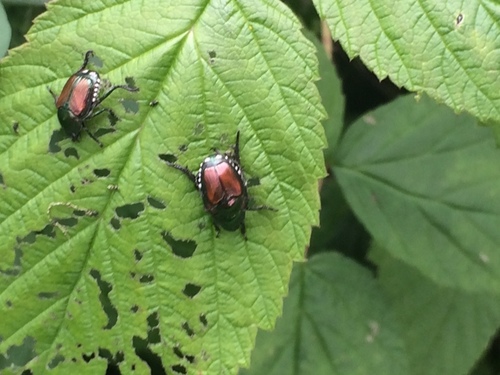
- Adults skeletonize leaves, leaving a lace-like appearance on foliage
Lookalikes
Green June beetle Cotinis nitida
Larger (about 20-28 mm), mostly green with a bronze sheen and lacking the regular white abdominal tufts; different flight and body shape.
European chafer Amphimallon majale
Paler tan-brown color and lacks the bright metallic green head and thorax and the white tuft pattern of Popillia japonica.
Oriental beetle Exomala orientalis
Similar in size but straw-colored with variable dark mottling, without the metallic green head and the white abdominal hair tufts.
↻Life cycle
Egg
Females lay eggs in soil (turf or grassy sites) in mid to late summer. Eggs hatch in about 1-2 weeks depending on temperature.
Larva (white grub)
Larvae pass through three instars feeding on grass roots through autumn, overwinter deeper in the soil and resume feeding in spring.
Pupa
Pupation occurs in soil in late spring; the pupal stage lasts a couple of weeks before adults emerge.
Adult (beetle)
Adults emerge in early summer, feed for 4-6 weeks, mate and the female lays eggs, completing the annual cycle.
🍃Diet and predators
Young eat
Roots and organic matter in soil, especially grass roots
Adults eat
Leaves, flowers and fruit of many deciduous trees, shrubs and garden plants
Predators of the young
Soil predators and parasitoids (beetle predators, nematodes, birds digging grubs), small mammals like skunks and raccoons can dig up and eat grubs
Predators of adults
Birds, predatory insects, spiders, and some small mammals; parasitic flies and wasps may attack adults or larvae in some regions
🌱Effect on plants and gardens
Adults feed on leaves, flowers and fruit of many ornamentals, trees and crops (roses, grapes, linden, birch, apple, grapevine and many others), often leaving leaves skeletonized. Larvae feed on grass roots, damaging lawns and turf.
How to get rid of japanese beetles
Use integrated methods: handpick adults into soapy water during early morning when beetles are sluggish; spot-treat larvae with biological controls such as Bacillus thuringiensis galleriae or Heterorhabditis bacteriophora entomopathogenic nematodes (applied to moist soil in late summer); milky spore (Paenibacillus popilliae) can reduce grubs over several years but effectiveness varies regionally. Chemical insecticides (neonicotinoids or pyrethroids for adults, grub-specific soil insecticides for larvae) are available—follow label directions, avoid spraying open flowers visited by bees, and consider nonchemical options first. Traps attract large numbers and can increase local damage if used alone. Cultural controls: maintain healthy turf, improve drainage, and reduce irrigation in late summer to discourage egg-laying.
📍Where and when to find it
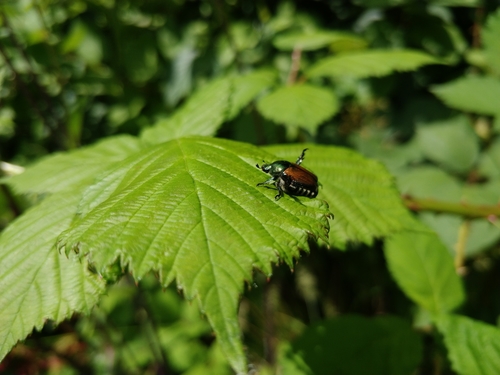
Adults on flowers, leaves and fruit of ornamental trees, shrubs and garden plants during warm summer days; look for grubs by digging in turf and lawn soil in late summer and early autumn.
Best time
June to August for adults in most temperate regions; early morning or late afternoon when adults are feeding or resting. Grubs visible when turf is dug up in late summer and spring.
Observation tips
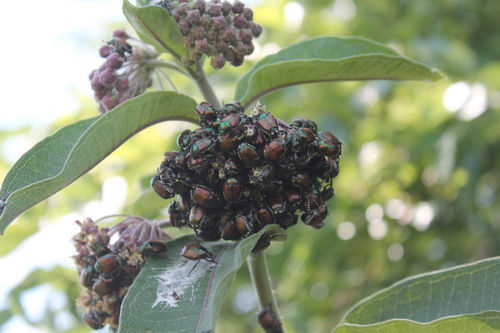
Check rose blossoms, grape leaves and linden trees for groups of feeding beetles. For grub surveys, cut a 30 cm square of turf and lift to inspect the first 5-10 cm of soil for C-shaped white grubs.
✨Fun facts
- Japanese beetle adults are attracted to certain plant odors and to other feeding beetles, which is why they often aggregate in large feeding groups.
- The beetle was first detected in the United States in 1916 and has spread widely; it is considered one of the most destructive turf and ornamental pests in invaded regions.
?Frequently asked questions
Are Japanese beetles harmful to people?
No — they are not poisonous or aggressive. They may nibble if handled but do not pose a medical threat.
Do Japanese beetles bite?
They do not bite humans in a meaningful way. Any 'bite' would be a minor nibble if you handle them.
Why are Japanese beetles in my garden?
Adults feed on many garden plants for food; females lay eggs in nearby turf, so landscapes with lawns and ornamentals attract them.
How do I get rid of Japanese beetles?
Handpick into soapy water, use targeted biological controls for grubs (nematodes, milky spore in suitable regions), maintain healthy turf, and consider chemical options only after reading labels. Avoid using pheromone traps alone because they can draw more beetles into the area.
Do Japanese beetles damage lawns?
Yes. Larval grubs feed on grass roots and can cause brown patches and turf that pulls up easily; damage is most evident in late summer and spring.
📷Photos of the japanese beetle
More beetles
This guide was written with AI assistance and fact-checked, last updated 2026-10-09. Identification from photos is never certain: don't handle insects you can't identify, and get medical advice for bites, stings or allergic reactions.