
European stag beetle
Lucanus cervus · Stag beetles
A large, dramatic beetle whose males have antler-like mandibles; larvae develop for years in decaying wood and adults are most visible in summer evenings.
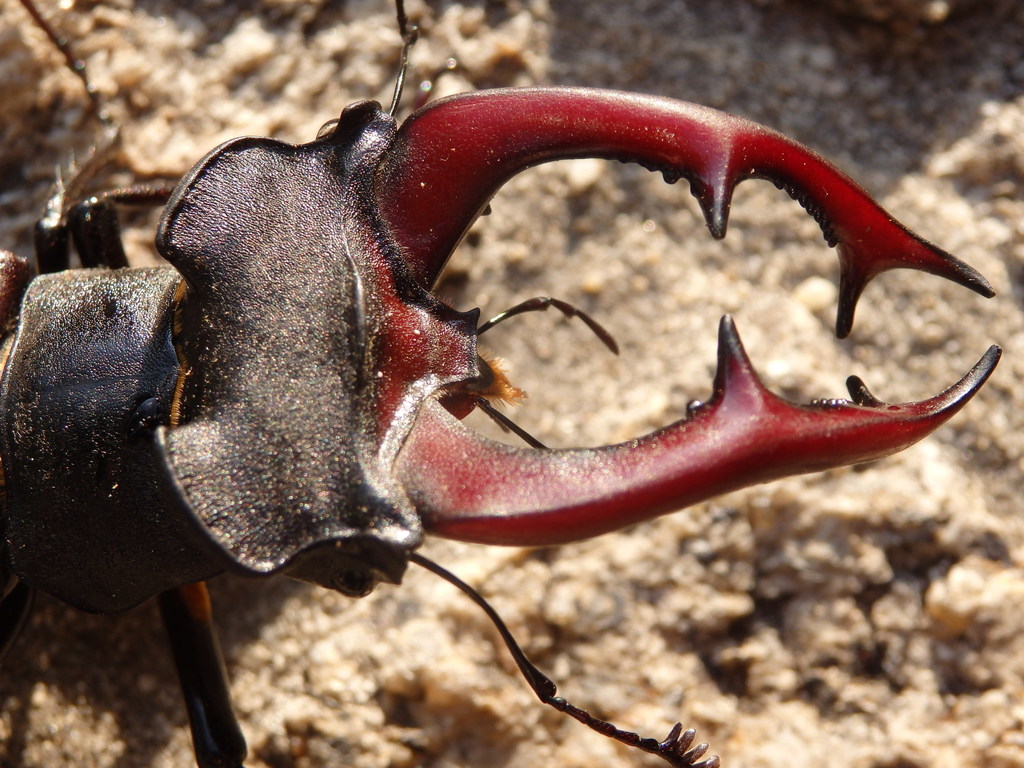
!Is the european stag beetle dangerous?
No. Not venomous. Males and females can give a pinch with their mandibles if handled roughly; the pinch can be painful but is not dangerous. Handle gently or observe without touching. If pinched, wash the area and apply basic first aid for minor skin breaks. Seek medical advice if a wound looks infected.
Pets
Not toxic to pets. Larger dogs or curious animals may be bitten (pinched) if they try to chew the beetle; this is unlikely to cause lasting harm but may distress the pet.
📖Overview
Lucanus cervus is one of Europe's largest beetles, notable for the male's enlarged, antler-like mandibles used in male-to-male contests. Larvae spend several years feeding on decaying hardwood and pupate in the wood; adults are short-lived (weeks to a few months) and are most often seen at dusk in late spring and early summer. The species has declined in parts of its range because of loss of veteran trees and dead wood, and it is protected in several European countries.
🔍How to identify a european stag beetle
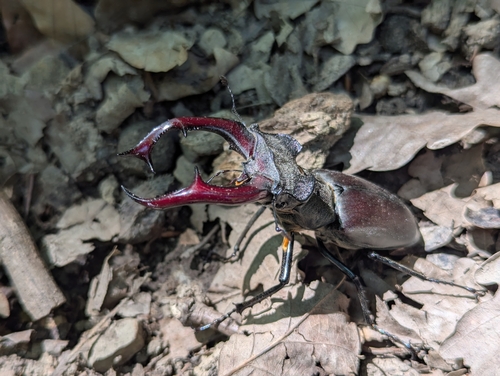
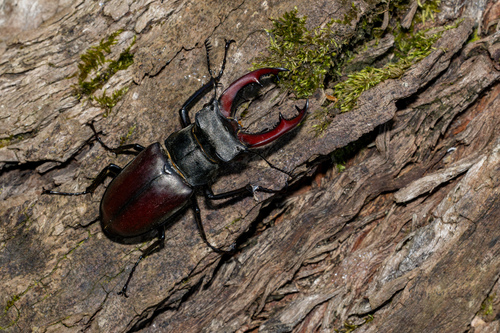
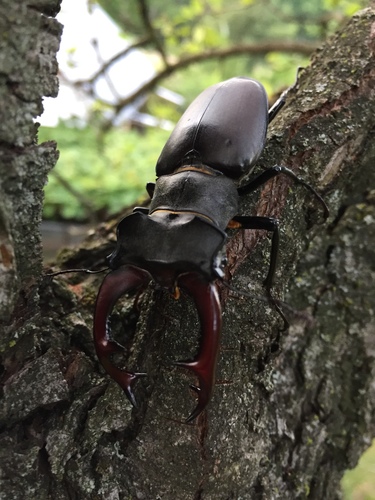
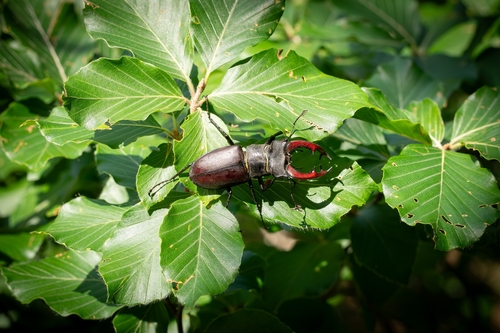
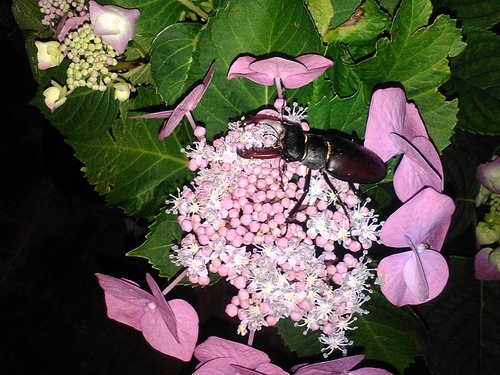
Males are bulky, glossy dark brown to black with very large, flattened mandibles that resemble stag antlers; females are smaller, with shorter, robust jaws. The pronotum (area behind the head) is smooth and wider than the head. Elytra (wing covers) are shiny and may be reddish-brown to dark brown or black. Legs are strong with toothed femora and tibiae suited for digging and gripping wood.
- Large size: males noticeably larger with antler-like mandibles; females smaller with short, strong jaws.
- Shiny, dark brown to black elytra with a smooth pronotum and robust body shape.
- Males display distinctly forked, flattened mandibles with teeth-like projections; females lack the long antlers.
- Found around old broadleaf trees, dead stumps and logs; seeing flying beetles at dusk in summer is characteristic.
Lookalikes
Lesser stag beetle Dorcus parallelipipedus
Smaller, uniformly black and less glossy; males lack the large antler-like mandibles typical of Lucanus cervus males.
Dorcus beetles (general) Dorcus spp.
Dorcus species are usually smaller, more matt black, and have shorter, more symmetrical jaws compared with the long, flattened mandibles of male Lucanus cervus.
↻Life cycle
Egg
Females lay eggs in decaying wood or soil beneath rotting stumps; eggs hatch after a few weeks.
Larva (grub)
White, C-shaped grubs feed inside decaying hardwood for several years (commonly 3-7 years), growing through several instars.
Pupa
Fully grown larvae leave the wood and pupate in the soil nearby inside a cocoon of soil and wood particles, usually in autumn; the adult forms within weeks but stays underground over winter and emerges the following late spring.
Adult (imago)
Adults emerge in late spring to summer to mate and disperse; they are short-lived compared with larval stage.
🍃Diet and predators
Young eat
Decaying hardwood and rotting wood (wood-decay fungi-associated material).
Adults eat
Tree sap, overripe fruit and fluids; adults feed little compared with larvae and primarily focus on reproduction.
Predators of the young
Woodpeckers, other birds, small mammals (mice, shrews), parasitic wasps and predatory beetles that may attack grubs in exposed wood.
Predators of adults
Birds (magpies, crows, jays, owls), foxes, badgers, hedgehogs and cats; many are taken during evening flights or when grounded.
🌱Effect on plants and gardens
Larvae feed on decaying hardwood (especially oak, beech and other broadleaves) and help break down dead wood, returning nutrients to the soil. Adults feed on tree sap and overripe fruit and do not damage living trees.
📍Where and when to find it
Look for flying adults at dusk around old broadleaf trees, garden lights, orchards and parkland; find larvae inside decaying stumps, logs and buried wood.
Best time
Late May to August, particularly warm, still evenings at dusk.
Observation tips
Turn off bright lights to spot natural evening activity, search deadwood safely without destroying larval habitat, and photograph from a low angle at dusk to capture flying or perched beetles.
✨Fun facts
- Male stag beetles use their huge mandibles like antlers to wrestle rivals for mating sites; fights rarely cause serious injury.
- The species has one of the longest larval stages among common European insects, often taking several years to reach adulthood.
- Because they fly at dusk, many people first notice stag beetles when adults are attracted to garden lights or seen cruising in warm evenings.
?Frequently asked questions
Do stag beetles bite?
They can pinch with their jaws if handled, especially females and large males, but they are not venomous and bites are not medically significant; treat as a minor pinch.
Are stag beetles dangerous?
No, they are not dangerous to people or property; their role is beneficial as decomposers of dead wood.
Why is a stag beetle in my garden?
If your garden has old trees, stumps, logs or rotting wood, it provides habitat and food for larvae and attracts adults seeking mating sites and sap/fruit.
How can I help stag beetles?
Leave or create piles of decaying hardwood, retain old stumps where safe, avoid removing dead wood, and provide log piles partly buried in soil to support larvae.
How do I get rid of stag beetles?
Control is generally unnecessary and discouraged; they are protected in many areas. If their presence is unwanted, avoid killing them—remove lights that attract adults and reduce exposed piles of rotting wood if you must.
Are stag beetles protected?
In many European countries Lucanus cervus is legally protected or of conservation concern due to habitat loss; check local regulations before handling or relocating them.
📷Photos of the european stag beetle
More beetles
This guide was written with AI assistance and fact-checked, last updated 2026-10-09. Identification from photos is never certain: don't handle insects you can't identify, and get medical advice for bites, stings or allergic reactions.