
Common eastern firefly
Photinus pyralis · Fireflies
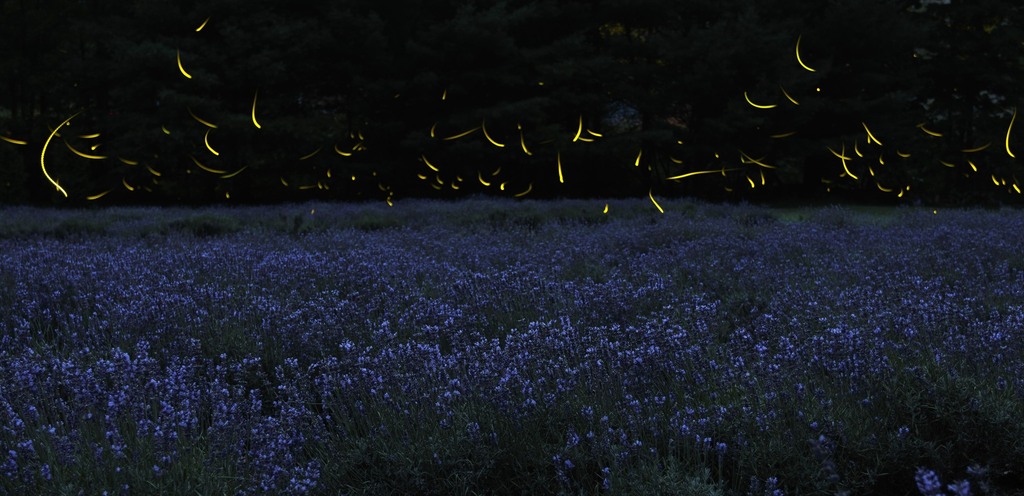
A widespread North American firefly whose males produce a rising J-shaped flash to find mates; harmless to people.
!Is the common eastern firefly dangerous?
No. Adults do not bite, sting, or transmit disease. They are harmless to handle briefly, though crushing them is discouraged because it destroys their light organs.
Pets
Fireflies contain defensive chemicals (lucibufagins) that make them distasteful. A dog or cat that eats one may drool or have mild stomach upset. Fireflies are highly toxic to pet lizards such as bearded dragons and should never be fed to reptiles; contact a veterinarian if a reptile eats one.
📖Overview
Photinus pyralis is one of the best-known firefly species across eastern North America. Adults are active on warm evenings in late spring and summer; males fly and produce a distinctive brief flash pattern while females respond from low vegetation. Larvae live on the ground and are predatory, feeding on small invertebrates. Adults do not bite people and are not dangerous.
🔍How to identify a common eastern firefly
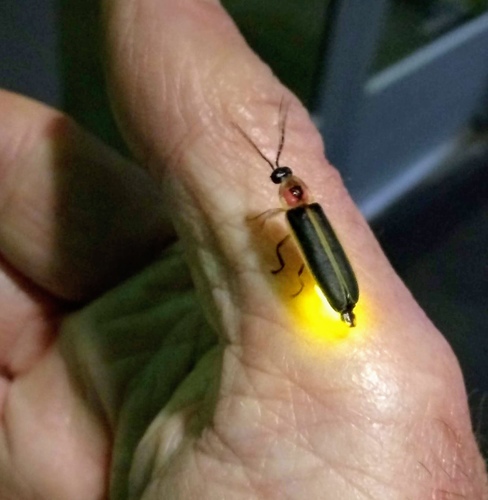
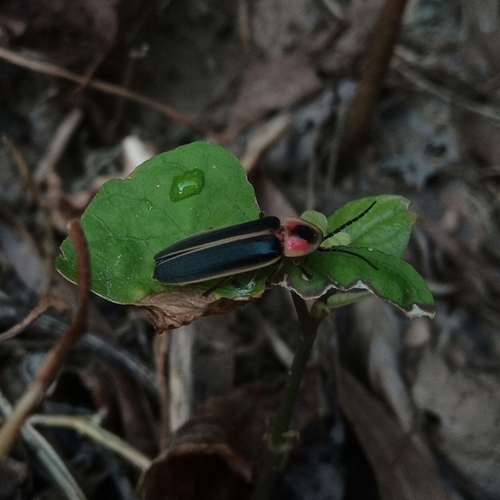
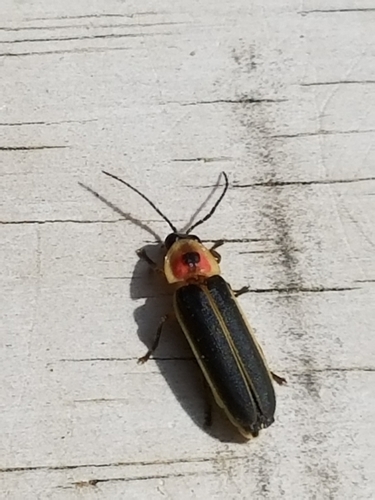
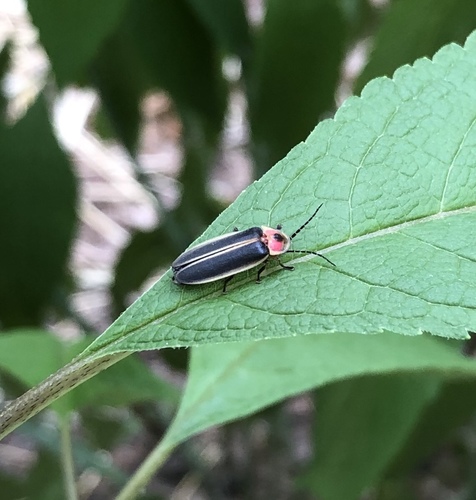
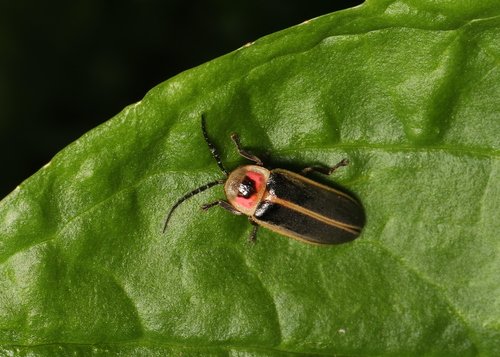
Adults are soft-bodied beetles 8-15 mm long with a rounded, somewhat flattened shape. The head is partially hidden by the pronotum (shield behind the head) which is often reddish or yellowish with a darker central mark. Elytra (wing covers) are brown to black with a matte or slightly glossy finish; the underside of the abdomen has the light-producing segments that glow yellow-green when lit. Males are typically slimmer and more active in flight; females are fully winged but fly less, usually perching low in vegetation.
- Watch for the male flash pattern: a single, quick flash followed by a pause, often in a J-shaped aerial display.
- Size 8-15 mm with a reddish or yellowish pronotum and dark brown to black elytra.
- Glowing yellow-green light from the underside of the abdomen at night; males flash while flying, females respond from vegetation.
Lookalikes
Other Photinus fireflies Photinus spp.
Closely related Photinus species differ mainly in flash timing and pattern; careful observation of flash sequence distinguishes them.
Synchronous firefly Photinus carolinus
Found mainly in the southern Appalachians; males flash in synchronized bursts of several quick flashes, while P. pyralis males flash individually with a single J-shaped flash.
↻Life cycle
Egg
Females lay small clusters of eggs in moist soil or leaf litter; eggs hatch in about 1-3 weeks depending on temperature.
Larva (glowworm)
Larvae are elongate, flattened, and usually dark; they live in soil or leaf litter and actively hunt snails, slugs, earthworms and other small invertebrates for one to two years.
Pupa
Larvae pupate in the soil or protected debris for 1-3 weeks before emerging as adults.
Adult (flying beetle)
Adults emerge in late spring or summer; they fly at dusk, produce species-specific light signals to find mates, mate and then females lay eggs.
🍃Diet and predators
Young eat
Carnivorous: snails, slugs, earthworms and other small soil invertebrates.
Adults eat
Adults of Photinus pyralis feed little; some may drink nectar or not feed at all while focusing on reproduction.
Predators of the young
Ground predators such as ants, spiders, ground beetles, and small vertebrates.
Predators of adults
Birds, bats and predatory insects. Some predatory firefly species (Photuris) mimic Photinus flashes and eat Photinus adults.
🌱Effect on plants and gardens
Adults feed little or not at all and do not damage plants. Larvae are predators of small soil invertebrates and do not harm vegetation.
📍Where and when to find it
Adults at dusk and early night in low vegetation, grass edges, and woodland margins; larvae in moist soil, under logs and leaf litter.
Best time
Late spring through summer evenings, just after dusk on warm, humid nights.
Observation tips
Watch from a dark spot with minimal artificial light, be patient and still; photograph at dusk with a tripod and long exposure to capture light trails.
✨Fun facts
- Firefly light is 'cold light': the chemical reaction that produces it gives off very little heat.
- Flash patterns are species-specific and used for mate recognition; females choose males based on timing.
- Larvae are often called glowworms and glow as well, which may help deter predators.
?Frequently asked questions
Do fireflies bite?
No — adults of Photinus pyralis do not bite people. Larvae are predators of small invertebrates and are not harmful to humans.
Are fireflies endangered?
Photinus pyralis is still common and widespread, but firefly populations overall are declining in some areas due to habitat loss, pesticide use and light pollution.
Why are there fireflies in my yard?
Your yard likely has the moist soil, leaf litter and low vegetation that firefly larvae and females prefer for shelter and egg-laying.
How can I attract fireflies to my yard?
Provide a natural area with native plants, leave leaf litter or a log pile, reduce lawn mowing and avoid pesticides. Reduce outdoor lighting at night.
Why do fireflies flash?
They flash to communicate for mating: males flash in flight and females respond with a species-specific pattern to indicate receptivity.
📷Photos of the common eastern firefly
More beetles
This guide was written with AI assistance and fact-checked, last updated 2026-10-09. Identification from photos is never certain: don't handle insects you can't identify, and get medical advice for bites, stings or allergic reactions.