
Green rose chafer
Cetonia aurata · Flower chafers
A metallic green, flower-visiting scarab beetle common across Europe; adults feed on flowers and fruit while larvae develop in decaying wood or compost.
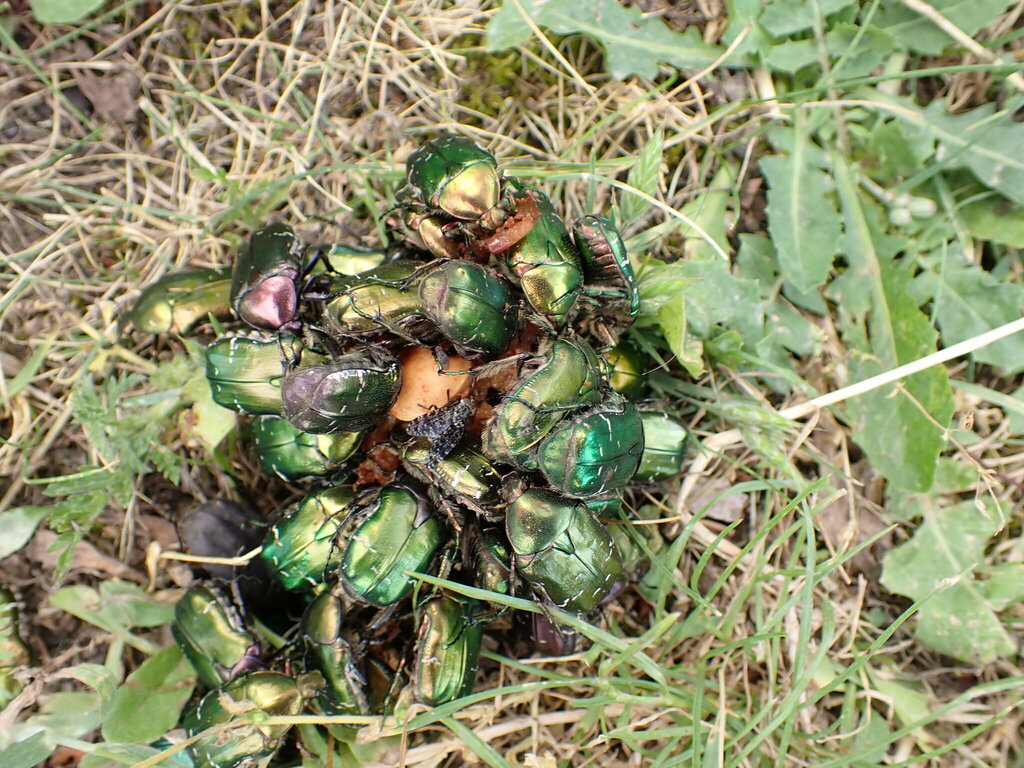
!Is the green rose chafer dangerous?
No. Not venomous and not dangerous. Adults do not bite people; they may emit a mild defensive odour if handled. No medical treatment is normally required if touched.
Pets
Harmless to pets. Dogs or cats eating many beetles could cause mild stomach upset, but the species is not toxic.
📖Overview
Cetonia aurata is a medium-sized scarab beetle (family Scarabaeidae) in the flower chafer subfamily Cetoniinae. Adults are most often seen on flowers in gardens, parks and woodland clearings where they feed on pollen, nectar and soft fruit. Larvae are white C-shaped grubs that live in decaying wood, compost and rich humus and typically take one to several years to develop. The species is widespread across much of Europe and nearby regions and is familiar to gardeners because of its bright, metallic appearance and habit of visiting roses and other blossoms.
🔍How to identify a green rose chafer
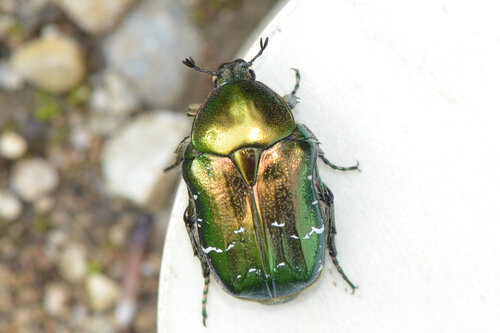
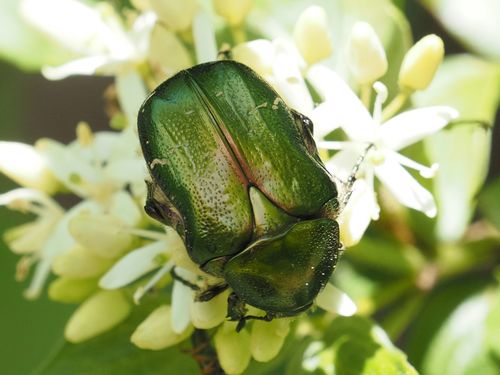
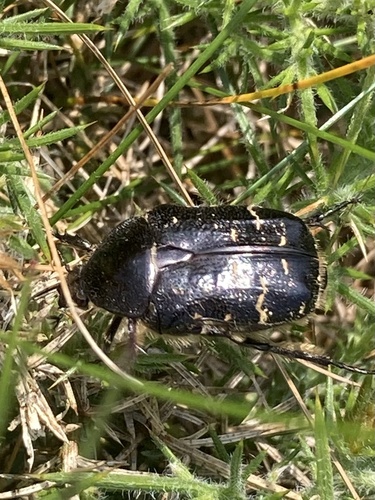
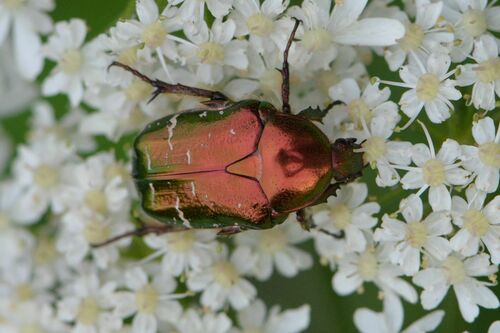
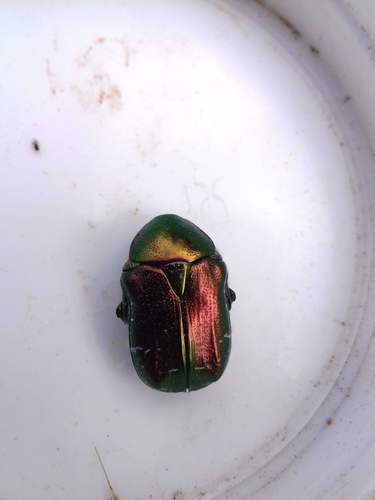
Adult beetles are broadly oval and flattened with a smooth, glossy, metallic upper surface. The elytra (wing cases) are fused visually into a continuous shiny surface sometimes showing faint lines or patches; the beetle flies with the elytra kept closed, unfolding its flight wings through notches at the sides of the elytra. Size varies but adults are generally large for a flower chafer and often show a green to golden sheen; some individuals show brownish or black markings. Larvae are typical scarab grubs: cream-coloured C-shaped bodies with a brown head capsule and well-developed legs on the thorax.
- Distinctive metallic green to golden glossy top surface; sheen varies with angle of light.
- Broad, flattened oval shape with smooth elytra that stay closed in flight, the wings emerging from the sides.
- Large size for a flower beetle (typically 14-20 mm) and frequent presence on flowers, especially roses.
Lookalikes
Hairy rose beetle Tropinota hirta
Smaller, usually brownish or hairy and lacks the continuous metallic green sheen of Cetonia aurata.
Protaetia species (flower chafers) Protaetia spp.
Some Protaetia are similar but often show distinct spots or different colour patterns; examine elytral markings and size to separate them.
↻Life cycle
Egg
Laid in decaying wood, compost or rich humus. Eggs hatch in a few weeks depending on temperature and moisture.
Larva (grub)
Cream-coloured, C-shaped scarab grubs feed on decomposing wood and organic matter for one to several years while growing through several instars.
Pupa
Larvae pupate in soil or rotting wood; the pupal stage lasts weeks to a few months before the adult emerges.
Adult (beetle)
Adults are active in late spring and summer, feed on flowers and fruit, mate and females lay eggs in suitable decaying organic matter.
🍃Diet and predators
Young eat
Decaying wood, compost, rich leaf litter and humus.
Adults eat
Pollen, nectar, flower petals and soft, overripe fruit.
Predators of the young
Woodland predators such as ground beetles, small mammals (shrews), and parasitic wasps or flies that attack larvae.
Predators of adults
Birds, bats and insectivorous mammals; may also be eaten by wasps or predatory insects.
🌱Effect on plants and gardens
Adults feed on pollen, nectar and soft fruit; they can cause cosmetic damage to roses and ripe fruit by nibbling petals or soft flesh but rarely cause serious harm to plants or crops.
📍Where and when to find it
Adults on open flowers (roses, blackthorn, thistles, etc.) in gardens, parks and woodland edges; larvae in decaying wood, compost heaps and rich soil.
Best time
May to August on warm, sunny days; daytime is best for seeing active adults.
Observation tips
Photograph them on flowers from above to capture the metallic sheen. Approach slowly to avoid startling them; they fly rapidly when disturbed.
✨Fun facts
- Despite the name, green rose chafers are attractive pollinators and are often seen feeding openly on flowers in daylight.
- They take off quickly without opening their wing cases: the hind wings unfold through notches at the sides of the closed elytra, giving them a fast, buzzing flight.
- Larvae help recycle wood and compost by breaking down decaying material over their multi-year development.
?Frequently asked questions
Are green rose chafers dangerous?
No. They are not venomous and do not pose a health risk to people.
Do green rose chafers bite?
They do not bite people. If handled roughly they may try to escape but will not actively bite.
Why is it on my roses?
Adults feed on pollen and petals and are attracted to roses and other open flowers for food; they are simply visiting to feed.
Are they bad for my garden?
Usually no. They are pollinators and cause only minor cosmetic damage to petals or soft fruit; larvae help decompose organic matter.
How can I get rid of them if they damage flowers or fruit?
Usually no action is needed. Gently pick adults off flowers and release them elsewhere, or use fine netting over vulnerable plants. Leave grubs found in compost or rotting wood alone: they help break it down, and the species is legally protected in some countries (for example Germany).
📷Photos of the green rose chafer
More beetles
This guide was written with AI assistance and fact-checked, last updated 2026-10-10. Identification from photos is never certain: don't handle insects you can't identify, and get medical advice for bites, stings or allergic reactions. More about the green rose chafer: iNaturalist, Wikipedia.