
Spotted cucumber beetle
Diabrotica undecimpunctata · Leaf beetles
A small, yellow-green leaf beetle with black spots that is a common garden pest of cucurbits and other crops.

!Is the spotted cucumber beetle dangerous?
No. Not dangerous to people. Adults do not have a venomous bite or sting; they may occasionally nip if handled but this is harmless. No significant human health risk.
Pets
Not toxic to pets. Heavy infestations could contaminate edible produce but do not pose a direct poisoning risk to dogs or cats.
📖Overview
Diabrotica undecimpunctata is a compact, day-active leaf beetle often found on cucurbit crops (cucumbers, squash, melon) and a wide range of other plants. Adults feed on leaves, flowers and fruit surfaces; larvae feed belowground on roots and seedlings. The species is an agricultural pest in North America and can transmit bacterial wilt to cucurbits.
There are several regional forms and subspecies with slightly different habits; adults are most noticeable in late spring through summer. Damage ranges from cosmetic feeding to severe seedling loss and disease transmission in susceptible crops. Natural enemies include predators, parasitic wasps and entomopathogenic nematodes that attack immature stages, but populations can build up in agricultural settings.
🔍How to identify a spotted cucumber beetle
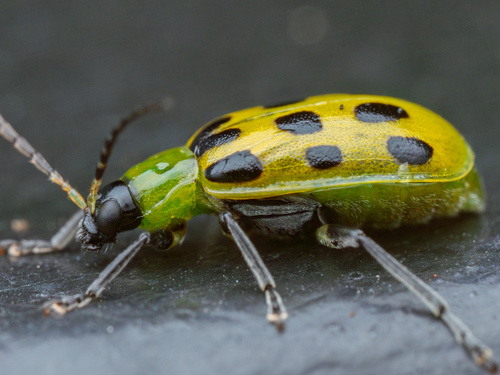
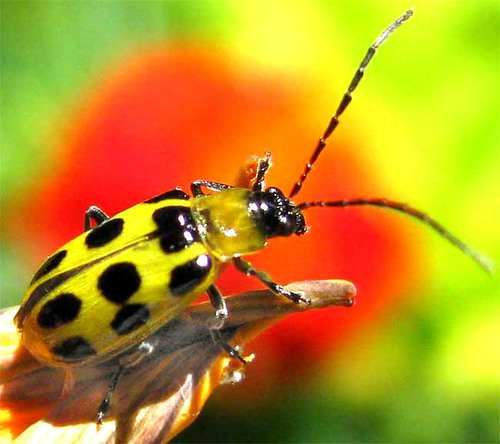
Adults are small (a few millimetres long), oval and slightly domed. The basic background color is yellow to yellow-green with 11-12 distinct round to oval black spots on the elytra (wing covers); spots and background tone vary among populations. The head, antennae and legs are dark. Larvae are slender, whitish, worm-like grubs with three pairs of tiny legs and a brownish head; they live and feed on roots in soil.
- Yellow to yellow-green oval beetle 4-7 mm long with 11-12 distinct black spots on the elytra.
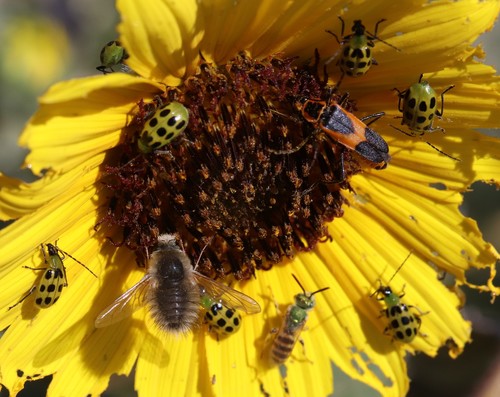
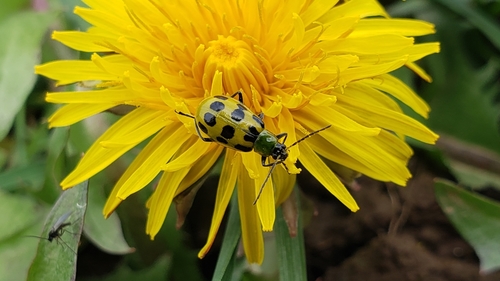
- Diurnal and commonly found on flowers and foliage of cucurbits and other host plants.
- Larvae are small, slender, whitish worm-like grubs found in soil feeding on roots near affected plants.
Lookalikes
Striped cucumber beetle Acalymma vittatum
Striped cucumber beetle has yellow elytra with three black longitudinal stripes rather than round spots.
Western corn rootworm Diabrotica virgifera virgifera
Western corn rootworm adults have black stripes (often broken or merged) on yellowish wing covers rather than separate round spots, and are strongly associated with corn.
↻Life cycle
Egg
Females lay clusters of small, oval eggs in soil near host plants; incubation lasts about 1-2 weeks depending on temperature.
Larva (grub)
Slender, whitish, worm-like larvae (rootworms) feed on roots and underground parts of host plants for several weeks; severe feeding can kill seedlings.
Pupa
Larvae pupate in the soil; pupal stage lasts several days to a few weeks as they transform into adults.
Adult (beetle)
Adults emerge, feed on aboveground plant parts, mate and lay eggs; there may be one or multiple generations per year depending on climate.
🍃Diet and predators
Young eat
Roots and underground parts of a range of host plants, including cucurbit seedlings and other crop roots.
Adults eat
Leaves, flowers and fruits of cucurbits and many other plants (beans, corn, ornamentals, weeds).
Predators of the young
Soil predators and parasitoids, including predatory beetles, ground beetles, entomopathogenic nematodes and some parasitoid wasps.
Predators of adults
Birds, predatory insects (such as assassin bugs and some beetles) and spiders; parasitic flies and wasps can attack adults occasionally.
🌱Effect on plants and gardens
Adults feed on foliage, flowers and fruit of cucurbits and many other plants (beans, corn, ornamentals). Larvae feed on roots and can damage seedlings; adults can transmit bacterial wilt (Erwinia tracheiphila) between cucurbit plants.
How to get rid of spotted cucumber beetles
Use an integrated approach: exclude with floating row covers while plants are blooming, hand-pick adults off plants in small gardens, remove weeds and alternate host plants, use trap crops to concentrate beetles, and plant resistant varieties if available. For severe infestations, targeted insecticide applications (follow label directions) or biological controls (predators, parasitic wasps, entomopathogenic nematodes against larvae) may be effective. Crop rotation and soil cultivation can reduce larval survival.
📍Where and when to find it
Adults on leaves, flowers and young fruit of cucurbits and other host plants; larvae in soil feeding on roots near seedlings.
Best time
Late spring through summer during daylight hours; best to look on warm sunny days when adults are feeding on flowers.
Observation tips
Photograph adults on the tops of leaves or flowers for clear markings. Check soil around damaged seedlings for slender whitish larvae.
✨Fun facts
- Despite the name, spotted cucumber beetles feed on many plant families, not only cucumbers.
- Adult feeding on flowers can reduce pollination or scar fruit, while larvae damage roots belowground.
- They can spread bacterial wilt between cucurbit plants, making small beetle populations more damaging than feeding alone.
?Frequently asked questions
Do spotted cucumber beetles bite?
They do not bite people in any significant way. Adults might nibble if handled but are not harmful.
Do spotted cucumber beetles transmit disease to plants?
Yes. They can transmit bacterial wilt (Erwinia tracheiphila) to cucurbits, which can kill vines and ruin crops.
Why are spotted cucumber beetles in my house or garden?
They are attracted to cucurbit crops, flowers and weedy hosts. Gardens near fields or weedy areas provide food and breeding sites.
How do I get rid of spotted cucumber beetles?
Use exclusion (floating row covers), hand-picking, trap crops, crop rotation and removal of weeds. For heavy infestations, follow label directions for approved insecticides or use biological controls like entomopathogenic nematodes for larvae.
Where do spotted cucumber beetles live?
They live where host plants are available: gardens, farms, field edges and weedy areas across much of North America. Larvae develop in soil feeding on roots.
📷Photos of the spotted cucumber beetle
More beetles
This guide was written with AI assistance and fact-checked, last updated 2026-10-10. Identification from photos is never certain: don't handle insects you can't identify, and get medical advice for bites, stings or allergic reactions. More about the spotted cucumber beetle: iNaturalist, Wikipedia.