
Green June beetle
Cotinis nitida · Fruit and flower chafers
A large metallic green scarab common in eastern North America that feeds on ripe fruit, sap and flowers; larvae develop in rich soil or compost.
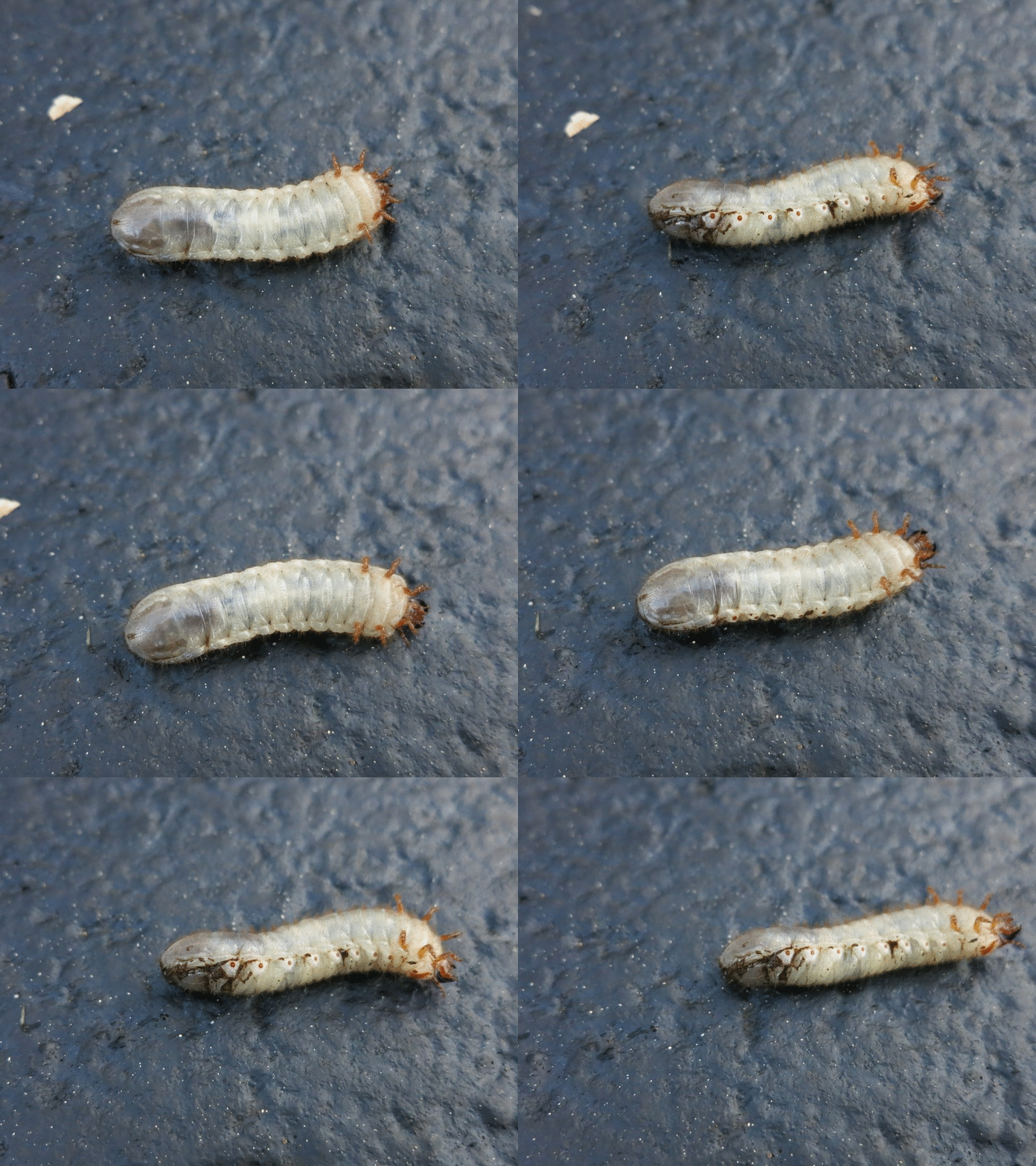
!Is the green june beetle dangerous?
No. Cotinis nitida is not venomous and does not pose a medical threat. Adults can cling or pinch slightly if handled but do not bite or sting in a medically significant way. Wash hands after handling to avoid minor irritation from soil or fruit residues.
Pets
Generally harmless to pets. Adults feeding on fruit could attract pets to eat the fruit rather than the beetles; ingestion of a few beetles is unlikely to cause harm but monitor for stomach upset.
📖Overview
Cotinis nitida is a conspicuous, metallic green scarab beetle of the subfamily Cetoniinae. Adults are active in summer and are commonly seen feeding on ripe or damaged fruit, tree sap and overripe flowers. Females lay eggs in rich, decaying organic soil or compost, where white C-shaped grubs grow and feed on decomposing organic matter (and sometimes turf roots in heavy infestations). The species is widespread in the eastern United States and can be locally abundant around orchards, compost piles and lawns.
🔍How to identify a green june beetle
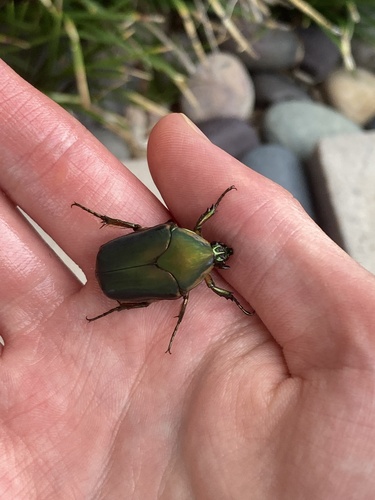
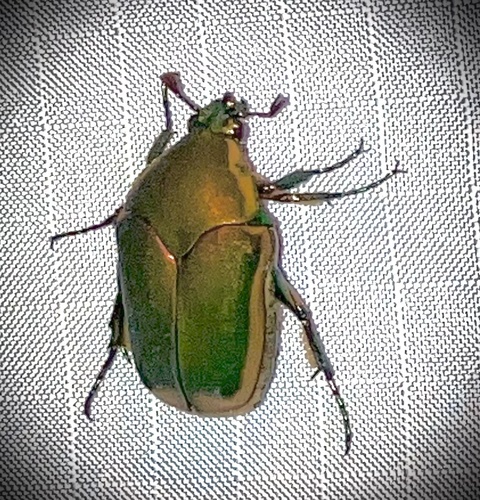
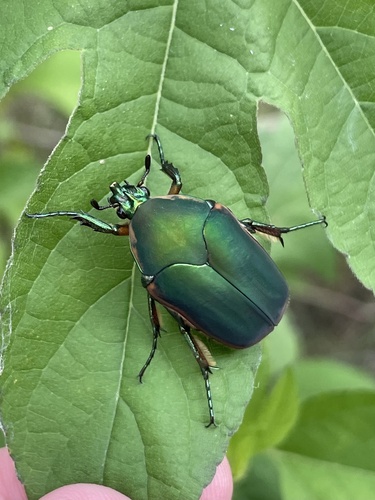
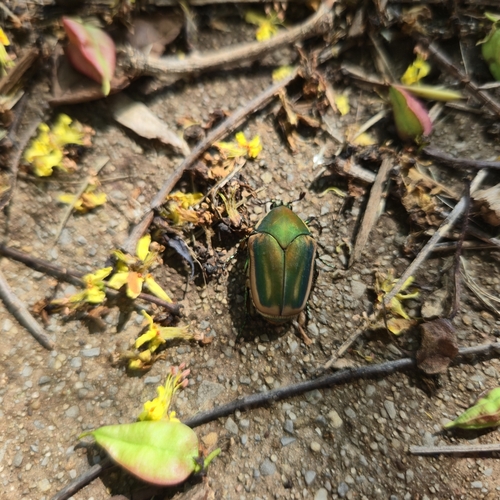
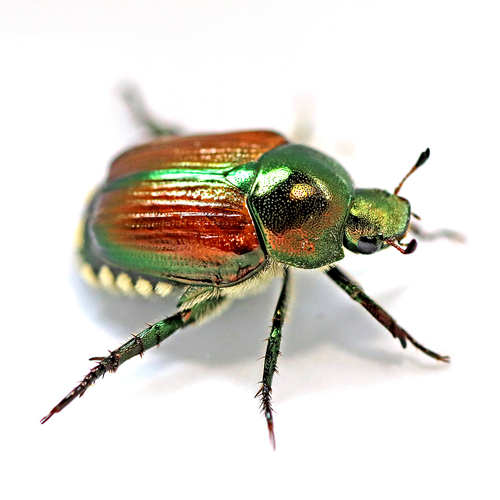
Adults are broadly oval, convex and relatively large for a scarab. The upper surface is a velvety, dull to slightly metallic green with tan to orange-yellow margins on the elytra. The head, legs and underside are a bright, shiny metallic green to gold. Legs are stout with spines for digging. Larvae are C-shaped white grubs with brown heads, typical of scarab beetles.
- Large, broad beetle 15-22 mm long with a velvety green upper surface and shiny metallic green underside
- Tan to orange-yellow margins along the elytra
- Stout legs with digging spines and a convex, oval body shape
- Usually active in daytime and dusk feeding on fruit or sap
Lookalikes
Figeater beetle Cotinis mutabilis
Cotinis mutabilis (southwestern species) has a greener, more uniform sheen and differs in geographical range (southwest US and Mexico); C. nitida has more yellowish margins and bronze shading and occurs in the eastern US.
June beetles (common scarabs) Phyllophaga spp.
Phyllophaga are generally smaller, brownish and not metallic green; their grubs and habits differ.
↻Life cycle
Egg
Females deposit eggs in rich, moist soil, compost or mulch. Eggs hatch in days to weeks depending on temperature.
Larva (white grub)
C-shaped white grubs feed on decaying organic material in soil and may feed on turf roots in heavy infestations; they grow through several instars.
Pupa
When mature the grub forms a pupal cell in soil and pupates, transforming into the adult beetle.
Adult (beetle)
Adults emerge in summer, feed on fruit, sap and flowers, mate and females return to soil to lay eggs. Adults are strong but clumsy fliers that buzz low over lawns on sunny days.
🍃Diet and predators
Young eat
Decaying organic matter in soil; occasionally turf roots if abundant
Adults eat
Ripe or damaged fruit, tree sap, overripe flowers and sometimes fermented fruit juices
Predators of the young
Soil predators and parasitoids (beetle predators, birds that dig, small mammals)
Predators of adults
Birds, small mammals, predatory insects and parasitic flies; humans may handpick them from fruit
🌱Effect on plants and gardens
Adults feed on ripe or damaged fruit, tree sap and flowers and can cause cosmetic damage to fruit; larvae consume decaying organic matter and in high numbers may chew on turf roots, causing brown patches in lawns.
How to get rid of green june beetles
Pick up fallen ripe fruit, harvest promptly, and net vulnerable fruit. Handpick adults from fruit into a bucket of soapy water. Manage compost and heavy organic mulch near lawns; for severe grub damage in turf, use approved grub controls following label instructions. Traps can catch adults but may attract more beetles to the area.
📍Where and when to find it
Adults on ripe or damaged fruit, tree sap flows and flowers; larvae in compost, mulch and rich garden soil.
Best time
Mid to late summer (June and July) during the day and at dusk.
Observation tips
Check fruit trees and compost piles on warm evenings; photograph adults on fruit or sap. Use a shallow container of soapy water to collect specimens safely for removal.
✨Fun facts
- Adults are most abundant in June and July in much of their range, which gives the species its name.
- The grubs crawl on their backs, using stiff hairs to move, rather than walking on their short legs.
- Larvae help break down compost and rich organic soil, contributing to nutrient cycling.
?Frequently asked questions
Are Green June beetles dangerous?
No. They are not venomous and do not pose a medical threat. They may pinch slightly if handled but are otherwise harmless.
Do Green June beetles bite?
They do not bite in a way that is harmful to people. Adults can grasp or pinch the skin with their legs but do not have biting mouthparts that pose danger.
Why are Green June beetles in my house or yard?
Adults are attracted to ripe or damaged fruit, tree sap and lights. Larvae are found in rich, moist soil, compost and mulch; yards with compost piles or heavy organic matter commonly host them.
How can I get rid of Green June beetles?
Remove attractants: pick up fallen ripe fruit, cover or manage compost, and net vulnerable fruit. Handpick adults from fruit into a bucket of soapy water. Treat grub problems by reducing overly rich soil, improving drainage, or in severe cases using approved grub controls (follow label instructions). Traps can catch adults but may attract more beetles and increase damage.
Do the larvae damage lawns?
Larvae mainly feed on decaying organic matter, but in high densities they can chew turf roots and cause brown patches. Proper lawn care and reducing excessive organic matter can limit problems.
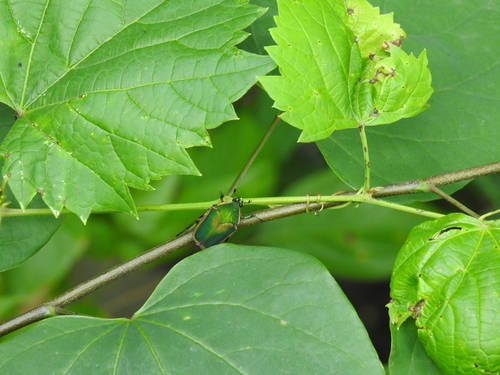
📷Photos of the green june beetle
More beetles
This guide was written with AI assistance and fact-checked, last updated 2026-10-09. Identification from photos is never certain: don't handle insects you can't identify, and get medical advice for bites, stings or allergic reactions.