
Oriental beetle
Anomala orientalis · Shining leaf chafers
A small scarab beetle whose white grub larvae feed on turf roots and ornamentals; native to Asia and an established turf pest in parts of North America.
!Is the Oriental beetle dangerous?
No. Oriental beetles do not bite or sting and are not dangerous to humans. Adults may occasionally nibble on flowers or soft plant tissue but do not pose a health risk. If grubs are handled, wash hands as with any soil-dwelling insect.
Pets
Grubs can be eaten by pets and may cause mild stomach upset if ingested in large numbers; adults are unlikely to harm pets. If a pet consumes many grubs, consult a veterinarian.
📖Overview
The Oriental beetle is a member of the scarab family (subfamily Rutelinae). Adults are active in summer and are often seen on flowers, foliage and around lights at night. Females lay eggs in turf or loose soil; the developing white grub larvae feed on grass roots and can cause brown patches in lawns. Originating in Asia, this species was introduced to North America in the early 20th century and is now established in parts of the eastern United States and Canada. Adults live for a few weeks to a couple of months during the breeding season.
🔍How to identify an Oriental beetle
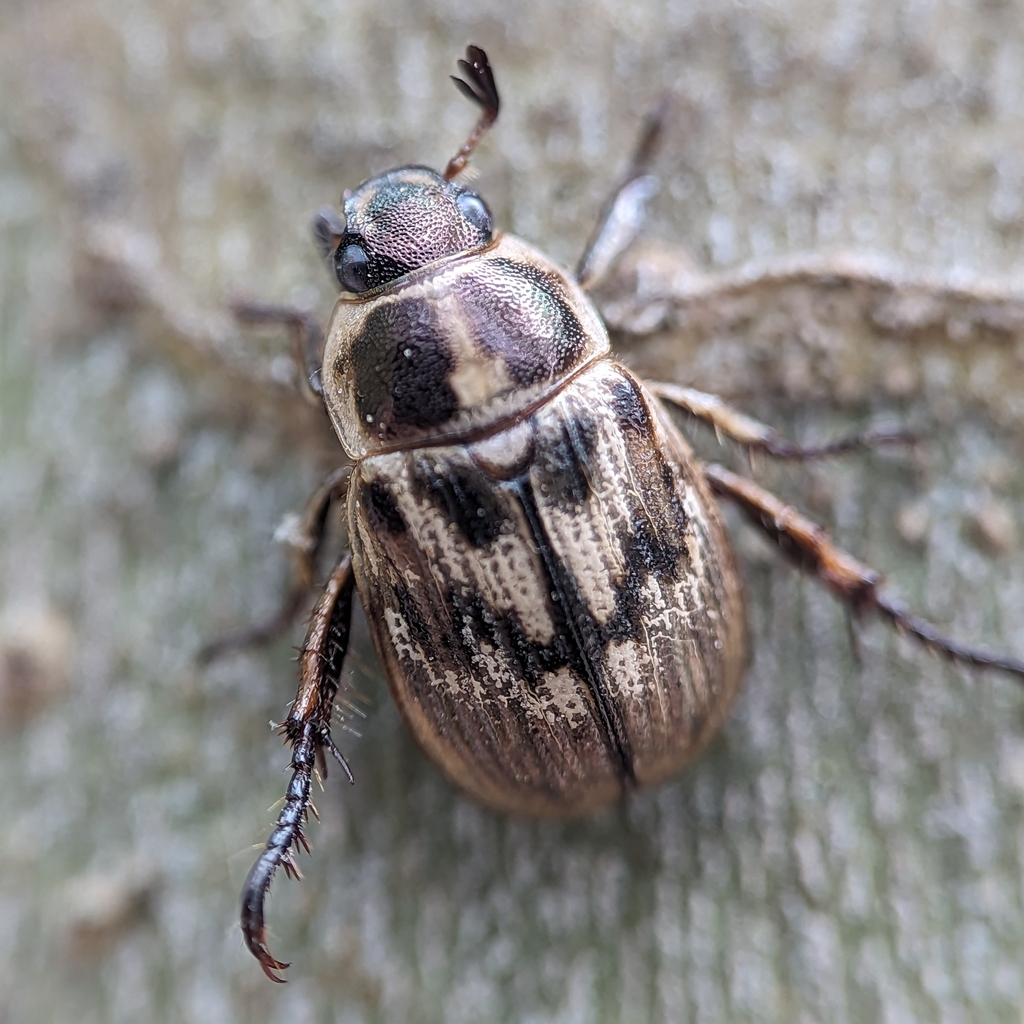
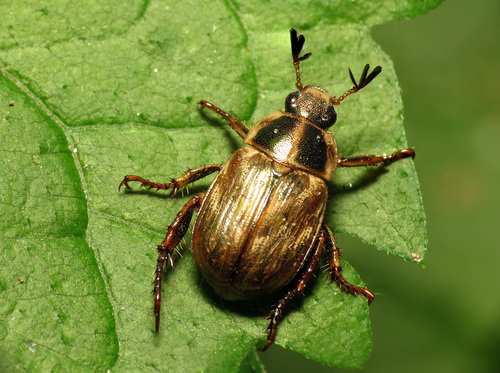
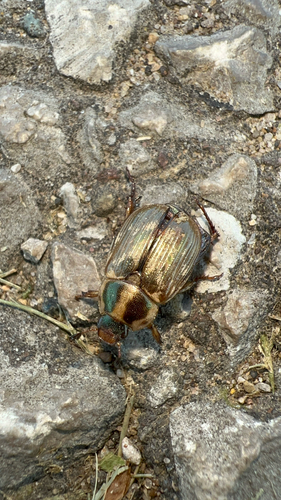
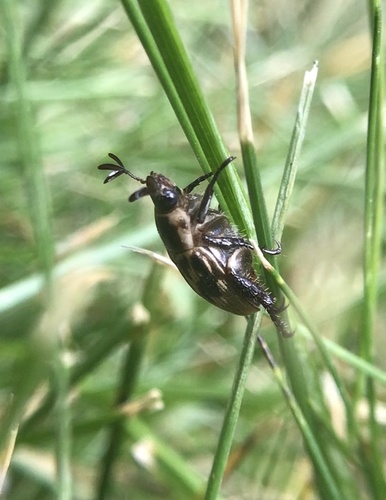
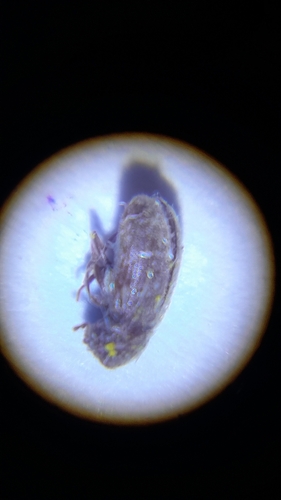
Adults are small, rounded scarab beetles about 8-11 mm long with a somewhat oval, convex body. Color is variable but typically a mottled mix of brown, tan and black on the elytra, giving a checkered or speckled appearance; the head and pronotum are usually darker. The underside is lighter and legs are typical scarab-shaped for digging. Larvae are C-shaped white grubs with a brown head, 1-3 cm long at maturity, with three pairs of thoracic legs.
- Small, rounded scarab beetle 8-11 mm long with mottled brown/tan/black elytra (checkered appearance).
- C-shaped white grubs with brown head in soil, 1-3 cm when mature, found feeding on grass roots.
- Adults active in summer and often attracted to porch lights or seen on flowers at dusk.
Lookalikes
Japanese beetle Popillia japonica
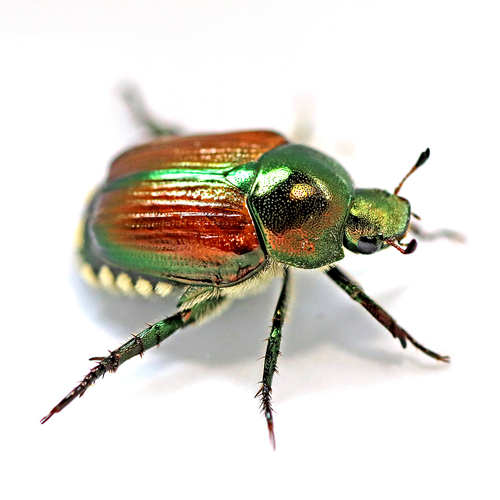
Japanese beetle is more metallic green and copper with distinct tufts of white hairs along the abdomen; oriental beetle is smaller and mottled brown/tan rather than metallic.
European chafer Amphimallon majale
European chafer is similar as a turf grub but adults are a uniform tan or light brown without the checkered elytral pattern of Oriental beetle.
↻Life cycle
Egg
Females lay eggs in soil or turf in summer. Eggs hatch in 1-3 weeks depending on temperature.
Larva (white grub)
Larvae are C-shaped white grubs that feed on grass roots throughout late summer and fall, then overwinter in the soil and resume feeding in spring.
Pupa
In late spring to early summer, mature larvae pupate in the soil and transform into adults.
Adult beetle
Adults emerge in summer, feed on flowers and foliage, mate and the cycle repeats; adults live for several weeks.
🍃Diet and predators
Young eat
White grub larvae feed on grass roots and roots of some ornamental plants.
Adults eat
Adults feed on flowers, foliage and sometimes overripe fruit or sap; they are attracted to lights at night.
Predators of the young
Birds, skunks, raccoons and predatory nematodes and soil pathogens.
Predators of adults
Birds, bats, predatory insects and spiders.
🌱Effect on plants and gardens
Larvae feed on grass roots and roots of some ornamentals, causing thinning and brown patches in lawns. Adults may feed on flowers and foliage but cause less damage than larvae.
How to get rid of Oriental beetles
Monitor lawns for grub damage in late summer and fall. Cultural controls: maintain healthy turf with proper irrigation, mowing and fertilization; reduce thatch to limit egg-laying sites. Biological control: apply entomopathogenic nematodes (for example Heterorhabditis bacteriophora) in late summer when grubs are small; these can reduce grub populations. Chemical control: if thresholds are exceeded, registered soil-applied insecticides timed for late summer or early fall when larvae are young are effective—follow label instructions and local regulations. Pheromone or light traps attract adults but may concentrate beetles locally and are not recommended as the sole control method.
📍Where and when to find it
Adults: on flowers, foliage and near porch lights in summer evenings. Larvae: dig 5-10 cm into turf in affected brown patches to find C-shaped white grubs.
Best time
Best to observe adults in June-August at dusk and at night when they are attracted to lights; check for grubs in late summer and early fall.
Observation tips
To confirm grub damage, gently peel back a square of turf; healthy roots resist lifting while grub-damaged turf comes up easily. Photograph adults on flowers or near lights with a macro or close-up setting; keep specimens in a small ventilated container if you need to show an expert.
✨Fun facts
- Oriental beetles were accidentally introduced to North America and became a turf pest separate from better-known Japanese beetles.
- Adult males are attracted to female sex pheromones; research on pheromones has produced traps used for monitoring.
- Damage to lawns is usually done by the larval stage underground, not by the visible adults on flowers.
?Frequently asked questions
Are oriental beetles dangerous to people?
No. They do not bite or sting and are not poisonous. The main concern is lawn and turf damage from their grubs.
Do oriental beetles bite or sting?
No — adults do not bite or sting. They may nibble plant material but are harmless to humans.
Why are there oriental beetles in my house or on my porch light?
Adults are attracted to artificial lights at night and may be found on porches, windows and outdoor lights. They do not infest houses but may wander indoors occasionally.
How do I get rid of oriental beetles in my lawn?
For grub problems: monitor in late summer, use cultural practices to keep turf healthy, consider entomopathogenic nematodes applied when grubs are small, or use a registered insecticide timed for late summer/early fall if damage is severe. Follow product labels and local guidance. Traps may be useful for monitoring but can increase local numbers if used improperly.
Where do oriental beetles live?
They are native to East Asia and now live in parts of eastern North America; adults live on flowers and foliage in gardens, lawns and field edges, while larvae develop in soil feeding on grass roots.
📷Photos of the Oriental beetle
More beetles
This guide was written with AI assistance and fact-checked, last updated 2026-10-10. Identification from photos is never certain: don't handle insects you can't identify, and get medical advice for bites, stings or allergic reactions. More about the Oriental beetle: iNaturalist, Wikipedia.