
Whitespotted sawyer
Monochamus scutellatus · Longhorn beetles
A boreal longhorn beetle whose larvae bore in dead or dying conifers; adults have long antennae and a distinctive pale scutellar spot.

!Is the whitespotted sawyer dangerous?
No. Not dangerous or venomous. Adults have strong jaws and can give a painful nip if handled or if they land on bare skin, but the bite is harmless apart from brief pain and occasionally a small wound; wash it with soap and water.
Pets
Harmless to pets. A pet that grabs an adult beetle might get a brief nip, but there is no venom or toxin involved.
📖Overview
Monochamus scutellatus is a species of longhorn beetle (family Cerambycidae) found across northern North America and parts of boreal forest regions. Adults are commonly found on recently dead or dying conifers, especially spruce, fir and pine, where they mate and lay eggs. Larvae develop by tunneling in the sapwood and heartwood of weakened trees and logging slash. The species is associated with natural decomposition and wood recycling in forest ecosystems and is not usually a threat to healthy living trees.
🔍How to identify a whitespotted sawyer
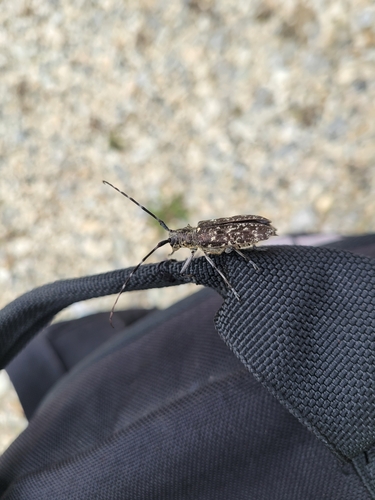
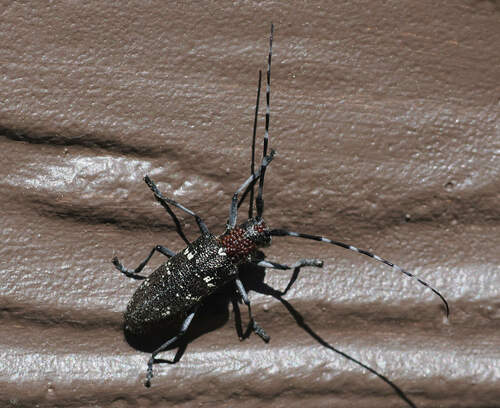
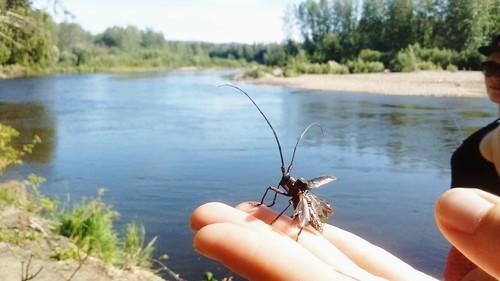
Adults are elongated, cylindrical beetles typical of Monochamus longhorns, with very long antennae (up to about twice the body length in males). Key identifying marks include a white patch at the scutellum (the small triangular area between the wing covers near the base). Males are glossy black, often with a faint bronze sheen; females are black with scattered white spots or mottling on the wing covers and grey-banded antennae.
- Look for a distinctive pale or cream scutellar spot between the bases of the wing covers.
- Long antennae much longer than the body in males; antenna segments banded or uniformly dark.
- Males glossy black; females black with scattered white spots or mottling on the wing covers.
- Found on recently dead or cut conifers (spruce, fir, pine) in boreal forests during summer.
Lookalikes
Other Monochamus longhorns Monochamus spp.
Many Monochamus species look similar; M. scutellatus is notable for the pale scutellar patch and its association with spruce and boreal conifers. Identification to species often requires close examination of body markings and genitalia or known range.
Prionus species (large longhorns) Prionus spp.
Prionus are usually larger and stouter; Monochamus are more slender with much longer antennae and different elytral patterns.
↻Life cycle
Egg
Females chew small pits in bark of weakened or recently cut conifers and deposit single eggs; eggs hatch in days to weeks.
Larva (roundheaded borer)
Wood-boring larvae tunnel in sapwood and heartwood, creating galleries as they feed for months to over a year depending on conditions.
Pupa
Larvae pupate within the wood in a chamber; pupation lasts days to weeks before adults emerge.
Adult (longhorn beetle)
Adults chew exit holes in the wood and emerge in summer to feed on bark and twigs, mate, and lay eggs on new hosts.
🍃Diet and predators
Young eat
Wood (sapwood and heartwood) of dead or dying conifers
Adults eat
Bark, tender twigs, and sometimes pollen or sap; adults may visit flowers occasionally
Predators of the young
Woodpeckers, predatory beetles, parasitic wasps and nematodes that attack larvae in wood
Predators of adults
Birds, predatory insects and small mammals
🌱Effect on plants and gardens
Larvae feed on dead, dying or recently felled conifers (spruce, fir, pine). They normally do not attack healthy standing trees and thus play a role in wood decomposition and nutrient cycling.
📍Where and when to find it
Look on trunks, branch stubs and cut logs of spruce, fir and pine; check freshly cut conifer firewood and logging slash for larval galleries and adult exit holes.
Best time
Summer months (local warm season); daytime or early evening when adults are active.
Observation tips
Photograph the scutellar area (small triangle between wing covers) and antennae length; inspect cut logs for round exit holes and frass to confirm recent emergence.
✨Fun facts
- Larvae of Monochamus and other longhorn beetles are commonly called roundheaded borers because the front of the larva's body is rounded.
- Males often have longer antennae than females; antenna length helps in locating mates by sensing pheromones.
- Whitespotted sawyers are attracted to freshly cut or damaged trees, so logging and wildfire areas often have many adults.
?Frequently asked questions
Are whitespotted sawyers dangerous to people?
No. They are not venomous and do not pose a medical threat. Adults can give a painful nip if handled, but it is harmless.
Do whitespotted sawyers damage houses or furniture?
They attack fresh conifer wood and forest slash. They do not commonly infest seasoned lumber in houses or finished furniture; storing cut wood and keeping it dry reduces risk.
Why is a whitespotted sawyer in my yard?
Adults are drawn to freshly cut, stressed or dead conifers. If you recently trimmed or cut conifer trees, sawyers may be using that wood to lay eggs.
How do I get rid of whitespotted sawyers?
Remove or promptly process (burn, chip, debark) freshly cut conifer logs and slash. Store firewood off the ground and use it quickly. For infested standing timber, salvage and proper disposal of affected wood is the practical control.
When can I see whitespotted sawyers?
Adults are most often seen during warm months (summer). They are active in daylight on trunks and branches and sometimes at night.
📷Photos of the whitespotted sawyer


More beetles
This guide was written with AI assistance and fact-checked, last updated 2026-10-10. Identification from photos is never certain: don't handle insects you can't identify, and get medical advice for bites, stings or allergic reactions. More about the whitespotted sawyer: iNaturalist, Wikipedia.