
Eyed click beetle
Alaus oculatus · Click beetles
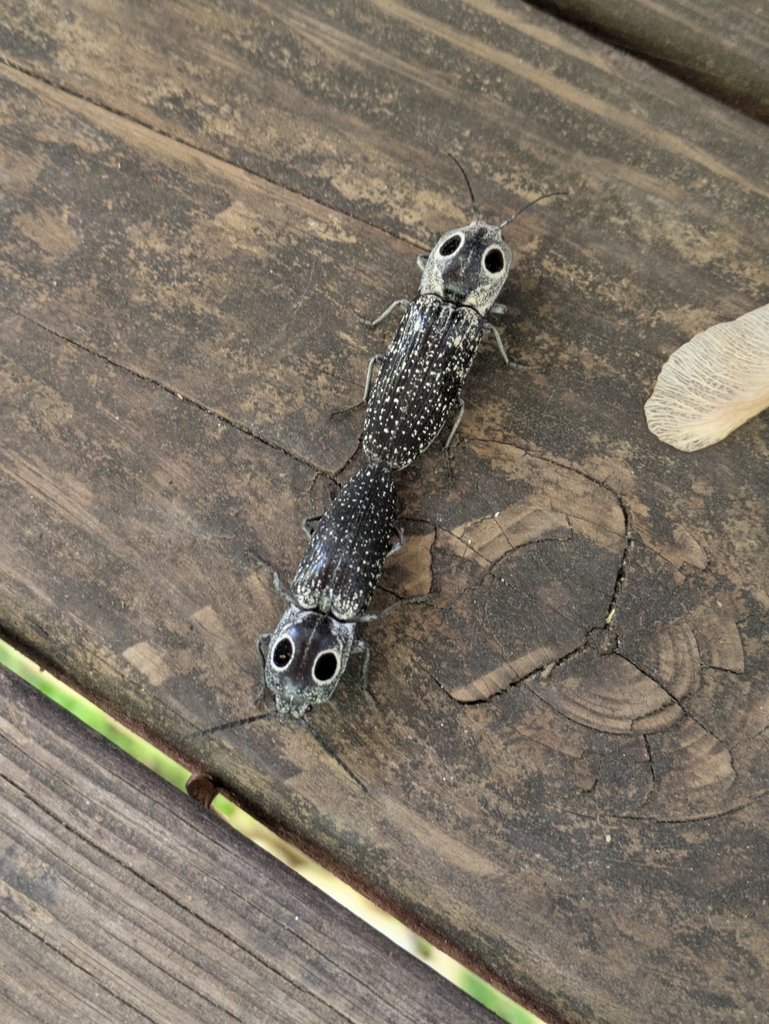
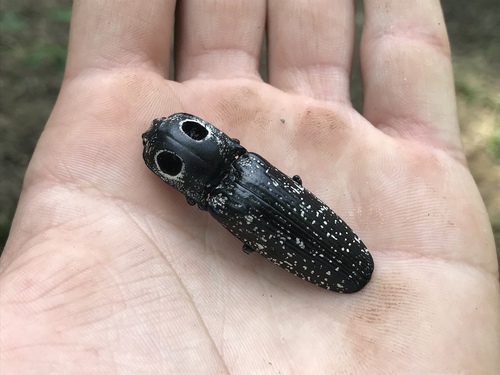
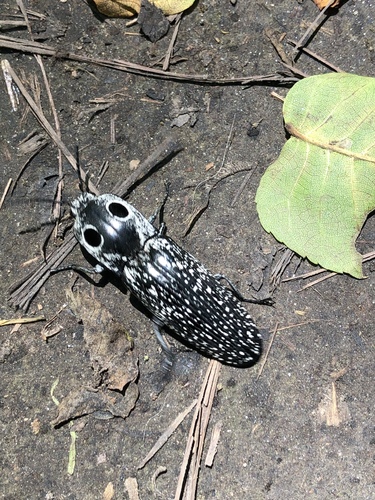
Large black-and-white click beetle with two prominent false 'eyes' on the thorax and a loud clicking leap used to right itself.
!Is the eyed click beetle dangerous?
No. Not venomous and not poisonous. They do not sting. They can pinch weakly with their mandibles if handled roughly but bites are harmless. Use caution when handling to avoid dropping the beetle; the click can be startling.
Pets
Harmless to pets. Unlikely to be eaten due to size and taste, but ingestion of any foreign insect could induce mild stomach upset in pets.
📖Overview
Alaus oculatus is a large, striking click beetle native to eastern North America. Adults are nocturnal and are often found on tree trunks, logs, or attracted to lights. When overturned they produce a loud mechanical click and flip into the air, a behavior used to escape predators and right themselves. Larvae live in decaying wood and are predatory on other insect larvae.
🔍How to identify an eyed click beetle
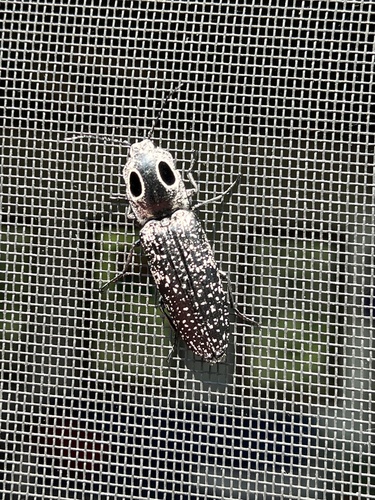
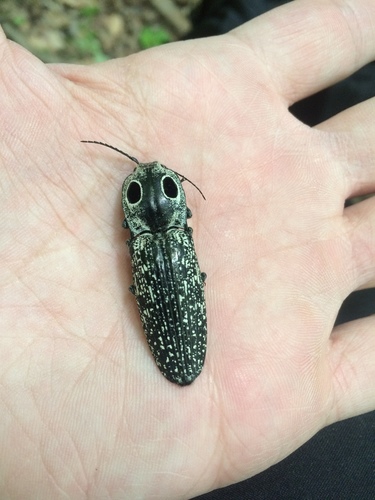
Adults are elongated and flattened with a rough, granular surface and bold black-and-white mottling. The most distinctive feature is a pair of large, oval dark patches on the pronotum surrounded by lighter rings that resemble eyes. Antennae are serrate; the rear thoracic edge and the body allow the beetle to snap and propel itself in a clicking action.
- Look for two large, eye-like spots on the pronotum surrounded by pale rings.
- Large size (25-45 mm) with coarse black-and-white mottled pattern over the body.
- When flipped, the beetle will produce a loud click and spring into the air — a diagnostic behavior of click beetles.
Lookalikes
Blind click beetle Alaus myops
Similar mottled pattern but usually smaller, with much smaller eye-like spots that lack a broad pale ring; range and pattern separate them.
Other large click beetles Various Elateridae
Other click beetles lack the bold, large, paired eye-like markings on the pronotum and often have finer texture and different size.
↻Life cycle
Egg
Laid in crevices in or near decaying wood; small and not often observed.
Larva (wireworm)
Elongated, hard-bodied wireworm that develops within decaying logs and stumps, feeding on other insect larvae and wood-boring insects; larval stage can last multiple years.
Pupa
Pupation occurs in cavities within the wood; metamorphosis to adult takes place inside the pupal cell.
Adult
Winged, nocturnal beetle that emerges to mate and disperse; adults may live for several months.
🍃Diet and predators
Young eat
Predatory on other insect larvae and wood-boring insects within decaying wood
Adults eat
Adults may feed little or take nectar, sap, or pollen occasionally; they are not significant feeders on living plants
Predators of the young
Woodpeckers, other predatory insects and parasitoids that access decaying wood
Predators of adults
Birds, small mammals, bats, and nocturnal predators; the false 'eyes' and clicking leap help deter or escape predators
🌱Effect on plants and gardens
Adults do not cause plant damage; larvae live in decaying wood and are predators of other insect larvae, so they are not a direct threat to living plants.
📍Where and when to find it
Adults on tree trunks, logs, porch lights, or flying at night; larvae inside decaying logs, stumps, and old fence posts.
Best time
Late spring through early autumn; best observed at night when attracted to lights.
Observation tips
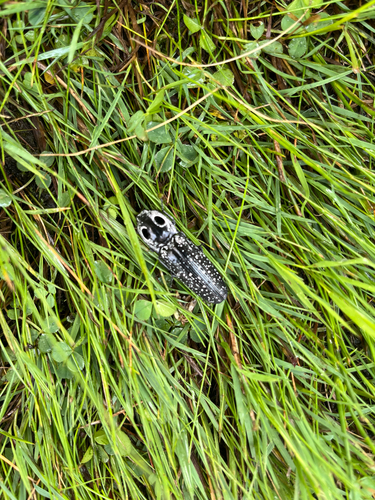
Check dead wood and tree trunks, and look near outdoor lights at night; photographing the pronotum 'eyes' and the click behavior helps confirm ID.
✨Fun facts
- The 'eyes' on the thorax are false markings that likely help deter predators by mimicking vertebrate eyes.
- The clicking mechanism is produced by a spine on the prosternum snapping into a groove on the mesosternum, propelling the beetle into the air.
- Larvae are long-lived and can spend multiple years developing inside decaying wood before pupating.
?Frequently asked questions
Do eyed click beetles bite?
They can nip with their mandibles if handled, but they do not bite in a way that harms people; any pinch is minor.
Are eyed click beetles poisonous or dangerous?
No. They are not venomous or poisonous to people or pets.
Why is an eyed click beetle in my house?
Adults are attracted to lights at night and may wander indoors. Larvae live in decaying wood, so having old logs, firewood piles, or stumps near a house can support local populations.
How do I get rid of them?
Remove or reduce nearby decaying wood, store firewood away from the house, seal gaps that let insects in, and turn off unnecessary outdoor lights at night. Hand-capture and release outdoors if found inside.
Are they beneficial?
Yes — larvae prey on other wood-boring insect larvae, and adults play a small role in the forest ecosystem without damaging live trees.
📷Photos of the eyed click beetle
More beetles
This guide was written with AI assistance and fact-checked, last updated 2026-10-10. Identification from photos is never certain: don't handle insects you can't identify, and get medical advice for bites, stings or allergic reactions. More about the eyed click beetle: iNaturalist, Wikipedia.