
Dogbane beetle
Chrysochus auratus · Leaf beetles
A small, metallic iridescent leaf beetle that feeds on dogbane and other Apocynaceae, common in eastern North America.

!Is the dogbane beetle dangerous?
No. Dogbane beetles are not venomous and do not sting. They do not bite people except possibly a mild pinch if handled roughly. No medical treatment is normally needed; wash skin if crushed.
Pets
Not considered dangerous to pets. Beetles may contain bitter compounds from their host plants, so a dog or cat that eats one may drool or have mild stomach upset.
📖Overview
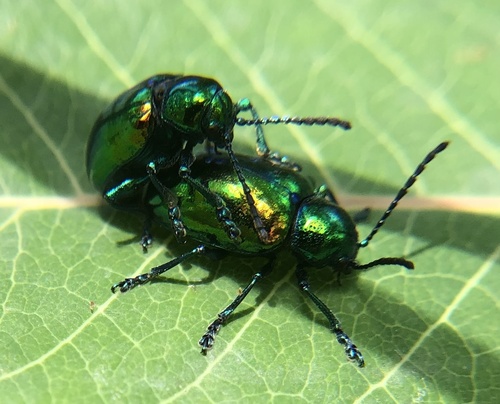
Chrysochus auratus is a small, brightly iridescent leaf beetle in the family Chrysomelidae. Adults are often seen feeding and mating on dogbane and related plants during warm months. Adults feed on host-plant leaves, while larvae live in the soil and feed on the roots. The species is familiar to gardeners for its striking metallic colors but is usually only a minor defoliator of its host plants.
🔍How to identify a dogbane beetle
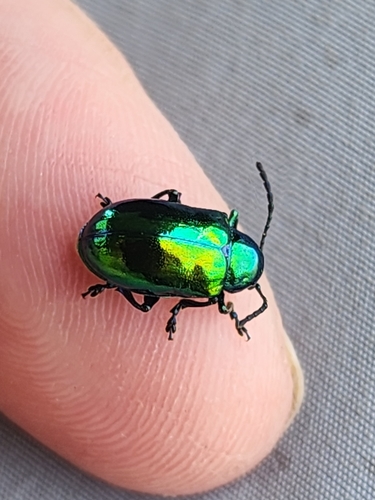
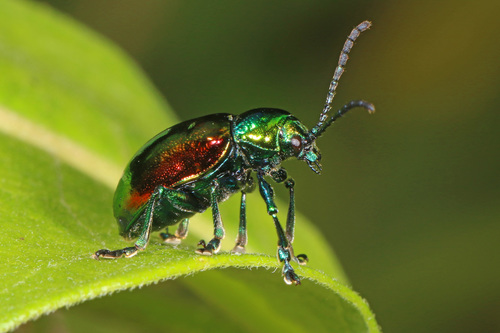
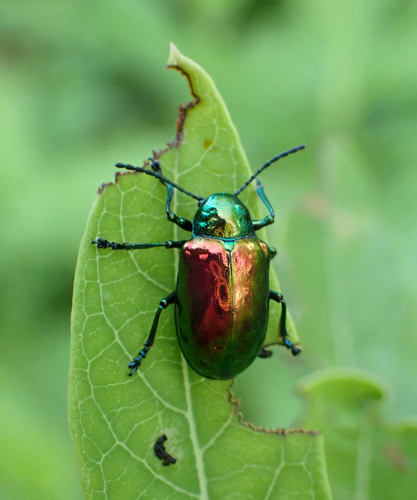
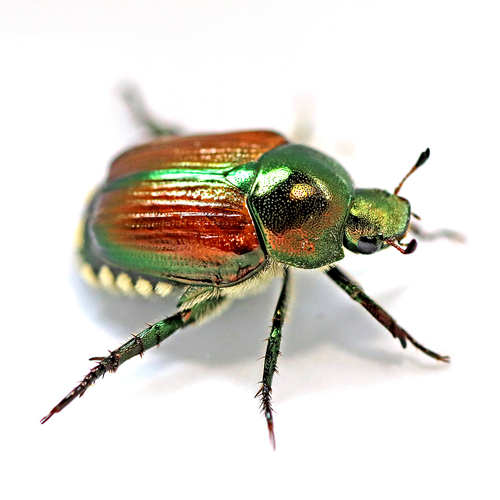
Adults are compact, broadly oval beetles with a smooth, shiny, metallic surface that shifts from green to blue to gold depending on the angle of light. They are relatively small (about 6-11 mm long). Legs and antennae are darker and less iridescent than the elytra. The body lacks strong patterning or spots; the main identification feature is the uniform metallic sheen.
- Uniform metallic, iridescent elytra that shift green, blue or gold depending on light
- Compact, broadly oval leaf-beetle shape 6-11 mm long
- Found on dogbane or milkweed-family plants during spring and summer
- Legs and antennae are darker and not shiny like the elytra
Lookalikes
Cobalt milkweed beetle Chrysochus cobaltinus
C. cobaltinus is more uniformly blue and is found farther west; host-plant preference and geographic range help separate them.
Tortoise beetles Various Cassidinae species
Tortoise beetles are more rounded and often have flattened margins; many show distinct spots or transparent margins unlike the smooth iridescent Chrysochus auratus.
↻Life cycle
Egg
Females lay small masses of eggs on host plants or near their base; newly hatched larvae drop to the ground.
Larva
Larvae are C-shaped grubs that live in the soil and feed on the roots of the host plant.
Pupa
Pupation occurs in the soil near the host plant.
Adult
Adults feed on host leaves, mate and disperse. They are the conspicuous metallic beetles seen on dogbane in summer.
🍃Diet and predators
Young eat
Roots of dogbane and related Apocynaceae plants
Adults eat
Leaves and sometimes flowers of dogbane and other Apocynaceae (milkweed relatives)
Predators of the young
Soil predators such as ground beetle larvae and ants, and some parasitoids
Predators of adults
Birds, predatory insects and spiders; bright coloration may offer limited warning or crypsis depending on light angle
🌱Effect on plants and gardens
Feeds primarily on dogbane and related Apocynaceae (sometimes milkweeds). Heavy local feeding can cause noticeable leaf damage but typically does not kill mature plants.
📍Where and when to find it
Look on leaves and stems of dogbane, milkweed and related plants in fields, roadsides, meadows and gardens. Larvae live underground on the roots and are rarely seen.
Best time
Late spring through summer during daylight hours when temperatures are warm
Observation tips
Photograph in bright sunlight to capture the iridescent color. Adults often drop to the ground when disturbed, so approach slowly.
✨Fun facts
- The beetle's color is iridescent and changes with viewing angle rather than being a single pigment.
- They are specialists on dogbane and other members of the milkweed family that produce toxic compounds; the beetles tolerate or sequester some host chemicals.
- Despite their bright metallic appearance, they are harmless to people and pets.
?Frequently asked questions
Are dogbane beetles dangerous?
No. They are not venomous or toxic to humans and do not pose a health risk.
Do dogbane beetles bite?
They do not normally bite people. Handling can result in a harmless pinch at most.
Why are these beetles on my plants?
They feed on dogbane and related plants (Apocynaceae). If those plants are nearby, the beetles are simply eating their preferred host.
How do I get rid of dogbane beetles?
Physical removal by hand-picking is effective for small numbers. Encourage predators and maintain plant vigor. Chemical controls are rarely needed; if used, choose targeted insecticides and follow label directions.
Will they kill my dogbane or milkweed plants?
Heavy, repeated feeding can weaken plants, but healthy mature plants usually tolerate some defoliation. In most gardens damage is minor.
📷Photos of the dogbane beetle

More beetles
This guide was written with AI assistance and fact-checked, last updated 2026-10-10. Identification from photos is never certain: don't handle insects you can't identify, and get medical advice for bites, stings or allergic reactions. More about the dogbane beetle: iNaturalist, Wikipedia.