
Black vine weevil
Otiorhynchus sulcatus · Weevils
A flightless, nocturnal weevil whose adults chew notches from leaves while larvae feed on roots and damage a wide range of ornamental plants and strawberries.
!Is the black vine weevil dangerous?
No. Black vine weevils do not bite, sting or transmit disease. They are harmless to people; handling adults may feel stiff but causes no harm.
Pets
Not poisonous to pets. Pets may dig up soil and accidentally expose grubs; the grub itself is not toxic but ingesting large numbers of insects could upset a pet's stomach.
📖Overview
The black vine weevil is a stout, flightless beetle introduced from Europe and now common in temperate gardens and nurseries worldwide. Adults are active at night and feed on foliage, producing characteristic semicircular notches on leaf margins. Larvae are white, C-shaped grubs that live in soil and feed on roots and root crowns, often causing wilting, poor growth or plant death. Populations can build up in container-grown plants, ornamental beds and strawberry plantings. The species commonly has one generation per year; in cool climates development may take longer.
🔍How to identify a black vine weevil
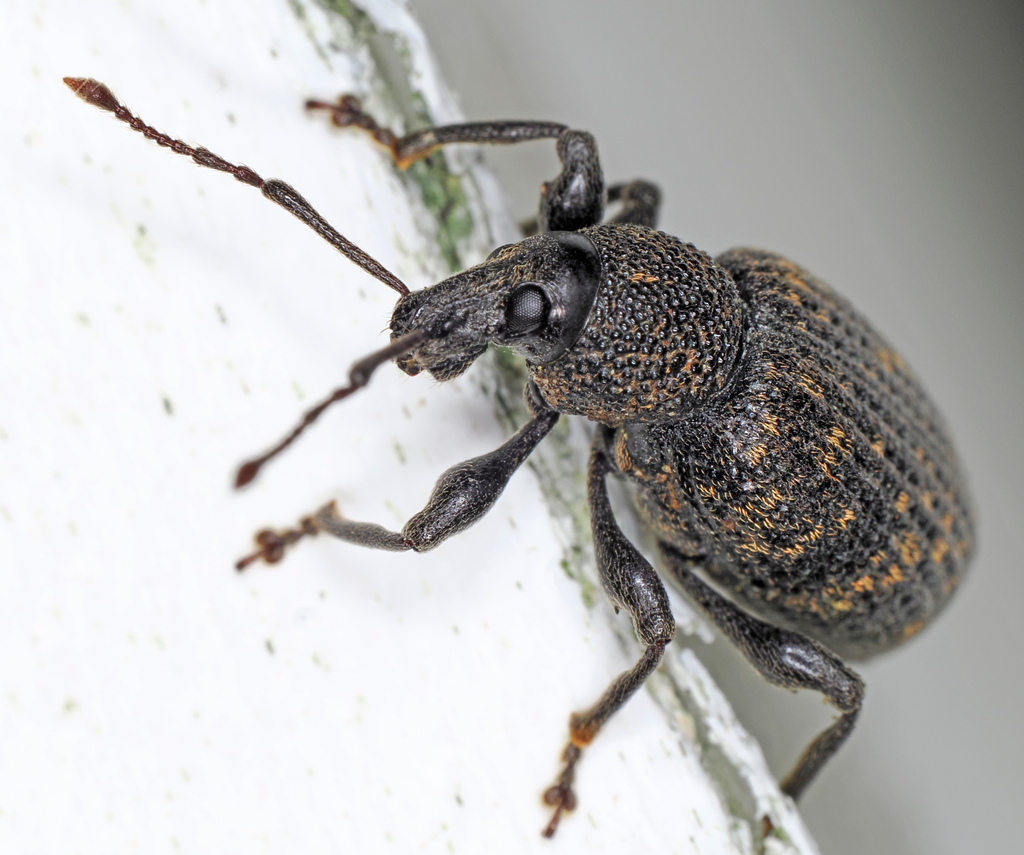
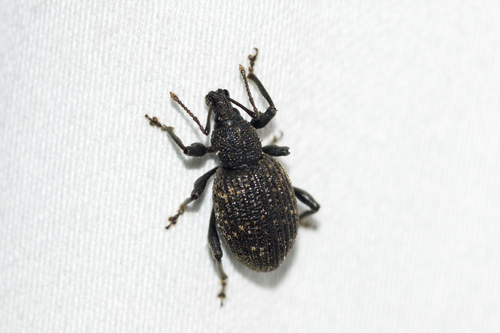
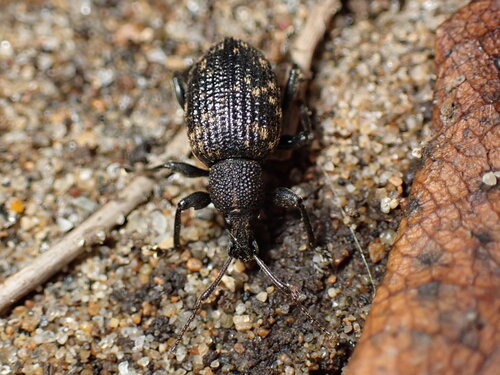
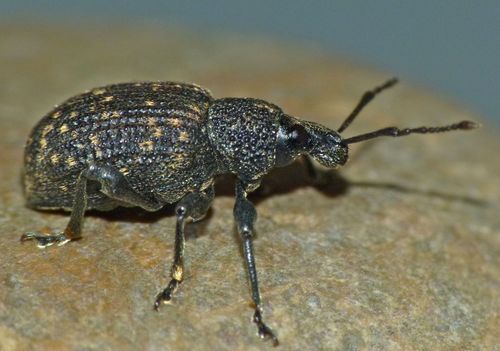
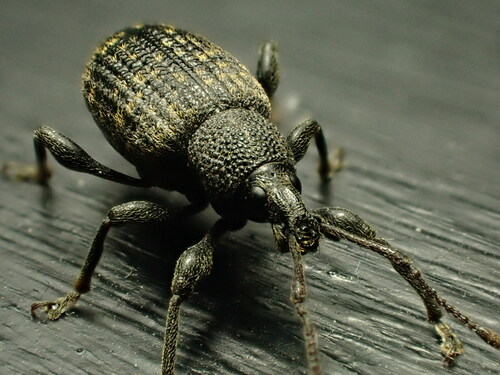
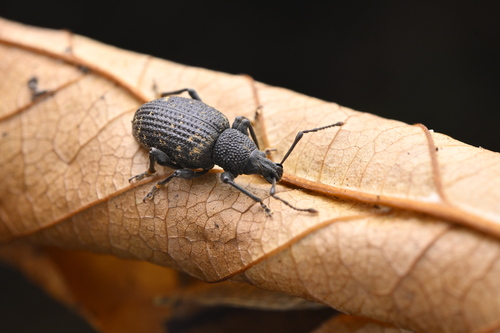
Adults are about 8-12 mm long, robust with a short, curved snout and fused elytra (they cannot fly). They are matte black to dark brown with small scattered flecks of yellowish hairs on the elytra. Legs and rostrum (snout) match the body color. Larvae are creamy-white, legless, C-shaped grubs with a brown head about 8-12 mm when mature. Pupae are cream-coloured and found in earthen cells in the soil.
- Flightless, stout beetle 8-12 mm long with a short curved snout, matte black with small flecks of yellowish hairs.
- Adults active at night and leave semicircular notches along leaf edges of host plants.
- Look in soil and around root crowns for C-shaped, cream-coloured grubs that damage roots.
- Adults cannot fly; tap foliage at night with a light or torch to spot them walking on leaves.
Lookalikes
Other Otiorhynchus weevils Otiorhynchus spp.
Many Otiorhynchus species look similar; O. sulcatus is distinguished by geographic range, host plants and specialist taxonomic features — professional ID may require examination of scale patterns or genitalia.
Strawberry root weevil Otiorhynchus ovatus
Much smaller (about 5-6 mm) and dark brown to black without the yellowish hair flecks; causes similar root damage to strawberries and ornamentals.
↻Life cycle
Egg
Females lay small, white eggs in soil near host plants. Eggs hatch in 2-3 weeks depending on temperature.
Larva (grub)
C-shaped, white grubs feed on roots and collars in the soil for weeks to many months, often overwintering and causing most plant damage.
Pupa
Larvae pupate in earthen cells in the soil and transform to adults over a period of days to weeks in spring or early summer.
Adult (weevil)
Flightless adults emerge, feed on foliage at night, mate and females lay eggs in soil. Adults can live several months.
🍃Diet and predators
Young eat
Roots, root hairs and root crowns of a wide range of herbaceous and woody plants.
Adults eat
Leaves and soft tissue of many shrubs and perennials; they create semicircular notches on leaf margins.
Predators of the young
Soil predators and parasites such as predatory beetles, entomopathogenic nematodes and mites; birds that dig in soil may eat exposed grubs.
Predators of adults
Ground beetles, small mammals and birds at night; predation is limited by the adult's hard body and nocturnal habits.
🌱Effect on plants and gardens
Larvae feed on roots of many ornamentals (rhododendron, azalea, primula, heuchera), shrubs, potted plants and strawberry plants, causing wilting, yellowing, dieback and plant death. Adults feed on leaves, creating notched margins that are mainly cosmetic but can reduce vigor if severe.
How to get rid of black vine weevils
Inspect new plants and root balls before buying or planting. Hand-pick adults at night by torchlight or by tapping plants over a tray, and trap them under boards or in rolled corrugated cardboard. Apply beneficial nematodes (Steinernema kraussei or Heterorhabditis species) to moist soil or compost in spring and late summer to autumn when larvae are active. Remove and destroy heavily infested potting mix and severely damaged plants. Where needed, use soil or plant treatments approved for vine weevil in your area, following the label exactly.
📍Where and when to find it
Adults on foliage at night, hiding at soil level or under pots by day; larvae in the soil around roots and root crowns.
Best time
Spring to autumn for adults (nighttime); check soil in spring and autumn for larvae.
Observation tips
Inspect new plants and potting mix before bringing them home. To find adults, shine a torch on foliage at night or tap plants over a light-coloured tray. To locate larvae, gently lift plants from pots and examine root mass and soil.
✨Fun facts
- Adults cannot fly because their wing cases are fused; populations spread mainly by movement of infested plants and soil.
- They are a major pest of container-grown plants and nurseries because larvae thrive in potting mixes and young roots.
- Entomopathogenic nematodes are an effective biological control option and are sold to control the soil-dwelling larvae.
?Frequently asked questions
Do black vine weevils bite or sting?
No. They do not bite or sting people and are not venomous.
Why are there holes in my plant leaves?
Adults feed at night and leave distinctive semicircular or scalloped notches on leaf edges — this damage is typical of black vine weevil adults.
Are black vine weevils harmful to my plants?
Yes. Larvae feeding on roots can cause wilting, yellowing and death, especially in container plants and strawberries.
How do black vine weevils get into my house or pots?
They often arrive as larvae or eggs in infested potting mix, nursery plants or soil moved between locations. Adults can climb pots and plants but cannot fly.
How do I get rid of black vine weevils?
Use an integrated approach: hand-pick adults at night, remove heavily infested plants, avoid moving contaminated soil, and treat soil with approved controls. Beneficial nematodes (e.g. Steinernema or Heterorhabditis species) applied to moist soil can kill larvae; some soil insecticides or systemic products reduce larvae but follow label and safety guidance.
When is the best time to treat for them?
Treat soil for larvae in spring or autumn when soil is moist and larvae are actively feeding; hand-pick adults at night in spring and summer to reduce egg-laying.
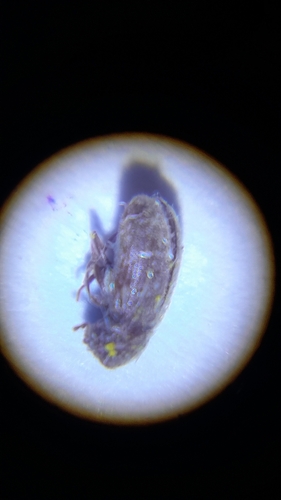
📷Photos of the black vine weevil
More beetles
This guide was written with AI assistance and fact-checked, last updated 2026-10-10. Identification from photos is never certain: don't handle insects you can't identify, and get medical advice for bites, stings or allergic reactions. More about the black vine weevil: iNaturalist, Wikipedia.