
Black oil beetle
Meloe proscarabaeus · Oil beetles
A flightless, wingless beetle that exudes oily, blistering haemolymph and whose larvae parasitise solitary bees.
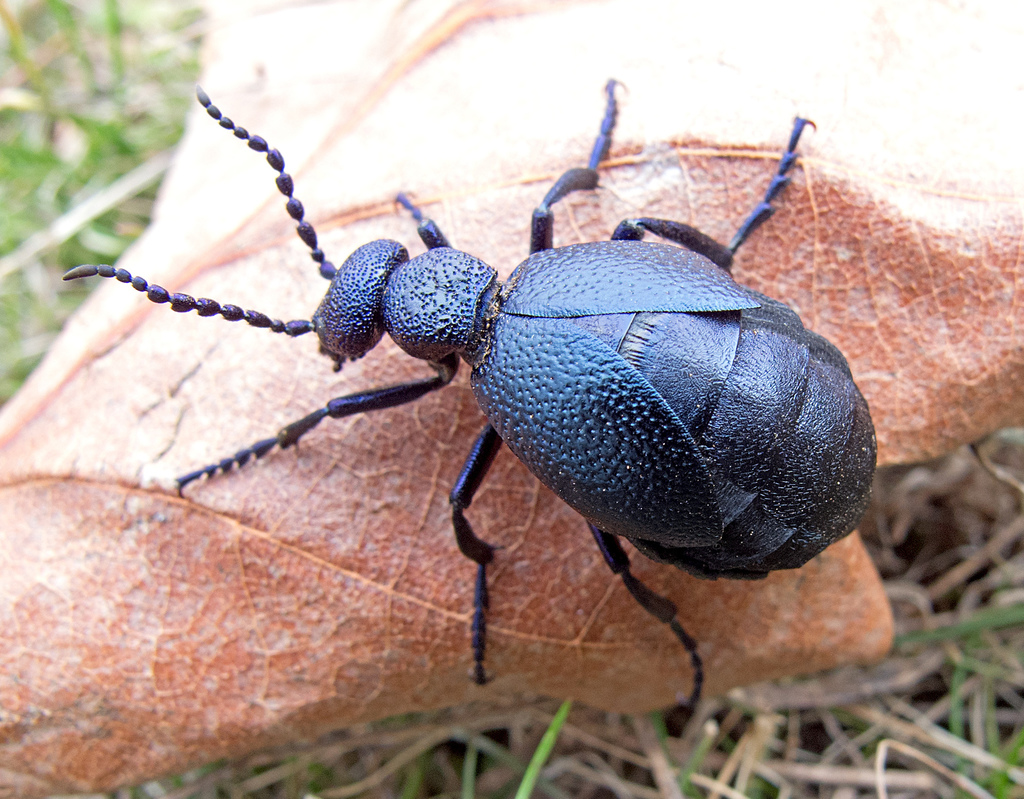
!Is the black oil beetle dangerous?
Yes, it can be. Adults do not bite or sting, but when disturbed they release oily haemolymph containing cantharidin, a blistering toxin. Skin contact can cause irritation and painful blisters; wash the area promptly with soap and water and avoid rubbing or touching the eyes. Cantharidin is poisonous if swallowed: seek medical help immediately if any part of a beetle is eaten, or for severe skin or eye reactions. Do not crush the beetle on skin.
Pets
Toxic if chewed or swallowed; can cause severe irritation, blistering and gastrointestinal distress in dogs and cats. Keep pets away from beetles and remove beetles from lawns or areas where pets forage.
📖Overview
Meloe proscarabaeus is a large, black oil beetle in the family Meloidae. Adults are slow-moving, wingless beetles often found on flowers and low vegetation in meadows, hedgerows and other grassy habitats. Females lay clusters of eggs in the soil; the first-stage larvae (triungulins) climb vegetation and hitch rides on solitary bees to reach the bees' nests, where they consume bee larvae and stored pollen. Adults feed on plant material and flowers. When threatened they exude oily haemolymph that can blister human skin and deter predators.
🔍How to identify a black oil beetle
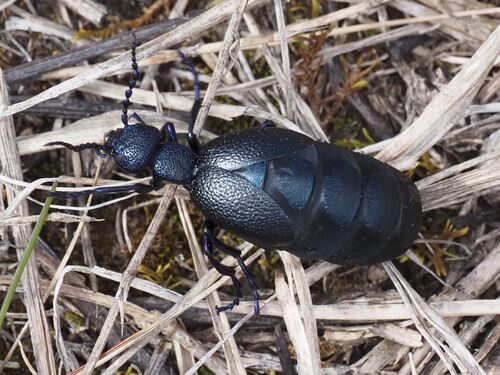
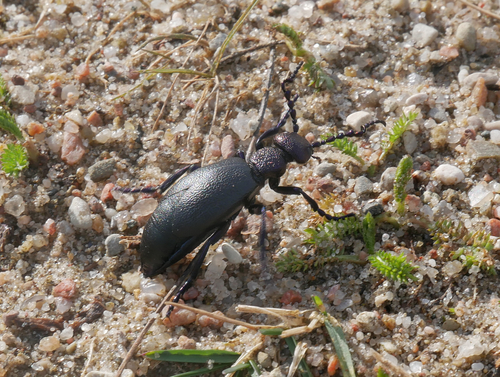
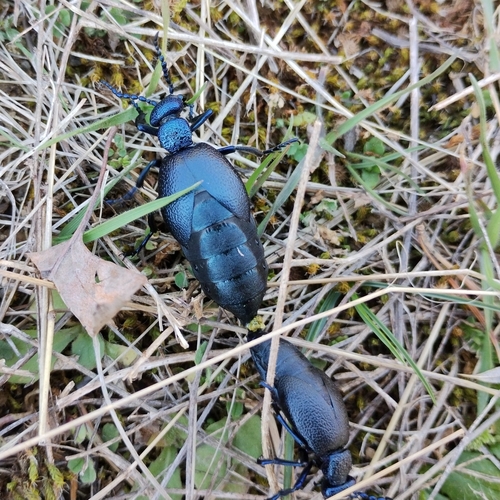
Adults are robust beetles with a narrow head and thorax and a large, soft, swollen abdomen. They are black, often with a bluish or violet sheen, and cannot fly: the short, overlapping elytra (wing covers) cover only the front of the abdomen and there are no flight wings. Males are generally smaller than females and have a distinctive kink in the middle of the antennae; females have a much more swollen abdomen when full of eggs.
- Large, soft-bodied black beetle (often with a bluish sheen) with short elytra that do not cover the swollen abdomen.
- Flightless: no functional hind wings and adults cannot fly.
- Distinctive swollen abdomen with constricted thorax and relatively slow, crawling movement.
- Found on low flowers and short grass in spring; females larger with more swollen abdomens.
Lookalikes
Violet oil beetle Meloe violaceus
M. violaceus is very similar and also blue-black; it has a finer, more evenly punctured pronotum, and close comparison of pronotum shape and texture is needed to separate them.
Other oil beetles Meloe spp.
Several Meloe species are black and similar; identification to species can require close examination of body shape, genitalia and geographic location.
↻Life cycle
Egg
Female lays clusters of eggs in soil; eggs hatch into active first-stage larvae (triungulins).
Larva (triungulin then later grub-like stages)
Triungulin larvae climb plants and attach to passing solitary bees (phoresy). They are carried to bee nests, where they feed on bee eggs, larvae and stored pollen. After feeding, larvae moult into grub-like stages that remain in the nest.
Pupa
After larval development in the bee nest, the insect pupates inside the nest or nearby in the soil.
Adult
Flightless adults emerge from the soil and feed on foliage and flowers, mate, and repeat the cycle.
🍃Diet and predators
Young eat
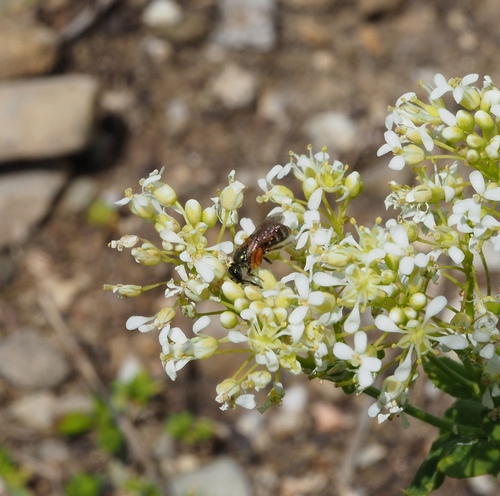
Parasitic on solitary bees: triungulins attach to bees and consume bee larvae and stored pollen in the bees' nests.
Adults eat
Feed on leaves, flowers and sometimes pollen of various herbaceous plants.
Predators of the young
Predators are limited because larvae develop inside bee nests; ants or nest parasites may occasionally attack them.
Predators of adults
Birds and small mammals may attempt to eat them, but the blistering haemolymph deters many predators.
🌱Effect on plants and gardens
Adults chew leaves and flowers of various plants but rarely occur in numbers large enough to cause serious garden damage. Larvae are parasitoids of solitary bees and therefore indirectly affect bee populations.
📍Where and when to find it
Adults on low-growing flowers and vegetation, especially in sunny meadows and hedgerows. Look for larvae (triungulins) on flowers and plants in spring, often clustered waiting for passing solitary bees.
Best time
March to June, midday on warm sunny days when adults feed on flowers; spring for triungulin activity.
Observation tips
Wear gloves if you need to handle or move a beetle. Photograph from above to capture the short elytra and swollen abdomen. Check flowers close to the ground for triungulin larvae during spring.
✨Fun facts
- The name 'oil beetle' comes from the oily, blister-causing haemolymph they release when threatened.
- Their first-stage larvae perform 'phoresy' by hitching a ride on solitary bees to reach food-rich nests.
- Adults are wingless: although beetles, they have reduced elytra and no functional flight wings.
?Frequently asked questions
Are black oil beetles dangerous?
Yes, it can be if handled or swallowed. They do not bite or sting, but they release a blistering fluid (cantharidin) that can cause painful skin blisters, and it is poisonous if eaten.
Do black oil beetles bite?
No. They do not bite or sting, but avoid touching them because of their blistering secretion.
Why is a black oil beetle in my garden or house?
They are common in meadows, gardens and grassy areas where flowers and solitary bees occur. Adults may wander into yards; they are unlikely to enter houses but may be found indoors if brought in on cut flowers or by accident.
How do I get rid of black oil beetles?
No control is needed; it is a harmless, declining species if left alone. Do not handle them with bare hands. If one is in a play area, move it with a stick, gloved hand or container to nearby vegetation.
Will black oil beetles harm my pets?
Yes, they can be harmful if chewed or swallowed because cantharidin can cause severe irritation and internal poisoning. Keep pets away and contact a veterinarian promptly if a pet may have eaten one.
Are black oil beetles protected or important?
They are an integral part of many grassland ecosystems and have a complex life cycle involving solitary bees; local conservation status varies by country, but they help illustrate insect ecological interactions.
📷Photos of the black oil beetle
More beetles
This guide was written with AI assistance and fact-checked, last updated 2026-10-10. Identification from photos is never certain: don't handle insects you can't identify, and get medical advice for bites, stings or allergic reactions. More about the black oil beetle: iNaturalist, Wikipedia.