
Reticulated net-winged beetle
Calopteron reticulatum · Net-winged beetles
A brightly coloured, soft-bodied beetle of woodland edges and flowers in eastern North America; distasteful to predators but harmless to people.

!Is the reticulated net-winged beetle dangerous?
No. Not venomous and not known to bite. The adults are distasteful to predators and may exude defensive chemicals if handled; handle gently or avoid touching to prevent skin irritation from secretions in very rare cases.
Pets
Generally harmless to pets. As with humans, avoid forcing pets to eat them because chemical defenses may cause mild stomach upset.
📖Overview
Calopteron reticulatum is a member of the net-winged beetle family (Lycidae). Adults are often seen on foliage, flowers and low shrubs in deciduous or mixed woodlands during warm months. They have soft, papery elytra with a reticulated (net-like) pattern of ridges and are aposematic (warningly coloured), which helps deter predators. Larvae live in leaf litter, under bark or in decaying wood and are thought to be predatory or saprophagous. This species is not considered an agricultural or household pest.
🔍How to identify a reticulated net-winged beetle
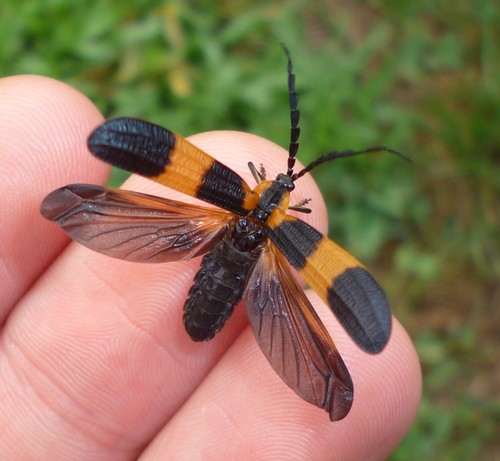
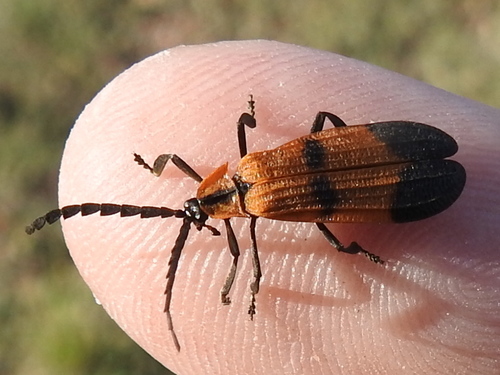
Adults are elongated, somewhat flattened and soft-bodied, with elytra that widen toward the tip and are covered in a network of raised ridges. The elytra are orange with a broad black band across the middle and black on the rear third; the pronotum is orange with a black central marking. Head and antennae are dark, and the antennae are flattened and somewhat saw-toothed.
- Soft-bodied, elongated beetle 10-20 mm long with netted (reticulate) elytra that widen toward the tip.
- Orange elytra with a black band across the middle and a black rear third.
- Elytra finely ridged giving a papery, netted appearance common to Lycidae.
- Found on foliage, flowers or low shrubs in woodland edges during daylight.
Lookalikes
End band net-winged beetle Calopteron terminale
Very similar shape and colour, but the elytra are orange with black only at the tip and lack the black band across the middle.
Lycus net-winged beetles Lycus spp.
Lycus species (mainly in the southwestern US and Mexico) also have bright warning colours but usually have a snout-like extended head and a different elytral pattern.
↻Life cycle
Egg
Laid in protected places such as under bark or in leaf litter; eggs hatch into larvae.
Larva
Elongate, somewhat flattened larvae live in leaf litter, soil, or under bark and are believed to feed on small invertebrates or decaying organic matter.
Pupa
Larvae pupate in sheltered sites in the litter or wood before emerging as adults.
Adult
Winged, brightly coloured beetles active on vegetation and flowers; adults are primarily involved in reproduction and dispersal.
🍃Diet and predators
Young eat
Thought to be predatory on small invertebrates or feed on decaying organic matter; precise diet not well documented.
Adults eat
Often visit flowers for nectar or pollen, may feed on plant sap or honeydew; adults are not significant feeders on living plants.
Predators of the young
Ground-dwelling predators such as ants and other predatory arthropods.
Predators of adults
Birds and predatory insects may attempt to eat them but often avoid them because adults are chemically defended and taste bad.
🌱Effect on plants and gardens
Adults visit flowers and foliage; they do not cause significant damage to living plants or crops.
📍Where and when to find it
Look on flowers, leaves and low shrubs in woodland edges and clearings; check leaf litter and under loose bark for larvae.
Best time
Late spring through summer during daylight hours.
Observation tips
Photograph against foliage or flowers to show the netted elytra; approach slowly as adults may fly short distances when disturbed.
✨Fun facts
- Net-winged beetles get their name from the reticulated (net-like) pattern of ridges on their elytra.
- Their bright colours warn predators: many net-winged beetles are chemically defended and taste bad.
- Some harmless insects mimic Lycidae colouring to gain protection from predators (Batesian mimicry).
?Frequently asked questions
Are reticulated net-winged beetles poisonous?
They are not dangerous to humans. Adults have chemical defenses that make them distasteful to predators but they are not known to be poisonous if touched.
Do they bite or sting?
No. They do not sting and are not known to bite people.
Why is one in my house?
Occasional adults may wander indoors after being attracted to lights or while searching for mates. They do not infest homes or breed indoors.
How do I get rid of them?
The simplest method is to gently capture and release them outdoors. They are not pests, so chemical control is unnecessary.
Where do they live?
They live in deciduous and mixed woodlands, often on foliage, low shrubs and flowers; larvae inhabit leaf litter, under bark, or decaying wood.
📷Photos of the reticulated net-winged beetle



More beetles
This guide was written with AI assistance and fact-checked, last updated 2026-10-10. Identification from photos is never certain: don't handle insects you can't identify, and get medical advice for bites, stings or allergic reactions. More about the reticulated net-winged beetle: iNaturalist, Wikipedia.