
Ten-lined June beetle
Polyphylla decemlineata · Scarab beetles
A large, nocturnal scarab beetle with ten pale stripes on a brown body; common in western North America and often attracted to lights.
!Is the ten-lined June beetle dangerous?
No. Ten-lined June beetles are not venomous and do not pose a medical threat. They cannot sting; they may pinch if handled roughly but bites are rare and not harmful. Wash hands after handling to avoid minor irritation from debris.
Pets
Generally harmless to pets. Dogs or cats that dig for grubs may expose themselves to soil parasites or eat large numbers and get an upset stomach; consult a veterinarian if ingestion causes symptoms.
📖Overview
Polyphylla decemlineata is a distinctive scarab beetle found across western North America. Adults are notable for their ten pale longitudinal stripes and, in males, large feathery antennae used to detect female pheromones. Larvae are C-shaped white grubs that develop in soil and feed on plant roots for multiple years. Adults are short-lived and mainly active on warm summer nights, often flying to lights.
🔍How to identify a ten-lined June beetle
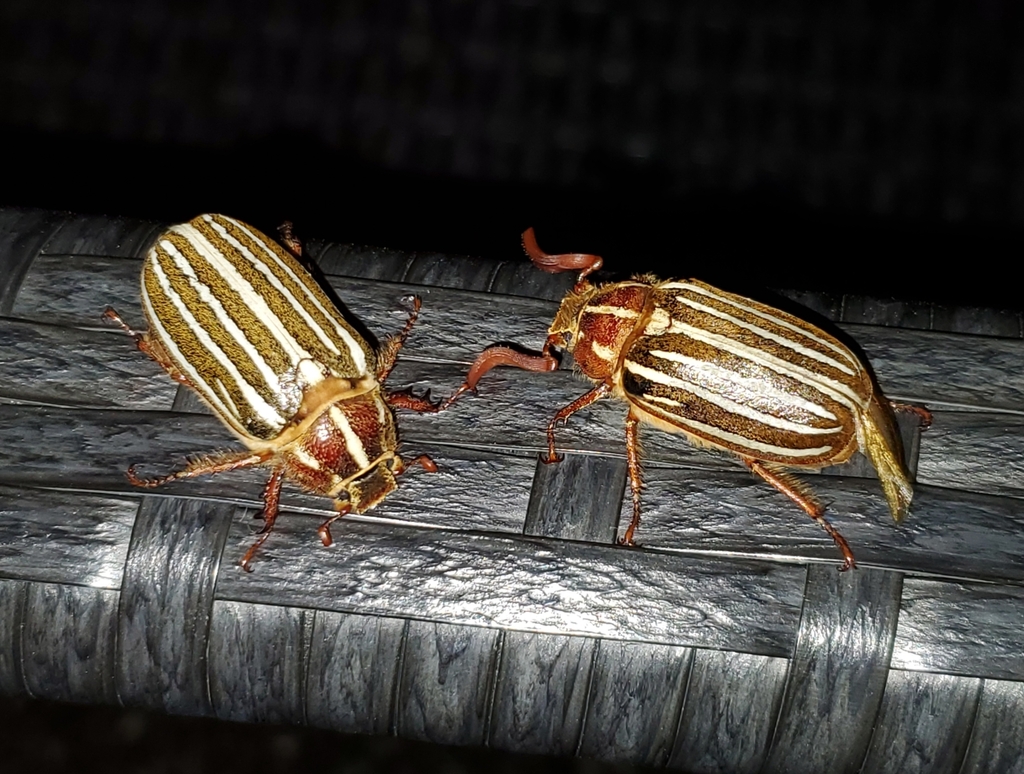
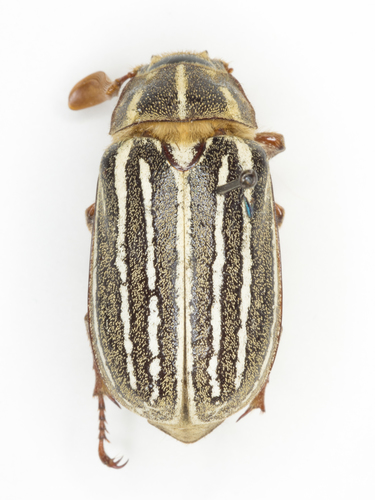
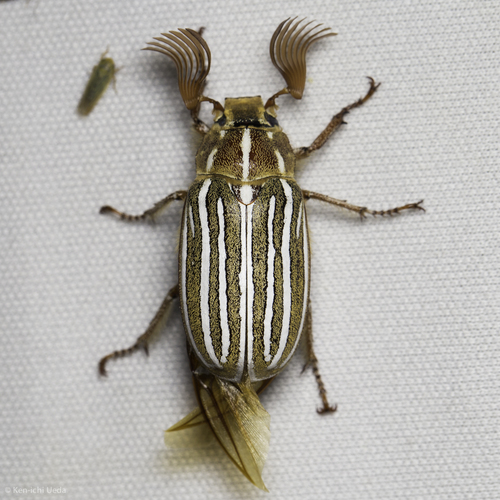
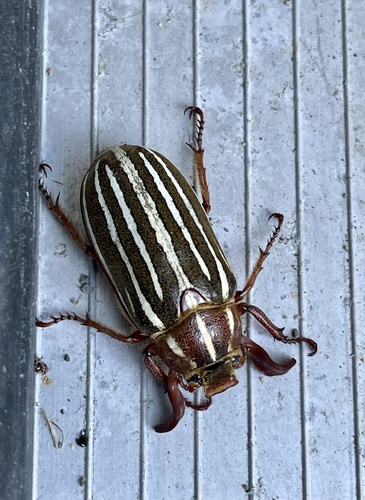
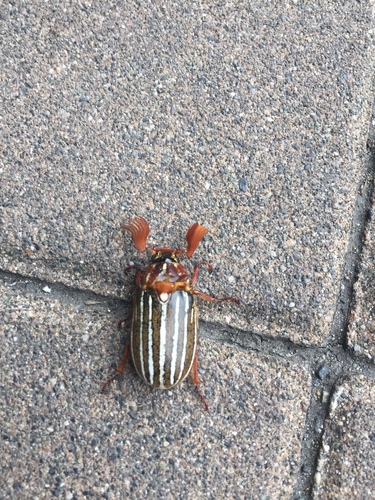
Adults are robust, oval beetles with a brown to reddish-brown background and five pale cream to whitish stripes on each elytron (ten stripes total). Males have very large, fan-like (lamellate) antennae; females have smaller, clubbed antennae. Body length typically ranges from about 20 mm to 30 mm. The legs are sturdy with spines typical of scarabs. Larvae are white C-shaped grubs with brown head capsules and three pairs of thoracic legs.
- Look for five pale stripes on each elytron (ten lines total) against a brown or reddish-brown background.
- Males have large, fan-like lamellate antennae; females have smaller, less conspicuous antennae.
- Large, robust scarab shape, 20-30 mm long, active at night and often flying to lights in June-July.
- Larvae are white, C-shaped grubs with a brown head capsule found in soil feeding on roots.
Lookalikes
Lined June beetles Polyphylla spp.
Related Polyphylla species may have similar striping; P. decemlineata is identified by its specific stripe pattern and regional range—examine antennae and consult local keys for precise ID.
Masked chafer Cyclocephala spp.
Smaller, uniformly colored, and lack the distinctive longitudinal pale stripes and large male antennae.
May/June beetles Phyllophaga spp.
Typically brown and more uniformly colored without the white longitudinal stripes and with different antennal structure.
↻Life cycle
Egg
Females lay eggs in soil during summer; eggs hatch in a few weeks depending on temperature.
Larva (grub)
White, C-shaped grubs develop in soil and feed on roots for 2-3 years (occasionally longer), molting through several instars.
Pupa
Larvae pupate in soil chambers in late spring to early summer, transforming into adults.
Adult (beetle)
Adults emerge in summer, are active for a few weeks to mate and lay eggs, then die.
🍃Diet and predators
Young eat
Roots and decaying organic matter in soil (grasses, seedlings and some ornamental plants).
Adults eat
Mostly feed on foliage of shrubs and trees occasionally; some adults may not feed much and focus on reproduction.
Predators of the young
Ground-dwelling predators such as moles, skunks, raccoons, rodents and insect-parasitic nematodes and fungi.
Predators of adults
Nocturnal birds, bats, small mammals and predatory insects; they are also attracted to lights which increases risk from predators and road mortality.
🌱Effect on plants and gardens
Larvae feed on roots of grasses, shrubs and tree seedlings; in large numbers they can damage lawns, ornamental plants and young trees. Adults may nibble foliage but rarely cause significant plant damage.
How to get rid of ten-lined June beetles
Reduce outdoor lighting at night to make your yard less attractive to adults. Handpick adults at night with a flashlight and drop into soapy water. For grub infestations in lawns, improve soil drainage and turf health, overseed and apply beneficial nematodes (Steinernema spp.) or approved grub insecticides timed to target young larvae in late summer or early fall. Have heavy infestations assessed by a lawn care professional before using broad-spectrum insecticides.
📍Where and when to find it
Adults: flying to lights at night, on tree trunks, or resting on buildings in June-July. Larvae: in soil under lawns, turf and near roots of shrubs and seedlings.
Best time
Late spring to mid-summer (June and July), after dusk and into the night.
Observation tips
Use a bright flashlight at night to spot adults on trunks or near lights. To see grubs, dig small soil patches in areas of lawn damage in late summer or spring.
✨Fun facts
- The 'ten lines' are actually five pale stripes on each wing cover, giving the species its common name.
- Males use their large feathery antennae to detect the scent of females from some distance away.
- When picked up, adults can make a loud hissing squeak by rubbing parts of the abdomen against the wing covers.
?Frequently asked questions
Are ten-lined June beetles harmful to people?
No. They are not venomous and rarely bite; at worst they may pinch if handled roughly.
Do ten-lined June beetles eat gardens or crops?
Larvae can damage lawns and young plants by feeding on roots if present in large numbers; adults cause little plant damage.
Why are they in my house or yard?
Adults are attracted to outdoor lights and may enter or gather near houses at night. Larvae live in soil beneath lawns and garden beds.
How do I get rid of them?
Turn off or reduce nighttime lights, handpick adults at night, and manage grub populations with cultural controls, beneficial nematodes or targeted insecticides if necessary.
How long do their grubs live in the soil?
Grubs typically take 2-3 years to mature, though timing varies with climate and food availability.
📷Photos of the ten-lined June beetle
More beetles
This guide was written with AI assistance and fact-checked, last updated 2026-10-10. Identification from photos is never certain: don't handle insects you can't identify, and get medical advice for bites, stings or allergic reactions. More about the ten-lined June beetle: iNaturalist, Wikipedia.