
Golden tortoise beetle
Charidotella sexpunctata · Tortoise beetles
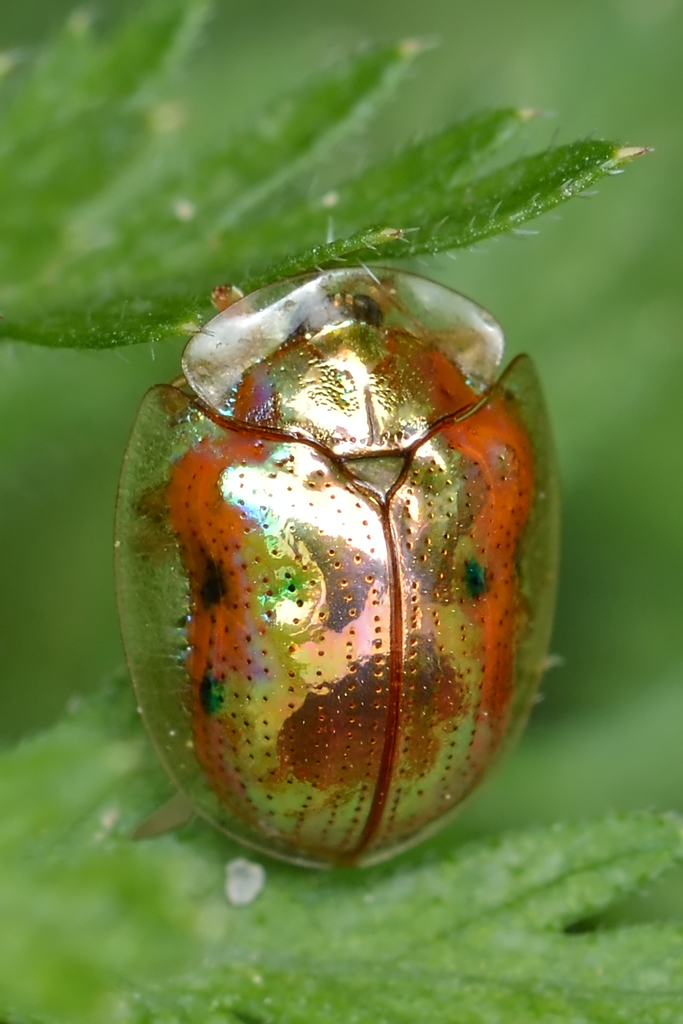
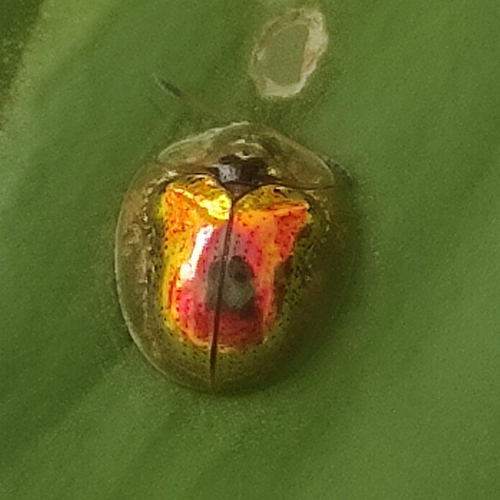
A small, shiny tortoise beetle that can appear metallic gold or turn reddish with black spots when disturbed; feeds mainly on bindweeds and morning glories.
!Is the golden tortoise beetle dangerous?
No. Harmless to people. They do not bite or sting and are not poisonous. Handle gently if needed.
Pets
Not known to be toxic to pets. Unlikely to cause problems if a pet snatches one, though many pets will not eat them.
📖Overview
Charidotella sexpunctata is a small leaf beetle in the tortoise beetle group known for a rounded, domed shape and a highly reflective, metallic appearance. Adults are most famous for their dramatic color change: calm beetles look bright gold, while disturbed or old individuals often become reddish with distinct black spots. They feed primarily on plants in the morning-glory and bindweed family (Convolvulaceae). Larvae carry a fecal-and-molted-skin shield on their rear, a defensive trait common to tortoise beetles.
These beetles occur across much of North and Central America and are most active in warm months. They are generally harmless to people but can be occasional pests on garden morning glories and, more rarely, on sweet potato crops where heavy feeding may cause noticeable leaf damage.
🔍How to identify a golden tortoise beetle
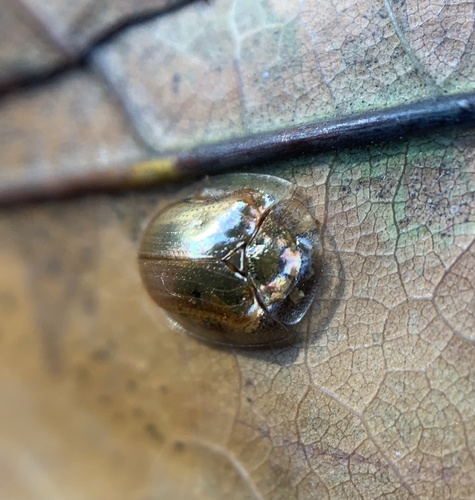
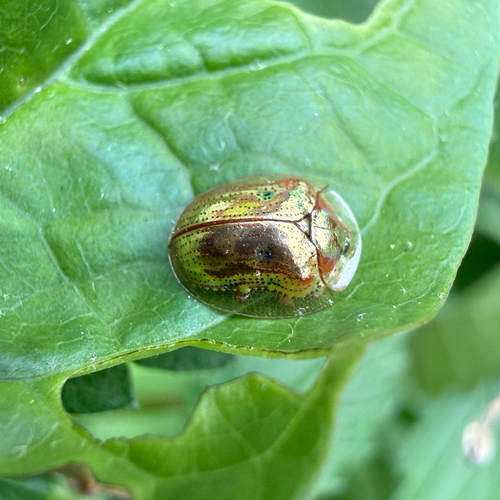
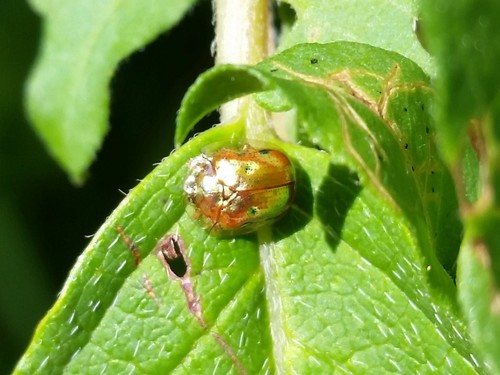
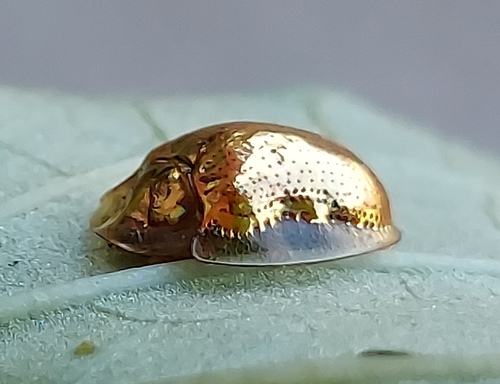
Adults are small (about 5-7 mm long), broadly oval and strongly domed like a tiny rounded shield. The pronotum and elytra have margins that curve down, hiding the legs when at rest. The characteristic trait is a reflective metallic surface: fresh adults often appear bright gold; when upset, the gold fades and the beetle can become red to reddish-brown with a pattern of up to six black spots on the elytra (the species name sexpunctata means "six-spotted"). Legs and underside are darker and not metallic. Larvae are elongate, dark, and bear spines; they typically hold a shield of feces and shed skins over the rear.
- Size about 5-7 mm, broadly oval and strongly domed or shield-shaped like a tiny turtle shell.
- Fresh adults have a bright metallic gold sheen that can change to red or reddish-brown with up to six black spots when disturbed.
- Elytra and pronotum margins curve down to hide legs, giving a smooth, rounded outline.
- Larvae carry a fecal shield (a dark, sticky lump) over the rear — a distinctive tortoise-beetle trait.
Lookalikes
Mottled tortoise beetle Deloyala guttata
Similar size and also on morning glories, but has a dark central pattern on a clear, partly transparent margin and is never uniformly gold.
Argus tortoise beetle Chelymorpha cassidea
Chelymorpha cassidea is larger (about 10 mm), less flattened at the edges, and red to orange with many black spots; it also feeds on bindweeds and morning glories.
↻Life cycle
Egg
Females lay clusters of small, elongate eggs on the underside of host-plant leaves.
Larva
Larvae are spiny and carry a defensive shield made of their feces and shed skins; they feed on the same host leaves as adults.
Pupa
Pupation occurs attached to the host plant, often on the underside of leaves.
Adult (beetle)
Adults emerge, feed on leaves, mate and continue the cycle; several generations may occur in warm climates.
🍃Diet and predators
Young eat
Leaf tissue of Convolvulaceae (morning glory, bindweed, sweet potato)
Adults eat
Leaf tissue of the same host plants; they scrape and chew leaves leaving windowed or skeletonized areas.
Predators of the young
Predatory insects (assassin bugs, ants), birds, parasitic wasps (some species), and spiders.
Predators of adults
Birds, predatory insects and spiders; the domed shape and cryptic metallic sheen provide some defense.
🌱Effect on plants and gardens
Adults and larvae feed on leaves of Convolvulaceae such as morning glories, bindweeds and occasionally sweet potato. Light to moderate feeding usually causes cosmetic leaf damage; heavy infestations can reduce foliage.
How to get rid of golden tortoise beetles
For minor garden damage, handpick adults and larvae into soapy water. Use floating row covers to protect young plants. For larger infestations on sweet potato, monitor and use insecticidal soap or pyrethroid-based products labeled for use on the crop, following label directions. Encourage natural enemies (predatory insects and birds).
📍Where and when to find it
On leaves of morning glories, bindweeds and sweet potato plants. Look on the undersides for eggs and larvae; adults sit on top of leaves.
Best time
Spring through early fall on warm, sunny days; mid-morning to afternoon when beetles are active.
Observation tips
Photograph from above to show the domed, metallic elytra. For larvae, check undersides of leaves for the fecal shield. Use a soft brush to coax adults onto a sheet for close photos.
✨Fun facts
- The beetle's gold color comes from microscopic surface structure and a thin layer of fluid; when that layer changes the visible color shifts to red or brown.
- Larvae use a 'fecal shield' — a clump of their feces and shed skins — as a mobile defense against predators.
- The species name sexpunctata means "six-spotted," referring to the typical pattern of black spots that appear on the red form.
?Frequently asked questions
Are golden tortoise beetles dangerous?
No. They are harmless to people and pets, do not sting or bite, and are not toxic.
Do golden tortoise beetles bite crops?
They feed on leaves of morning glories, bindweeds and sometimes sweet potato. Light feeding is cosmetic; heavy infestations can reduce foliage and harm yields.
Why does my golden tortoise beetle turn red?
The beetle's metallic gold color can change to red or reddish-brown when disturbed, aged, or when the waxy fluid layer that creates the metallic effect is lost.
How do I get rid of golden tortoise beetles in my garden?
Handpick adults and larvae into soapy water for small gardens. Use floating row covers to protect plants. For serious infestations on crops, use approved insecticides or insecticidal soap following label directions and encourage natural predators.
Why is this beetle on my morning glory?
Morning glories and related plants are a preferred food. Adults and larvae feed on the leaves, so those plants attract the beetles.
📷Photos of the golden tortoise beetle
More beetles
This guide was written with AI assistance and fact-checked, last updated 2026-10-10. Identification from photos is never certain: don't handle insects you can't identify, and get medical advice for bites, stings or allergic reactions. More about the golden tortoise beetle: iNaturalist, Wikipedia.