
Twice-stabbed lady beetle
Chilocorus stigma · Lady beetles
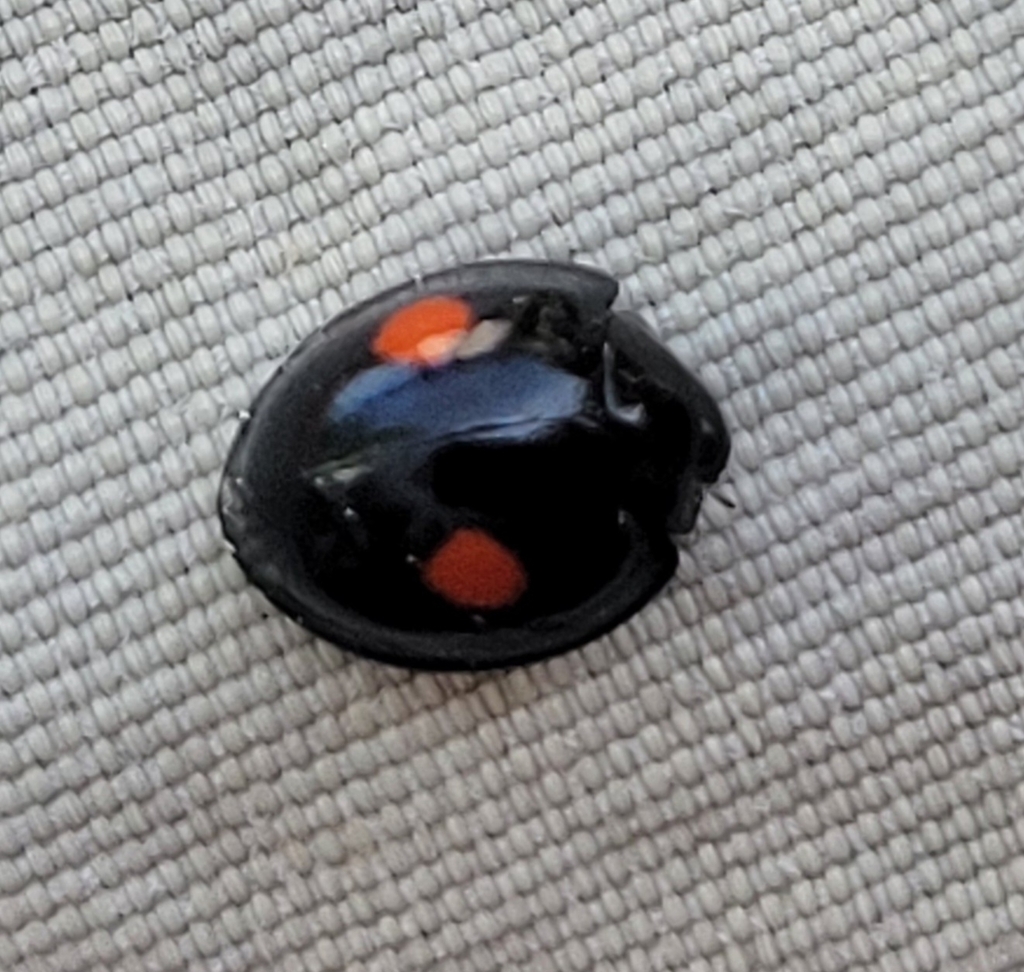
A small black lady beetle with two round red spots that preys on scale insects and other sap-sucking pests.
!Is the twice-stabbed lady beetle dangerous?
No. Not dangerous. Does not have a medically significant bite or sting. Handling may rarely cause mild skin irritation or an unpleasant odor if beetles exude defensive chemicals; wash hands if needed.
Pets
Generally harmless to cats and dogs. Ingesting a few beetles is unlikely to cause harm beyond minor digestive upset.
📖Overview
Chilocorus stigma is a small, mostly black lady beetle native to North America that feeds on scale insects, mealybugs and certain aphids. It is considered a beneficial predator in orchards, gardens and on landscape trees where scale outbreaks occur. Adults and larvae are both predatory; adults are often found on tree bark, branches and under loose bark where scale colonies occur.
These beetles are not harmful to people or pets. They do not have a medically important bite or sting and are valued as natural pest control agents. They overwinter as adults in bark crevices, leaf litter or sheltered sites and become active in spring to hunt prey and reproduce.
🔍How to identify a twice-stabbed lady beetle
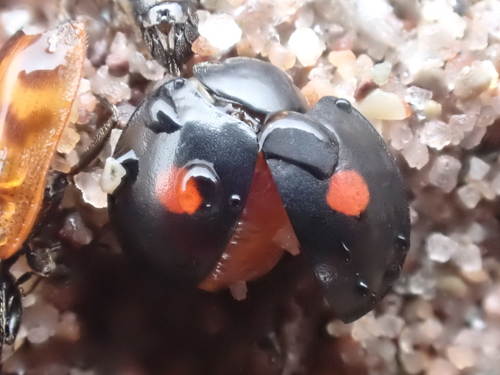
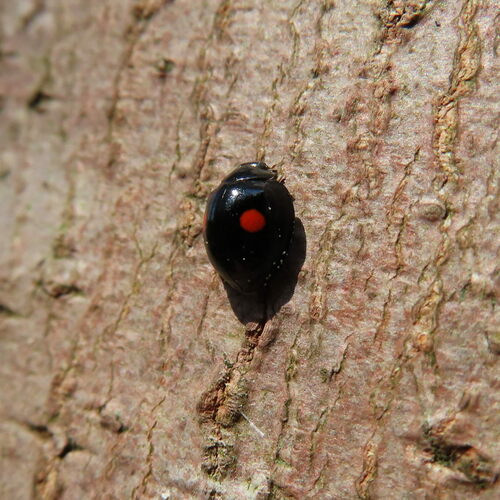
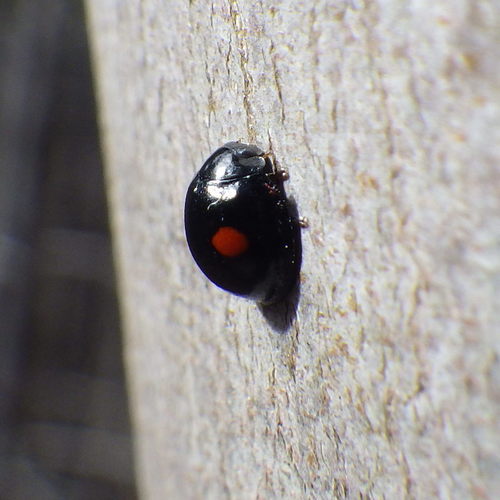
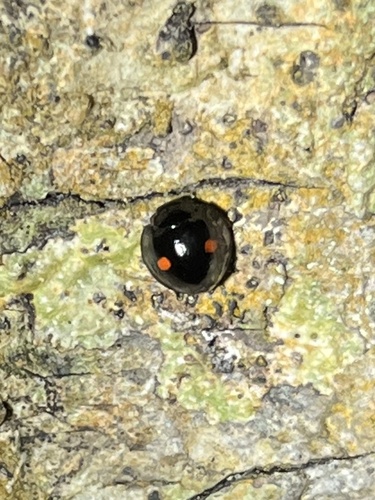
Adult Chilocorus stigma are nearly round to slightly oval, shiny black beetles with two distinct red to orange circular spots—one on each elytron—positioned near the middle of each wing cover; this gives the common name "twice-stabbed." Adults are relatively small and smooth-bodied. Larvae are elongated, somewhat alligator-like in profile, dark grey to black and covered with long, branched spines; they are active predators. Pupae are attached to substrate near feeding sites and resemble a rounded immobile form of the larva.
- Small (3-5 mm), shiny black, rounded, helmet-shaped beetle with one red/orange spot on each elytron.
- Spots are distinct and sit near the middle of each elytron, away from the midline.
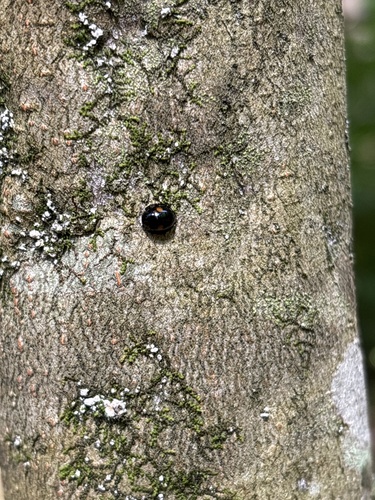
- Found on bark, branches and foliage near scale insect colonies; larvae are dark, elongated and alligator-like.
Lookalikes
Kuwana's lady beetle Chilocorus kuwanae
Very similar overall; C. kuwanae is an introduced species in some areas and can differ subtly in spot shape and pronotum markings—identification often requires close examination or expert confirmation.
Twospotted lady beetle Adalia bipunctata
The black (melanic) form of Adalia bipunctata also has red spots, but they sit near the shoulders, the pronotum has pale markings, and the body is less helmet-shaped.
↻Life cycle
Egg
Small, elongate eggs laid in clusters near colonies of scale insects and other prey.
Larva
Elongate, dark predatory larvae covered with long branched spines that actively feed on scale and mealybug bodies; they undergo several instars.
Pupa
Immobile pupal stage attached to bark or nearby substrate, where metamorphosis into the adult occurs.
Adult
Shiny black beetle with two red spots; adults continue to hunt and reproduce and will overwinter in sheltered sites.
🍃Diet and predators
Young eat
Predatory on scale insects, mealybugs and small hemipteran pests
Adults eat
Predatory on the same sap-sucking insects (scales, mealybugs, some aphids)
Predators of the young
Predatory wasps, ants, birds and other insectivores
Predators of adults
Birds, spiders and larger predatory insects
🌱Effect on plants and gardens
Feeds on armored and soft scales, mealybugs and some aphids, helping reduce pest populations on fruit trees, ornamental trees and shrubs.
📍Where and when to find it
Look on bark, branches and foliage of trees and shrubs where scale insects or mealybugs occur; check under loose bark and in crevices for overwintering adults. Larvae are found close to prey colonies.
Best time
Spring through early fall during warm daylight hours; early morning or midday when temperatures are moderate is often best.
Observation tips
Inspect infested branches and the undersides of twigs. Use a hand lens to see small adults and larvae. Avoid using insecticidal sprays before surveying, as these reduce beneficial populations.
✨Fun facts
- The common name 'twice-stabbed' refers to the two red spots that look like two small 'stabs' on an otherwise black beetle.
- Because they eat scale insects, Chilocorus stigma is considered an important natural control agent in orchards and on ornamental trees.
- Adults can overwinter for several months in bark crevices or leaf litter and reappear in spring to continue feeding.
?Frequently asked questions
Are twice-stabbed lady beetles harmful to people?
No. They are not dangerous and do not have a medically significant bite or sting.
Do twice-stabbed lady beetles bite?
They can nibble if handled roughly but bites are rare, tiny and not harmful.
Why is this beetle on my tree or shrub?
They are hunting for scale insects, mealybugs or other sap-sucking pests and will stay where prey is abundant.
How can I encourage them in my garden?
Avoid broad-spectrum insecticides, provide diverse plantings and leave bark crevices or leaf litter for overwintering habitat to support natural populations.
Are they effective as biocontrol?
Yes. Chilocorus stigma is an effective predator of many scale insect species and can help reduce pest populations in orchards and on ornamentals.
📷Photos of the twice-stabbed lady beetle
More beetles
This guide was written with AI assistance and fact-checked, last updated 2026-10-10. Identification from photos is never certain: don't handle insects you can't identify, and get medical advice for bites, stings or allergic reactions. More about the twice-stabbed lady beetle: iNaturalist, Wikipedia.