
Common black ground beetle
Pterostichus melanarius · Ground beetles
A shiny black, nocturnal predatory beetle common in gardens, fields and woodland edges that helps control pests.
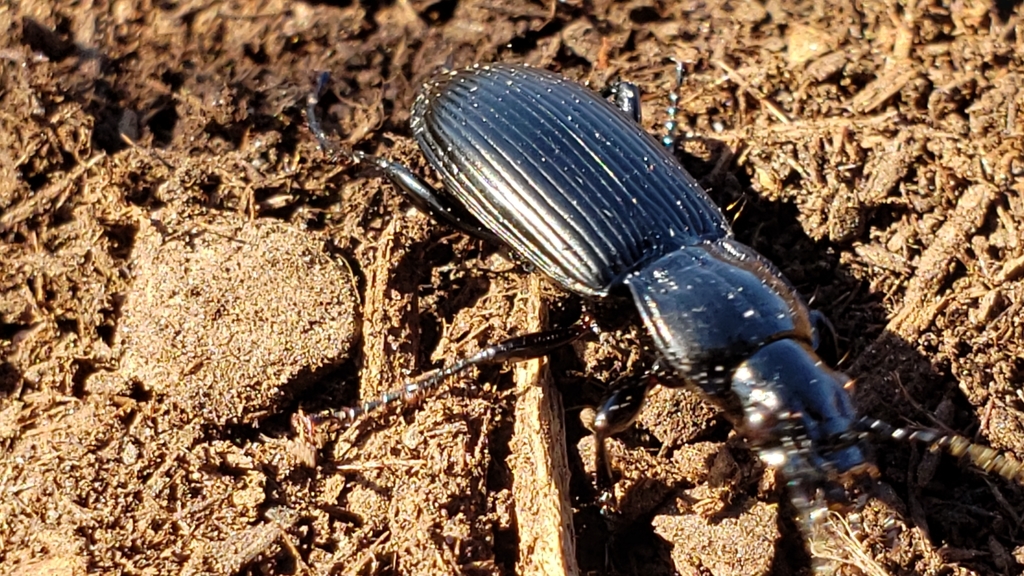
!Is the common black ground beetle dangerous?
No. Not venomous and not medically significant. They may try to bite if handled roughly but bites are rare, small and not dangerous. Wash the area if skin is broken and treat as a minor scrape.
Pets
Harmless to pets. If a pet eats a beetle it is unlikely to cause harm beyond mild stomach upset in some cases.
📖Overview
Pterostichus melanarius is a widespread, primarily nocturnal ground beetle that preys on a wide range of soil-surface invertebrates. Native to much of Europe and parts of Asia, it has been introduced and established in parts of North America. Adults are active hunters that shelter during the day under stones, logs, leaf litter or other ground cover. They are often seen on pavements, in garden beds and around compost heaps at night.
This species is considered beneficial in agricultural and garden settings because it eats slugs, caterpillars, aphids and other pest insects. It does not bite people in any meaningful way and is not venomous. Populations are typically stable in suitable habitats, and the beetle adapts well to disturbed and semi-urban environments.
🔍How to identify a common black ground beetle
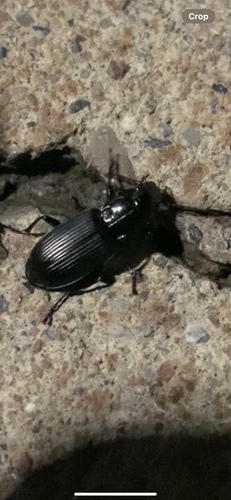
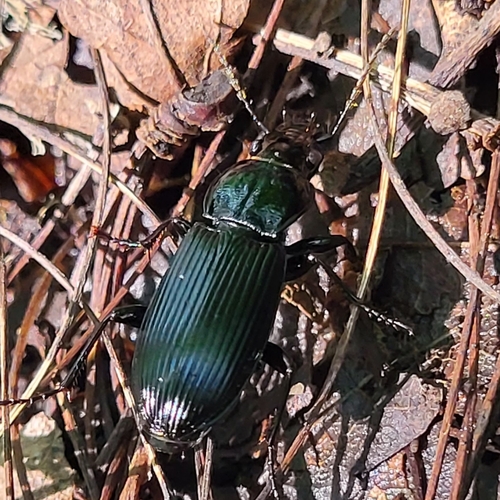
Adults are elongate, moderately flattened beetles with a smooth, shiny black to very dark brown body. The elytra (wing covers) have fine longitudinal striae (grooves) and the pronotum (area behind the head) is narrower than the elytra with rounded sides. Legs and antennae are fairly long and often slightly brownish. Females are similar to males but may be a little broader when viewed from above.
- Shiny, smooth black elongate body 12-18 mm long with fine grooves on the elytra
- Pronotum narrower than elytra with rounded sides and no sharp lateral teeth
- Long legs and antennae; active at night on the ground, often found under stones, logs or leaf litter
- When compared to other dark ground beetles, P. melanarius is relatively common in disturbed and agricultural habitats
Lookalikes
Pterostichus madidus Pterostichus madidus
Very similar in size, shape and colour; P. madidus often has reddish-brown legs, and the two are separated reliably by details of the pronotum and elytra that need close inspection.
Carabus species Carabus spp.
Carabus beetles are generally larger, heavier-bodied and often metallic or sculptured; P. melanarius is smaller and more elongate.
↻Life cycle
Egg
Laid in soil or hidden litter in spring and early summer. Eggs hatch after a few weeks depending on temperature and moisture.
Larva
Active, elongated larvae live in soil and feed on other invertebrates. They go through several growth stages over weeks to months.
Pupa
Larvae pupate in the soil. The pupal stage lasts days to weeks before adults emerge.
Adult
Sexually mature, ground-dwelling beetles that hunt at night. Adults overwinter in sheltered ground debris and resume activity in spring.
🍃Diet and predators
Young eat
Predatory: small soil invertebrates such as insect larvae, springtails and tiny worms
Adults eat
Predatory: slugs, snails, caterpillars, earthworms, other insects and their larvae; opportunistic scavenging occurs
Predators of the young
Ground-dwelling predators such as birds, larger beetles, spiders, centipedes and small mammals
Predators of adults
Birds, mammals (shrews, hedgehogs), larger ground beetles and amphibians; parasitic wasps and mites may affect immature stages
🌱Effect on plants and gardens
Does not feed on healthy plants; helps reduce populations of slugs, caterpillars and other invertebrates that damage crops and garden plants.
📍Where and when to find it
Look at ground level under stones, logs, plant pots, leaf litter and around compost heaps. Larvae are in the soil; adults forage on the surface at night.
Best time
Spring to autumn, after dusk or during the first hours of night; early evening and before dawn are best for spotting active adults.
Observation tips
Check shelters with a torch after dark or gently lift stones and logs during the day. Use a shallow tray and camera close to the ground to photograph the beetle's dorsal side.
✨Fun facts
- Ground beetles like P. melanarius are important biological control agents and can significantly reduce pest numbers in gardens and farms.
- Most individuals have reduced hind wings and cannot fly, though a minority are fully winged; they rely on fast running to hunt.
- Pterostichus melanarius tolerates disturbed habitats and is one of the first ground beetles to colonize newly managed farmland.
?Frequently asked questions
Are common black ground beetles harmful?
No. They are not venomous and do not transmit disease. They are beneficial predators in gardens.
Do Pterostichus melanarius bite?
They can pinch with their mandibles if handled roughly, but bites are rare and not medically significant.
Why is this beetle in my house?
They sometimes enter buildings at ground level seeking shelter, moisture or overwintering sites, especially when disturbed outside cover is scarce.
How do I get rid of them?
Because they are beneficial, avoid killing them when possible. Remove attractive shelters (stones, leaf litter) near foundations, seal gaps at ground level, and use hand removal or a vacuum for occasional indoor visitors.
Where does the common black ground beetle live?
On the ground in gardens, fields, grassland and woodland edges across Europe and parts of Asia; introduced populations occur in North America.
📷Photos of the common black ground beetle
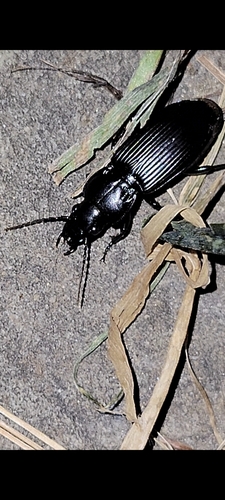
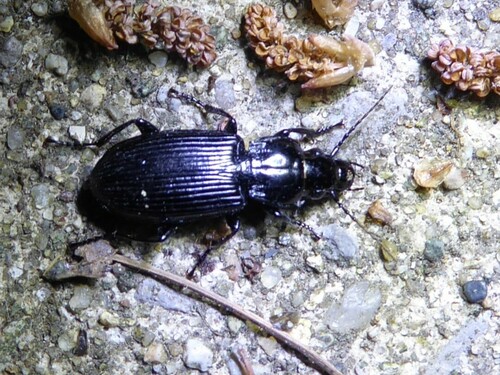
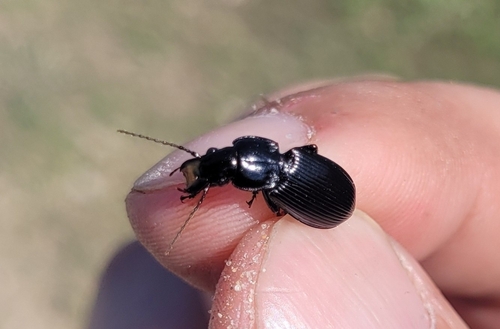
More beetles
This guide was written with AI assistance and fact-checked, last updated 2026-10-10. Identification from photos is never certain: don't handle insects you can't identify, and get medical advice for bites, stings or allergic reactions. More about the common black ground beetle: iNaturalist, Wikipedia.