
Red palm weevil
Rhynchophorus ferrugineus · Snout beetles
A large, long-snouted beetle that bores into palm trunks and crowns; a highly destructive invasive pest of many palm species worldwide.
!Is the red palm weevil dangerous?
No. Red palm weevils are not venomous and do not pose a toxic threat to people. Adults do not normally bite; any nip would be minor. The main concern is economic and ecological damage to palms. When handling pesticide-treated palms or when applying control treatments, follow label safety instructions.
Pets
Not directly harmful or toxic to pets. Pets could spread infested plant material if they chew or move palm offcuts; keep pets away from treated areas and follow pesticide safety precautions.
📖Overview
Rhynchophorus ferrugineus is a species of snout beetle (weevil) whose larvae tunnel inside trunks and crowns of palm trees, often killing heavily infested palms. Native to South and Southeast Asia, it has spread widely through trade and transport of infested palms and planting material and is now established across the Middle East, North Africa, the Mediterranean region of southern Europe and a few Caribbean islands. Adults are strong fliers and use chemical cues and pheromones to find suitable palms for egg laying. Damage is primarily caused by the creamy, legless larvae feeding inside the vascular tissue, which can take months or years to become externally obvious.
Infestations can be difficult to detect in early stages because much of the feeding is internal. Management relies on early detection (traps, inspection), cultural controls (removal of infested palms and quarantine), and targeted insecticide or biological treatments. Because this species attacks economically and culturally important palms (date, coconut, oil and ornamental palms), it is a major concern for agriculture and urban landscapes where palms are planted.
🔍How to identify a red palm weevil
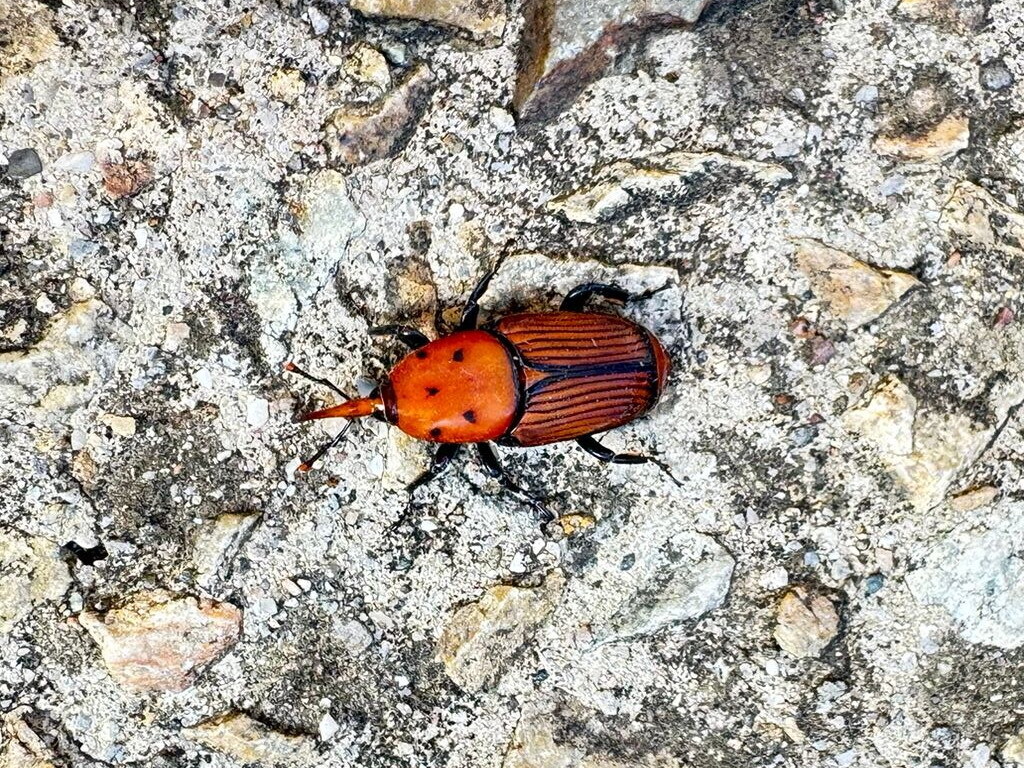
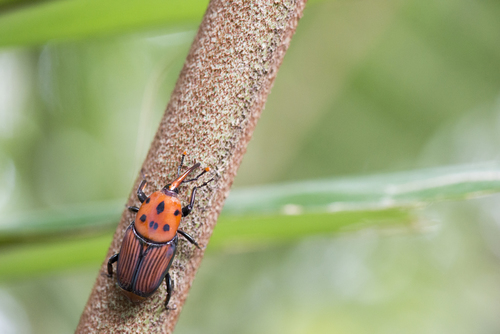
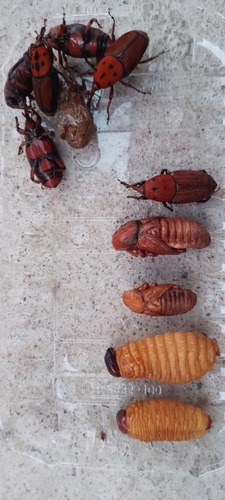
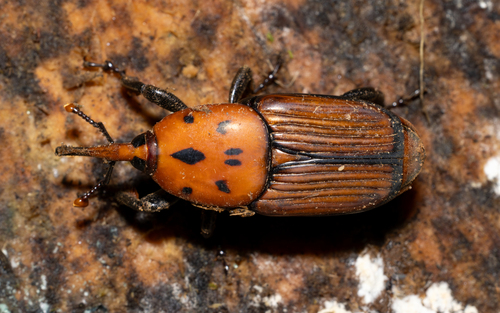
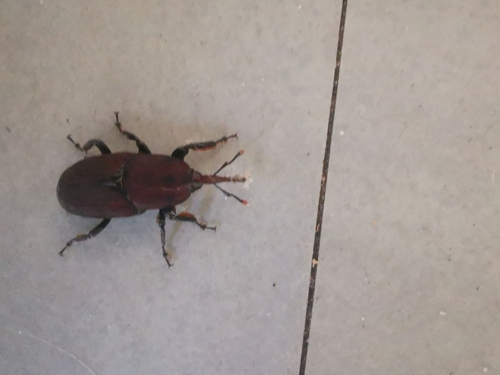
Adults are large, elongate weevils with a characteristic curved rostrum (snout). Body length commonly 20-40 mm (2-4 cm), occasionally up to about 50 mm depending on sex and region. Colouration is variable but often reddish to rust-coloured with black markings or spots; some regional forms are darker or almost black. Antennae are elbowed and arise from the snout. Larvae are cream-coloured, legless grubs with a brown head capsule and can reach 50-60 mm long when fully grown. Pupae are cream to pale brown and found inside a cocoon of palm fibers within the trunk.
- Large weevil with a long, curved snout (rostrum) and elbowed antennae set on the snout.
- Typically reddish-rust body with darker spots or patches; colouration can vary by region.
- Adults 20-40 mm long; larvae are large, creamy legless grubs found inside palm tissue.
- Look for signs of infestation: chewed frass, holes in the crown or trunk, oozing sap, and collapsing crown or wilting fronds.
Lookalikes
Asian palm weevil Rhynchophorus vulneratus
Very similar in appearance; historically confused with R. ferrugineus. Distinguishing often requires geographic context or genetic analysis; some regional color forms overlap.
South American palm weevil Rhynchophorus palmarum
Occurs in Central and South America and the Caribbean; adults are usually entirely black, lacking the reddish colouring of R. ferrugineus.
Sago palm weevil Rhynchophorus bilineatus
Found in parts of Oceania and Southeast Asia; differs in regional distribution and some patterning but still similar-looking to non-experts.
↻Life cycle
Egg
Females lay eggs singly or in small groups in wounds, soft tissue near the crown, leaf bases, or cracks in the trunk. Eggs hatch in about 2-5 days depending on temperature.
Larva (grub)
Legless cream grubs bore and feed inside the palm, creating galleries and extensive damage. Larval stage lasts several weeks to months and is the most destructive stage.
Pupa
Larvae pupate within a cocoon of palm fibers inside the trunk or crown; pupal stage lasts about 1-3 weeks.
Adult
Adults emerge, fly to find palms, mate and the cycle repeats. Adults can live weeks to months and are attracted to stressed, wounded, or healthy palms.
🍃Diet and predators
Young eat
Inner tissues of palm trunks and crowns (fibrous vascular tissue), causing tunnelling and decay.
Adults eat
Sap, plant exudates and soft palm tissue near wounds; adults also feed minimally while seeking egg-laying sites.
Predators of the young
Birds, some predatory insects, parasitoids and entomopathogenic nematodes and fungi (used in biocontrol). Natural enemies exist but are often insufficient to stop outbreaks.
Predators of adults
Birds and predatory insects; parasitoids sometimes attack adults or immatures in native range.
🌱Effect on plants and gardens
Larvae bore into trunks and crowns of many palm species (date palms, coconut, Canary Island date palm, oil palm, ornamental palms and others), weakening and often killing trees. Infested palms may show crown collapse, holes in the trunk, chewed plant tissue, frass (sawdust-like material) and fermenting odours.
How to get rid of red palm weevils
Integrated approach: monitor with pheromone-baited traps to detect and reduce adult numbers; inspect crowns and leaf bases regularly for early signs; remove and destroy heavily infested palms (chip and burn or deep burial) to prevent spread; for early infestations, targeted trunk injection or localized insecticide application and trunk drenches can be effective when applied by professionals. Biological agents (entomopathogenic nematodes, Beauveria bassiana fungi) have shown effectiveness as part of an integrated program. Quarantine and sanitation (avoiding movement of infected palms or offcuts) are critical. Consult local plant health authorities for approved methods and protected-species rules.
📍Where and when to find it
Inspect crowns, leaf bases, and the upper trunk of palms; look for larvae by examining frass, holes and soft areas. Adults may be found on trunks, in crowns or near pheromone traps.
Best time
Year-round in warm climates; look for adult activity in warm months and at dusk. Early detection is easier during periods of active adult flight.
Observation tips
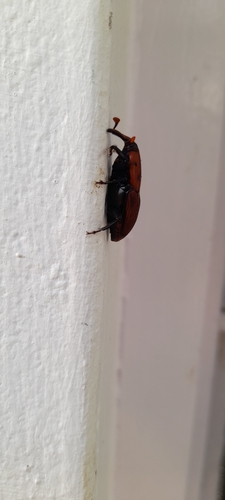
Use pheromone traps to detect adult presence. For photos, capture clear images of the snout, overall body shape and any distinctive markings. When inspecting palms, wear gloves and take precautions with unstable crowns or diseased trees.
✨Fun facts
- The species has spread globally largely via movement of infested palms and nursery stock.
- Pheromone-baited traps are used both for monitoring and to mass-capture adults to slow spread.
- In some cultures, related palm weevil larvae are used as a traditional food source, though R. ferrugineus is primarily known as a pest.
?Frequently asked questions
Do red palm weevils bite?
No — adults are not known to bite people habitually. They are not dangerous to humans, but handling infested palm material can be unpleasant.
Will a red palm weevil kill my palm?
Yes. Heavy or prolonged larval feeding often kills palms by destroying the growing point and vascular tissue; early detection improves chances of saving the tree.
Why is a red palm weevil in my yard?
They are attracted to palms for breeding. Stressed, wounded or recently transplanted palms are especially attractive, and adult weevils can fly in from nearby infestations.
How do I get rid of red palm weevil?
Follow an integrated program: set pheromone traps for monitoring, inspect palms regularly, remove and destroy heavily infested trees, and employ professional trunk injections or approved biological controls for early infestations. Contact local agricultural or plant health authorities for approved, region-specific treatments.
Can I prevent red palm weevil spreading to other palms?
Yes. Quarantine and do not move palms, offcuts or soil from infested sites; use clean planting stock; repair wounds promptly and follow monitoring and trap programs recommended by local authorities.
📷Photos of the red palm weevil
More beetles
This guide was written with AI assistance and fact-checked, last updated 2026-10-10. Identification from photos is never certain: don't handle insects you can't identify, and get medical advice for bites, stings or allergic reactions. More about the red palm weevil: iNaturalist, Wikipedia.