
Goliath beetle
Goliathus goliatus · Goliath beetles
One of the largest and heaviest beetles, a diurnal African scarab that feeds on sap and fruit and whose larvae develop in rich decaying wood and humus.
!Is the Goliath beetle dangerous?
No. Goliathus goliatus is not venomous and poses no toxic risk. Adults have weak, brush-like mouthparts for sap and fruit and do not bite, but their strong, spiny legs and claws can grip and scratch if the beetle is handled. Handle gently; do not put it in the mouth. Clean any scratch with soap and water.
Pets
Not poisonous to pets. A large beetle may startle a curious pet or scratch with its spiny legs; avoid letting pets chew on the beetle to prevent injury to both.
📖Overview
Goliathus goliatus is a very large scarab beetle native to tropical West and Central Africa. Adults are strong fliers, active by day, and are often found on tree sap flows, rotting fruit or flowers. The species is well known to collectors and is frequently reared in captivity because its larvae reach substantial size and are easy to rear on decaying wood and nutrient-rich substrate.
Males typically have a Y-shaped horn on the head used in contests, while females lack or have a much smaller horn. Larvae are thick, C-shaped grubs that feed on decomposing wood and rich organic material; they pupate in the substrate and emerge as adults after metamorphosis.
🔍How to identify a Goliath beetle
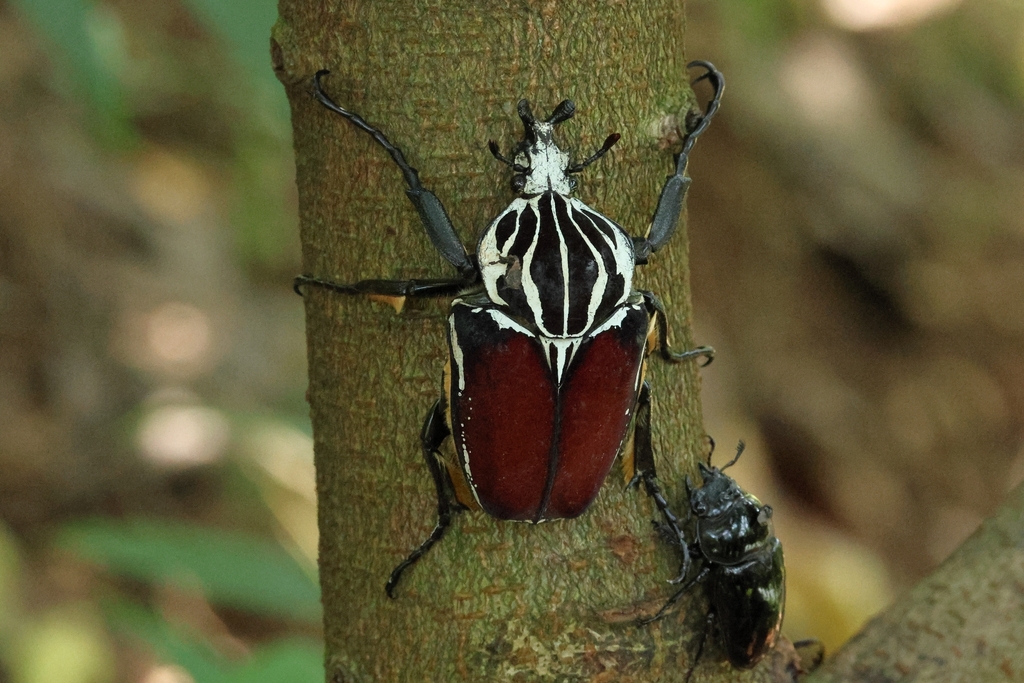
Adults are very large (several centimeters long) and stout, with a glossy, often contrasting pattern of black and pale patches on the elytra and pronotum. Males usually have a prominent Y-shaped horn on the head used for pushing rivals. The legs are robust with spines for gripping wood and branches. Color and pattern vary between populations but commonly include black with white, cream or brown markings.
- Very large, heavy-bodied scarab beetle, 60-110 mm long.
- Contrasting pattern on elytra and pronotum (black with white, cream or brown patches).
- Males usually have a Y-shaped horn on the head; females lack a horn and have a wedge-shaped head for digging.
- Robust legs with spines and a glossy, often slightly hairy body surface.
Lookalikes
Goliath beetle (Goliathus orientalis) Goliathus orientalis
G. orientalis typically has a different elytral pattern and more extensive white areas; geographic ranges and subtle morphology also differ.
Goliath beetle (Goliathus cacicus) Goliathus cacicus
G. cacicus is similar in size but has distinct color pattern and markings on the pronotum and elytra; consultation with keys or comparison to reference specimens helps separate them.
↻Life cycle
Egg
Females lay eggs in decaying wood or rich humus; eggs hatch in a few weeks depending on temperature and moisture.
Larva (grub)
Large C-shaped grubs feed on decaying wood and organic-rich substrate for many months as they grow through several instars.
Pupa
Larvae pupate in chambers within the substrate; metamorphosis takes place over weeks to months before adults emerge.
Adult (beetle)
Adults emerge to feed, mate and disperse. They are strong fliers and are active during the rainy season.
🍃Diet and predators
Young eat
Decaying wood, leaf litter and humus rich in organic matter.
Adults eat
Tree sap, ripe or rotting fruit, and occasionally nectar or plant exudates.
Predators of the young
Small mammals, shrews, ants and other predators that can dig into decaying logs.
Predators of adults
Birds, bats, small carnivores and predatory insects; they may also be collected by people for trade.
🌱Effect on plants and gardens
Adults feed on tree sap, ripe/rotting fruit and occasionally nectar; larvae decompose dead wood and humus, contributing to nutrient cycling rather than damaging living plants.
📍Where and when to find it
Adults: on tree sap flows, rotting fruit, flowers and branches in lowland tropical forest. Larvae: inside decaying logs or rich humus layers.
Best time
Rainy season months in the beetle's local range; adults are diurnal and easiest to spot during daylight on fruiting trees.
Observation tips
Look for large beetles on tree trunks, sap runs and fallen fruit. Use a telephoto lens or approach slowly; if photographing, a low-angle shot shows size and horn shape well.
✨Fun facts
- Goliathus goliatus is among the heaviest insects as an adult; large specimens can weigh several tens of grams.
- Male Goliath beetles use a Y-shaped horn to tussle with other males over food and mates.
- They are popular in the exotic pet and insect trade because their larvae grow large and are straightforward to rear.
?Frequently asked questions
Do Goliath beetles bite or sting?
No. They do not sting and their mouthparts are adapted for sap and fruit, not biting. Their spiny legs can grip and scratch if handled, which is harmless beyond a minor scratch.
Are Goliath beetles dangerous to people or pets?
No—they are not venomous or poisonous. Handle gently because the spiny legs can scratch; small children should be supervised.
Why is a Goliath beetle in my house?
If you live in its range, an adult may fly into a house by day, attracted to sweet fruit or sap nearby. Larvae develop in decaying wood and leaf litter and would not develop inside occupied buildings.
How do I get rid of a Goliath beetle?
They are harmless; capture gently with a container and release outside. Avoid killing it.
Can I keep a Goliath beetle as a pet?
Yes, they are kept by experienced breeders. Larvae need a deep substrate of decaying wood and leaf litter and, unlike most beetle grubs, need extra protein in their diet; adults need fruit or sap-based food. Follow local regulations regarding collection and trade.
How long do Goliath beetles live?
Larval development may take many months; adults typically live several months. In captivity with good care adults often survive 6-12 months.
More beetles
This guide was written with AI assistance and fact-checked, last updated 2026-10-10. Identification from photos is never certain: don't handle insects you can't identify, and get medical advice for bites, stings or allergic reactions. More about the Goliath beetle: iNaturalist, Wikipedia.