
Pine weevil
Hylobius abietis · True weevils
A brown, 8-12 mm weevil whose adults feed on bark of young conifer seedlings and whose larvae develop in stumps and roots, making it a serious forestry pest in Europe and parts of Asia.
!Is the pine weevil dangerous?
No. Pine weevils do not have venom, do not transmit disease, and are not dangerous to people. They may pinch if handled but do not bite in a medically significant way. No special first aid is required beyond cleaning the area if the skin is broken.
Pets
Not toxic to pets. Large numbers could be a nuisance if pets eat them, but they are not known to cause poisoning.
📖Overview
Hylobius abietis is a widespread conifer pest in Europe and parts of temperate Asia. Adults emerge from stumps and woody debris and chew the bark of newly planted pine and spruce seedlings, often killing them by girdling. Females lay eggs in rotting stumps, root plates and nearby soil; larvae are white, C-shaped grubs that feed under the bark of the stumps and roots of recently felled or dead conifers. Adults are long-lived for beetles (often 2-5 years) and can move several hundred metres to a few kilometres in search of host plants, so infestations are persistent near recently harvested or thinned forest.
🔍How to identify a pine weevil
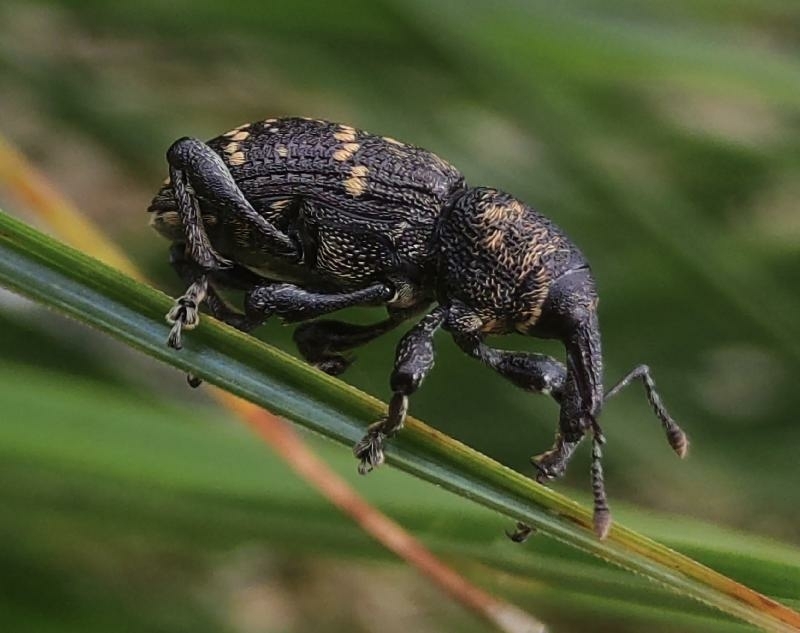
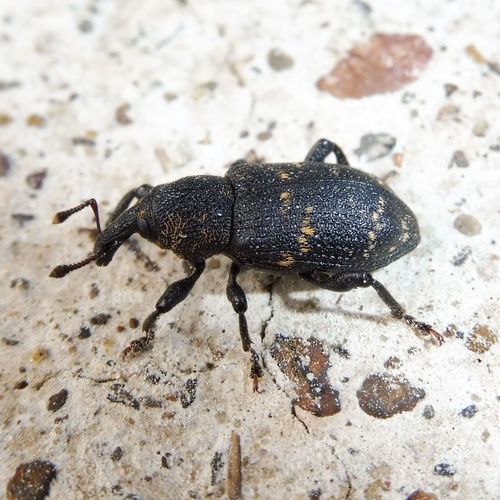
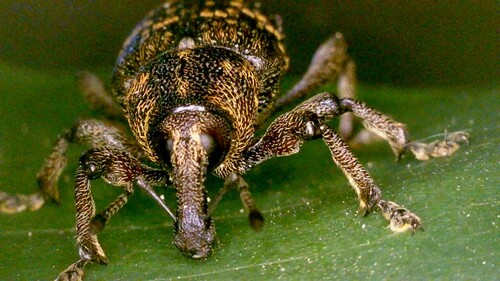
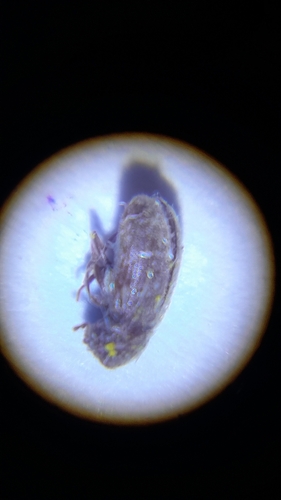
Adult pine weevils are robust weevils about 8-12 mm long with a distinct snout (rostrum). The body is elongate-oval and covered with patches of reddish-brown and black scales that give a mottled brown appearance. Legs and rostrum are typically darker. Larvae are legless, creamy-white, C-shaped grubs with brown head capsules and grow to about 15-20 mm when fully grown.
- Size 8-12 mm with a distinct elongated snout (rostrum) typical of weevils
- Mottled reddish-brown and black scaly patches on the elytra giving a rough, camouflaged look
- Adults often found on or near young conifer seedlings, and fresh feeding marks are semicircular or irregular gouges on bark
- Larvae are C-shaped, creamy-white grubs in stumps and root plates
Lookalikes
Other Hylobius species Hylobius spp.
Related Hylobius species are similar in shape; H. abietis tends to be larger and more widespread in Europe. Specific identification may require close examination of scale pattern and male genitalia.
Black vine weevil Otiorhynchus sulcatus
Black vine weevil is generally uniformly dark and lacks the pronounced mottled reddish-brown scaling of H. abietis and is more commonly a nursery and garden pest on broad-leaved plants.
↻Life cycle
Egg
Females lay small white eggs in cracks in stumps, root collars and nearby soil, often in rotting wood or humus.
Larva (grub)
Larvae are white, legless, C-shaped grubs that feed in stumps and roots for many months, sometimes overwintering.
Pupa
Pupation occurs in the soil or within decaying wood near the feeding site; pupal stage lasts a few weeks before adults emerge.
Adult (weevil)
Adults emerge in spring and feed on bark of seedlings and young trees; they can live several years and reproduce multiple times over their life.
🍃Diet and predators
Young eat
Inner bark (phloem) of stumps and roots of recently felled or dead conifers
Adults eat
Feed on bark and cambium of young conifer stems (pine, spruce, fir), especially seedlings and saplings
Predators of the young
Soil-dwelling predators, parasitic wasps and fungi can attack larvae; birds and mammals occasionally consume grubs when exposed
Predators of adults
Predatory beetles, birds, small mammals and parasitic hymenoptera may prey on adults; entomopathogenic fungi and nematodes can also affect populations
🌱Effect on plants and gardens
Adults strip bark from stems of young conifers (pine, spruce, fir) causing girdling and mortality; larvae develop under the bark of stumps and roots of freshly cut conifers; it is the adult feeding that makes the species so damaging in plantations.
How to get rid of pine weevils
Integrated measures work best: remove or burn leftover stumps and root plates when feasible to reduce breeding sites; protect young seedlings with physical guards (tree collars, plastic mesh) or insect-proof sleeves; use traps baited with conifer odours (such as pine billets or alpha-pinene and ethanol lures) to monitor adult numbers; in some situations targeted insecticides or seedling treatments are used by forestry managers — follow local regulations and professional advice. Replanting away from recently harvested areas and using rapid cultivation methods can reduce losses.
📍Where and when to find it
Look on young conifer seedlings and nearby stumps, root plates and piled slash. Larvae are found inside stumps and roots.
Best time
Best observed from spring to autumn, especially at dusk or at night when adults feed.
Observation tips
Examine new planting areas near recent clear-cuts. Use a flashlight at dusk to spot adults on stems; look for characteristic feeding damage (gouged bark) at the base of seedlings.
✨Fun facts
- Adult pine weevils can live several years, which helps populations persist near harvested sites.
- They are strongly attracted to the resin odours (such as alpha-pinene) and ethanol given off by fresh conifer stumps, which forestry managers use for monitoring and trapping.
- Larvae develop harmlessly in stumps; the species is economically important because the adults kill newly planted trees.
?Frequently asked questions
Do pine weevils bite people?
They can pinch if handled but do not bite in a medically significant way and are not dangerous to people.
Are pine weevils harmful to trees?
Yes: adults feed on the bark of young conifer seedlings and can kill them by girdling; larvae damage roots and develop in stumps.
Why are pine weevils in my planting area?
They colonise areas with recent clear-cutting or many stumps, which provide breeding sites. Adults disperse to nearby replanting areas to feed on seedlings.
How do I get rid of pine weevils?
Reduce breeding habitat by removing or treating stumps, protect seedlings with physical guards, use odour-baited traps for monitoring, and consult forestry extension services about approved insecticide or biological options.
When are pine weevils most active?
Adults are active from spring through autumn (commonly April to October), feeding mainly at night and during dusk and dawn.
📷Photos of the pine weevil
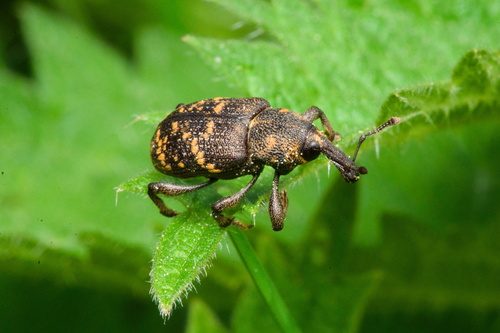
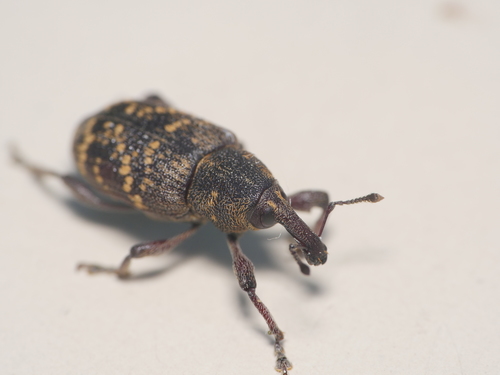
More beetles
This guide was written with AI assistance and fact-checked, last updated 2026-10-10. Identification from photos is never certain: don't handle insects you can't identify, and get medical advice for bites, stings or allergic reactions. More about the pine weevil: iNaturalist, Wikipedia.