
Emerald ash borer
Agrilus planipennis · Metallic wood-boring beetles
A small metallic green wood-boring beetle native to Asia that is a highly destructive invasive pest of ash trees.
!Is the emerald ash borer dangerous?
No. Emerald ash borer does not bite or sting people and is not harmful or venomous. It poses no direct health risk to humans, though heavy infestations can increase dead wood hazards in urban areas (falling branches or trees).
Pets
Not toxic to pets. Pets could be injured by falling dead branches or trees in heavily infested areas, but the beetle itself is harmless to animals.
📖Overview
Agrilus planipennis is a metallic wood-boring beetle in the family Buprestidae. Native to northeastern Asia, it was first detected in North America in the early 2000s and has since killed millions of ash trees. Adults feed on ash foliage but cause little direct damage; the destructive stage is the larva, which tunnels under the bark and disrupts the tree's water and nutrient transport. Spread occurs naturally by adult flight and over long distances by movement of infested firewood, nursery stock, and other ash wood materials.
🔍How to identify an emerald ash borer
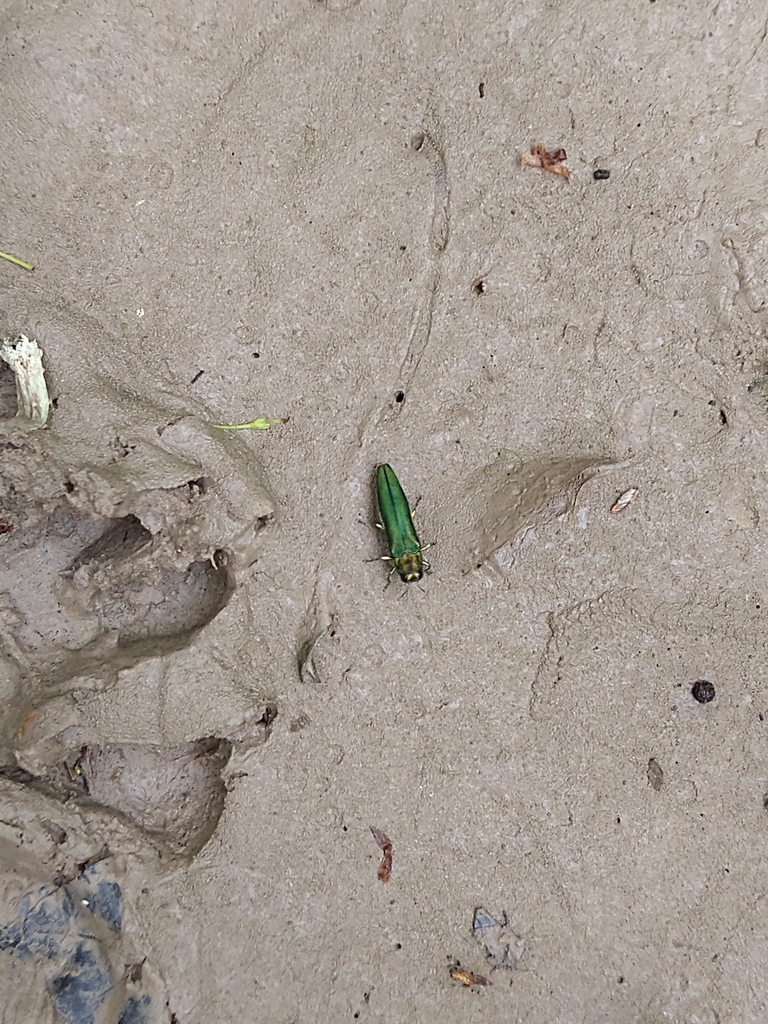
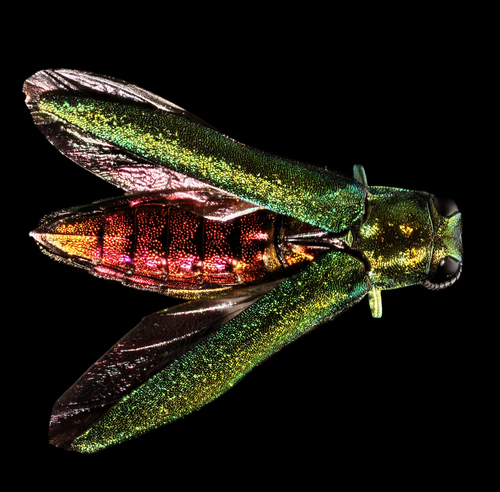
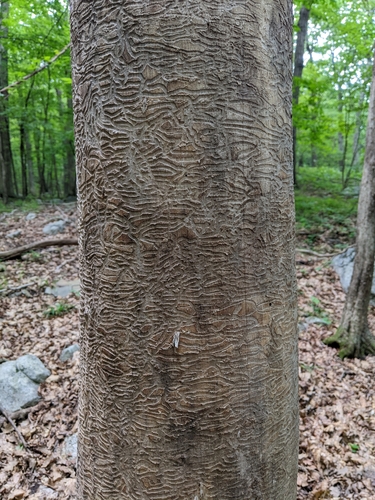
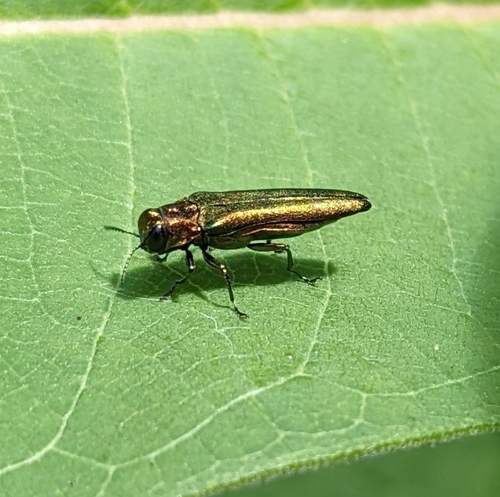
Adults are slim, elongated, and metallic emerald green with a jewel-like sheen. They are 7.5-13.5 mm long and about 3-3.5 mm wide, giving a narrow, bullet-shaped profile. The wing covers (elytra) are finely textured; when the wings are spread, the upper surface of the abdomen is a bright metallic coppery-red, a key feature. Larvae are cream-colored, flattened, and elongate with bell-shaped segments, and carve S-shaped galleries in the inner bark and outer sapwood; mature larvae reach about 26-32 mm long.
- Small metallic green beetle 7.5-13.5 mm long with a narrow, elongate body; the abdomen under the wings is coppery-red.
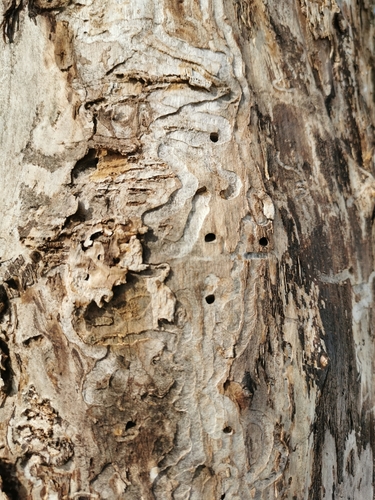
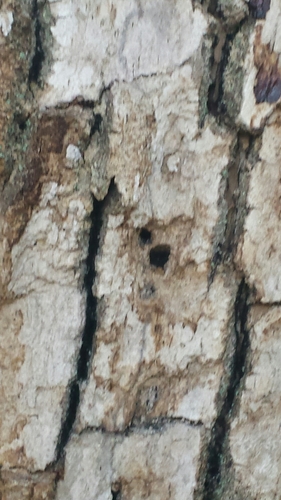
- D-shaped emergence holes about 3-4 mm wide in the bark of ash trees.
- S-shaped larval galleries visible under peeled bark and thinning, wilting crown on infected ash trees.
- Other signs of infestation include epicormic shoots, bark splitting, and increased woodpecker activity on ash trunks.
Lookalikes
Two-lined chestnut borer Agrilus bilineatus
Also an Agrilus species but typically has two pale lines on the elytra and is associated with stressed hardwoods like chestnut and oak; host tree and elytral markings help distinguish it.
Native Agrilus species Various Agrilus spp.
Many native Agrilus are smaller or have different host trees and lack the bright uniform metallic green of EAB; correct ID may require expert examination.
↻Life cycle
Egg
Females lay single eggs in bark crevices of ash trees in late spring to summer. Eggs are small, about 1 mm, and hatch in 1-2 weeks.
Larva (grub)
Larvae are white, flattened, and legless with bell-shaped segments. They tunnel beneath the bark in serpentine galleries, feeding on phloem and outer sapwood. Larval development usually spans one to two years depending on climate.
Pupa
Larvae pupate in chambers in the outer sapwood or bark in spring. Pupation lasts days to weeks before adults emerge.
Adult beetle
Adults chew a distinctive D-shaped exit hole in the bark and feed on ash foliage for a short period before mating and laying eggs. Adults are active in warm months and survive a few weeks to a few months.
🍃Diet and predators
Young eat
Inner bark and outer sapwood (phloem and cambial tissues) of ash trees.
Adults eat
Feed on ash foliage; adult feeding causes minor damage compared with larval feeding.
Predators of the young
Woodpeckers, some predatory insects and parasitoid wasps (introduced and native species may attack larvae).
Predators of adults
Birds and predatory insects; introduced parasitoid wasps used in biological control attack the eggs and larvae rather than adults.
🌱Effect on plants and gardens
Larvae feed on the inner bark and outer sapwood of ash trees (Fraxinus spp.), interrupting water and nutrient flow and typically killing infested trees within 2-10 years depending on infestation intensity and tree health. Ash species vary in susceptibility; some North American ash have little resistance.
How to get rid of emerald ash borers
Prevent movement of firewood and ash wood products from infested areas. For valuable trees, professional systemic insecticide treatments (trunk injections or soil-applied systemic products containing emamectin benzoate or other labeled active ingredients) can protect trees when applied correctly and on the recommended schedule. Biological control using parasitic wasps has been used in some regions but provides slow population suppression. Heavily infested trees may need removal to reduce risk of falling limbs and limit local beetle spread. Contact local forestry or extension services for regulated control and quarantine rules.
📍Where and when to find it
Look on ash trees: adults on foliage and trunks in summer; under loose bark for larval galleries; D-shaped exit holes on bark. Dead or declining ash often show obvious signs.
Best time
Best observed May to August for adults; larval galleries and exit holes can be seen year-round when bark is peeled.
Observation tips
Check lower trunk and branches for bark splitting and woodpecker damage. Use binoculars to inspect crowns and consult local extension services for confirmed identification.
✨Fun facts
- First confirmed in North America in 2002, EAB has killed hundreds of millions of ash trees and drastically changed some urban and forest landscapes.
- The D-shaped exit hole is a signature sign used by arborists and foresters to confirm adult emergence.
- Moving infested firewood is a major pathway for long-distance spread; many management campaigns focus on 'Don't Move Firewood' outreach.
?Frequently asked questions
Is the emerald ash borer dangerous to people?
No. It does not bite or sting and is not harmful to humans, but it kills ash trees which can create hazards from falling branches or dead trees.
Do emerald ash borers bite or sting?
No. They do not bite or sting people or pets.
Why is an emerald ash borer in my yard?
If you have ash trees, EAB may be present because it targets ash as its host. Infestations often start where ash are abundant or after infested wood was moved into the area.
How do I get rid of emerald ash borer?
For individual high-value trees, hire a certified arborist to apply recommended systemic insecticides or injections. For large infestations, removal of heavily infested trees and coordinated management with local authorities is common. Follow local quarantine and disposal rules.
How can I tell if my ash tree has emerald ash borer?
Look for D-shaped exit holes, S-shaped larval galleries under the bark, thinning or sprouting in the crown, epicormic shoots, bark splitting, and increased woodpecker activity.
Can cutting or burning firewood stop spread?
Restricting movement of firewood from infested areas is one of the most effective ways to slow human-assisted spread. Burning on-site removes infested material; follow local regulations.
📷Photos of the emerald ash borer
More beetles
This guide was written with AI assistance and fact-checked, last updated 2026-10-10. Identification from photos is never certain: don't handle insects you can't identify, and get medical advice for bites, stings or allergic reactions. More about the emerald ash borer: iNaturalist, Wikipedia.