
Bloody-nosed beetle
Timarcha tenebricosa · Leaf beetles
A stout, flightless black leaf beetle that reflex-bleeds bright red haemolymph when threatened and feeds mainly on bedstraw and similar low plants.

!Is the bloody-nosed beetle dangerous?
No. Not venomous and does not bite people. The beetle can exude red haemolymph that tastes bitter and can stain skin or clothing; avoid handling if you do not want stains. Wash skin with soap and water if contact occurs.
Pets
Generally harmless to pets. The bitter haemolymph is unpalatable; ingestion in small numbers is unlikely to cause serious harm but may cause mild stomach upset.
📖Overview
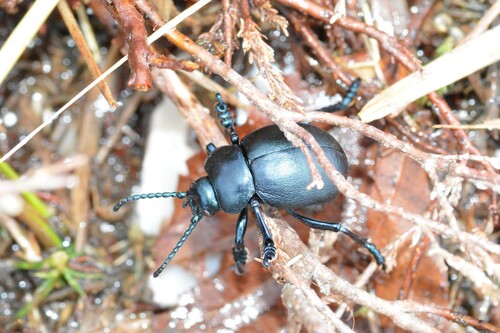
Timarcha tenebricosa is a compact, slow-moving leaf beetle common across much of Europe. It is flightless (elytra fused), with a rounded, domed body and glossy dark coloration. When disturbed it often releases a bright red haemolymph from joints or mouthparts — hence the name "bloody-nosed" — which is a defensive, unpleasant-tasting fluid. Adults and larvae feed on low-growing herbs, especially bedstraws (Galium spp.). This species is not dangerous to people and is not usually a major garden pest.
🔍How to identify a bloody-nosed beetle
Adults are robust and elongate-oval with completely fused elytra, so they cannot fly. They have a smooth, shiny surface with no prominent spots or stripes; legs and antennae are relatively short. When handled or threatened many individuals exude a bright red fluid from joints or the mouthparts (reflex bleeding). Larvae are soft-bodied, grub-like and feed openly on host plants.
- Glossy, rounded black or very dark blue-black body with fused elytra — beetle cannot fly.
- Size about 11-18 mm and noticeably stout/compact compared with most other leaf beetles.
- If handled, may exude bright red haemolymph from joints or mouthparts (bloody-nosed behaviour).
- Short antennae and legs relative to body size; smooth, unspotted elytra.
Lookalikes
Lesser bloody-nosed beetle Timarcha goettingensis
Very similar; T. goettingensis is smaller (about 8-11 mm) with a more finely punctured surface. Size is the easiest clue, but genitalia examination is sometimes needed for reliable separation.
Other black Chrysomelid beetles Various
Other leaf beetles may be less rounded or have visible separable elytra and are often able to fly; check for fused elytra and the reflex bleeding behaviour.
↻Life cycle
Egg
Small eggs are laid on or near host plants. Exact clutch sizes vary; eggs hatch into larvae that feed on the same host plants.
Larva (grub)
Larvae are soft-bodied and feed openly on leaves of host plants. They grow through several instars before pupation.
Pupa
Larvae pupate in the soil or leaf litter near food plants, metamorphosing into adults.
Adult
Adults are flightless, feed on the same plants as larvae, and may overwinter to reproduce the following season.
🍃Diet and predators
Young eat
Leaves of bedstraws (Galium spp.) and related low herbaceous plants.
Adults eat
Same as larvae — mostly Galium spp. and other low-growing herbs.
Predators of the young
Ground predators such as beetles, spiders, birds and small mammals; parasitic wasps may attack larvae in some areas.
Predators of adults
Birds, small mammals and predatory insects; chemical defence (bitter haemolymph) reduces predation by some predators.
🌱Effect on plants and gardens
Feeds mainly on bedstraws (Galium species) and other low herbaceous plants; may cause local defoliation of host plants but rarely causes serious damage to gardens or crops.
📍Where and when to find it
Search on bedstraw (Galium spp.) and other low herbaceous plants in meadows, grassy margins, hedgerows and gardens. Adults on foliage; larvae on the same plants.
Best time
April to September in temperate Europe; daytime when temperatures are mild and plants are in leaf.
Observation tips
Photograph from above to show the rounded fused elytra and glossy surface. Avoid squeezing; the red haemolymph can stain clothing and hands.
✨Fun facts
- The "bloody nose" is not blood but red-coloured haemolymph used as a chemical defence.
- Unlike many beetles, Timarcha tenebricosa cannot fly because its elytra are fused.
- Its slow, heavy appearance and bright defensive bleed make it easy to recognise in the field.
?Frequently asked questions
Do bloody-nosed beetles bite?
No. They do not bite people; handling may cause reflex bleeding but they are not aggressive.
Are bloody-nosed beetles poisonous?
No, they are not poisonous to touch. The red haemolymph tastes bitter to predators and can stain skin, but it is harmless to people; just wash your hands after handling.
Why is a bloody-nosed beetle in my house or garden?
They occur where their food plants grow. If you have patches of bedstraw or similar low herbs near paths, walls or lawns they may wander into gardens or buildings while searching for food or shelter.
How do I get rid of bloody-nosed beetles?
For small numbers, handpick and relocate them or drop them into soapy water. Removing or thinning host plants nearby reduces local populations. Broad chemical controls are usually unnecessary.
Can bloody-nosed beetles damage my garden?
They feed on low plants and can defoliate small patches of host plants, but they rarely cause serious damage to gardens or crops.
📷Photos of the bloody-nosed beetle


More beetles
This guide was written with AI assistance and fact-checked, last updated 2026-10-10. Identification from photos is never certain: don't handle insects you can't identify, and get medical advice for bites, stings or allergic reactions. More about the bloody-nosed beetle: iNaturalist, Wikipedia.