
Rosemary beetle
Chrysolina americana · Leaf beetles
A small, metallic green and purple leaf beetle that feeds on rosemary and other aromatic herbs and can damage garden herbs when abundant.
!Is the rosemary beetle dangerous?
No. Rosemary beetles do not bite or sting and are not venomous. They are harmless to humans; handle gently if necessary. No special first aid is required beyond normal handwashing after handling insects.
Pets
Not known to be toxic to pets. Large numbers could nibble pet-accessible herb plants but direct harm to pets is unlikely.
📖Overview
Chrysolina americana is a small, brightly metallic leaf beetle in the family Chrysomelidae. Adults feed on leaves and flowers of aromatic plants in the mint family (Lamiaceae), especially rosemary, lavender, thyme and sage. Originally native to the Mediterranean region, it has spread beyond its native range and is now often found in gardens where its preferred herbs are grown.
The beetle is not dangerous to people or pets, but when present in large numbers it can defoliate herb plants and reduce their vigour. Outbreaks are usually concentrated on cultivated herbs near homes and gardens rather than wild vegetation.
🔍How to identify a rosemary beetle
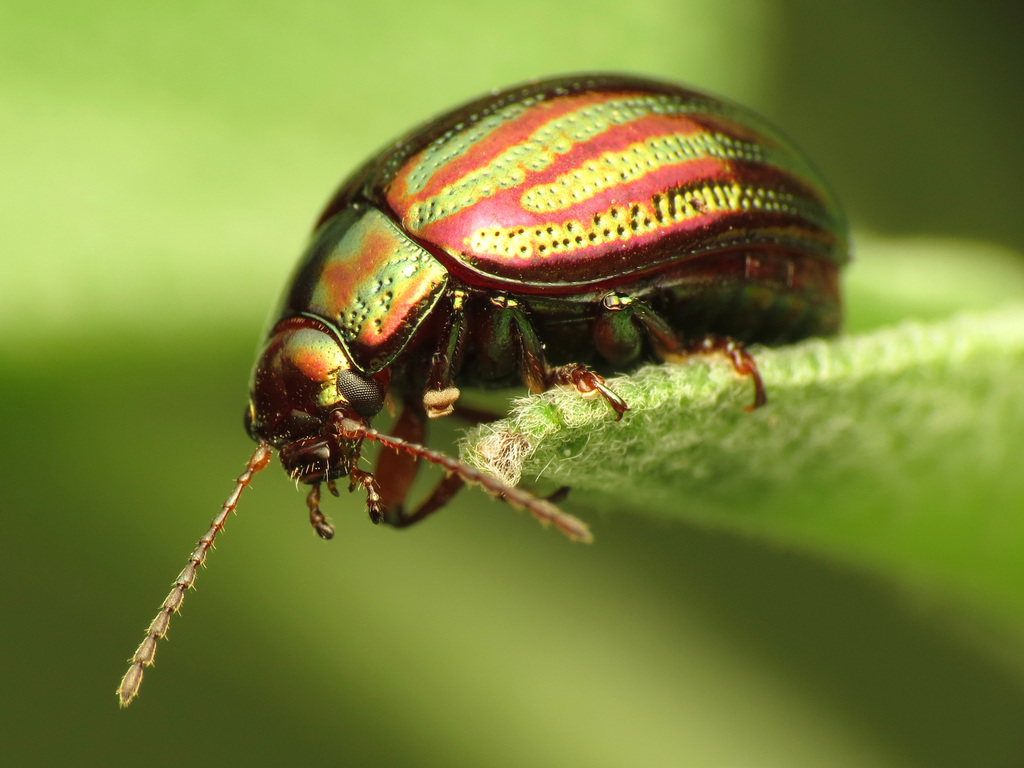
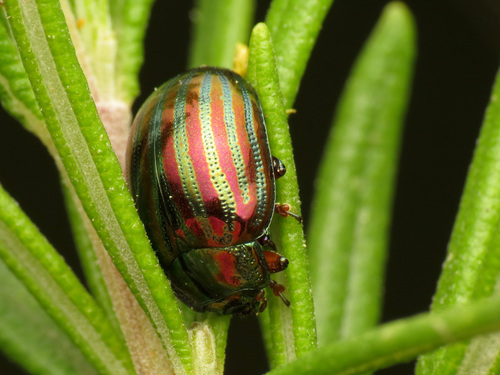
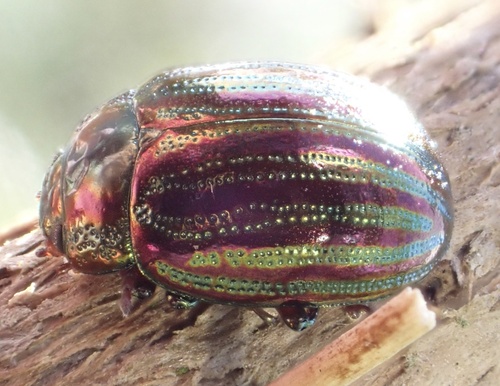
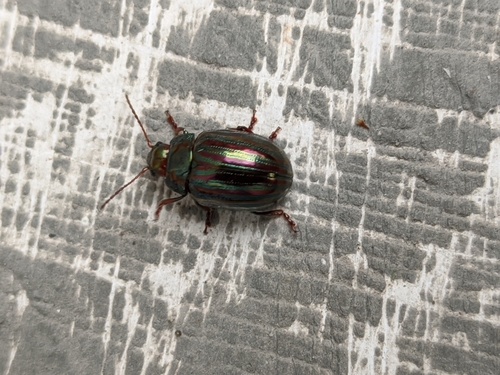
Adults are compact, oval beetles about 5-8 mm long with a highly metallic, iridescent appearance. The elytra (wing cases) show alternating longitudinal bands of bright metallic green and purple-bronze, often with a golden sheen around the edges. Legs and antennae are metallic bronze to dark. Larvae are soft-bodied, plump, and usually grey-brown; they feed on the underside of leaves and on growing tips.
- Small oval beetle 5-8 mm long with striking metallic green and purple-bronze longitudinal bands.
- Found feeding on rosemary, lavender, thyme, sage and other mint-family herbs; often seen crawling on leaves and stems.
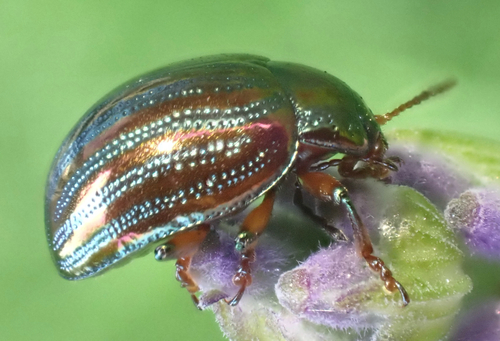
- Shiny iridescent elytra with narrow alternating colour stripes and a golden sheen around edges.
- When disturbed, adults usually drop from plants or hide in dense foliage; they rarely fly.
Lookalikes
Other metallic Chrysomelid leaf beetles Various Chrysomelidae
Many leaf beetles are metallic green but Chrysolina americana is distinctive for its alternating green and purple-bronze longitudinal bands and small size; look at host plant (herbs) and the striped elytra to separate it from plain metallic species.
Green dock beetle Gastrophysa viridula
Gastrophysa viridula is metallic green but feeds on docks (Rumex) and lacks the purple-bronze striped pattern of the rosemary beetle.
↻Life cycle
Egg
Females lay small clusters of eggs on the underside of host-plant leaves or near growing tips. Eggs hatch in days to weeks depending on temperature.
Larva
Larvae are leaf-feeding and may hide on the undersides of leaves or within dense foliage. They grow through several instars over one to several weeks.
Pupa
Larvae pupate in the soil or leaf litter near host plants, transforming into adults after a pupal period of several days to weeks.
Adult
Adults emerge, feed on host plants and reproduce. There is usually one generation per year; adults are long-lived and can be found on host plants year-round, laying eggs mainly from late summer to spring.
🍃Diet and predators
Young eat
Leaves and soft tissue of rosemary, lavender, thyme, sage and other Lamiaceae
Adults eat
Leaves, shoots and flowers of aromatic herbs in the mint family (Lamiaceae), especially rosemary and lavender
Predators of the young
Predatory insects, spiders and insectivorous birds
Predators of adults
Birds, predatory insects and some parasitic wasps (specific parasitoids are not well documented for this species)
🌱Effect on plants and gardens
Adults and larvae feed on leaves and tender shoots of rosemary, lavender, thyme, sage and other members of the mint family. Heavy feeding can cause cosmetic damage, reduce growth and occasionally defoliate young plants.
How to get rid of rosemary beetles
For small infestations hand-pick beetles, larvae and egg clutches from plants and drop them into a container of soapy water. Prune out and destroy heavily affected shoots. Encourage natural enemies such as predatory insects and birds. For severe infestations, use insecticidal soap, horticultural oil or a pyrethrin product labelled for use on edible herbs, following label instructions. Avoid broad-spectrum insecticides that kill beneficial insects and bees. Inspect nursery stock and new herb plants before planting to reduce introductions.
📍Where and when to find it
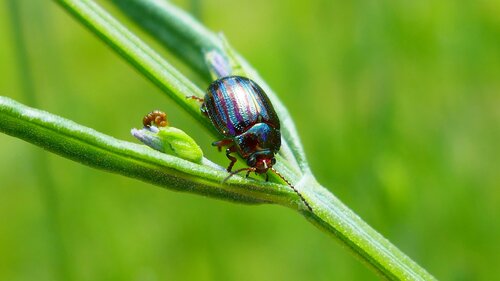
Look on rosemary, lavender, thyme, sage and other mint-family herbs; adults are on leaves, stems and flowers, larvae on undersides of leaves and within foliage.
Best time
Year-round in temperate regions, but adults and larvae are easiest to find from late summer through spring; mild, sunny days are best for observing adults.
Observation tips
Inspect new herb plants before bringing them into the garden. Photograph beetles on herb foliage from several angles to show the striped elytra for identification.
✨Fun facts
- Although called the rosemary beetle, it commonly uses several different aromatic herbs in the mint family.
- Its bright metallic colours make it easy to spot on green herb foliage during warm months.
- It spread northwards out of the Mediterranean in recent decades, partly via the trade in potted herbs and nursery plants.
?Frequently asked questions
Are rosemary beetles harmful to people?
No. They do not bite or sting and are not poisonous to people.
Will rosemary beetles kill my rosemary?
Heavy infestations can defoliate young or small plants and reduce growth, but established shrubs usually recover if beetle numbers are controlled.
How do rosemary beetles get into my house or garden?
They are often introduced on potted herbs or nursery stock; adults can also fly short distances between nearby plants.
How do I get rid of rosemary beetles?
Hand-picking and destroying beetles and larvae is effective for small infestations. For larger outbreaks use insecticidal soap, horticultural oil or a labelled insecticide for edible herbs, and inspect new plants before planting.
Do rosemary beetles fly away when disturbed?
They can fly but often drop from plants or hide in dense foliage when disturbed; flight ability varies with temperature and individual beetles.
📷Photos of the rosemary beetle
More beetles
This guide was written with AI assistance and fact-checked, last updated 2026-10-10. Identification from photos is never certain: don't handle insects you can't identify, and get medical advice for bites, stings or allergic reactions. More about the rosemary beetle: iNaturalist, Wikipedia.