
Green tiger beetle
Cicindela campestris · Tiger beetles
A fast, metallic green day‑active beetle found on sunny bare ground in Europe; a striking predator that can deliver a painful but harmless bite.
!Is the green tiger beetle dangerous?
No. Not venomous. Adults can deliver a sharp pinch with their strong mandibles if handled, which is painful but not medically dangerous. Clean any bite as you would a small puncture wound and seek medical help only if signs of infection or an allergic reaction occur.
Pets
Not toxic. A curious pet might get a pinch from the beetle; no venomous risk. Dogs or cats that eat many beetles could experience mild digestive upset.
📖Overview
Cicindela campestris is a widespread, diurnal ground‑beetle known for its bright metallic sheen and extremely fast running speed. Adults hunt visible prey on sunny patches of bare soil, paths and heathland. Larvae are sit‑and‑wait predators that live in vertical burrows and capture passing arthropods. The species is common across much of Europe and parts of western Asia and is associated with open, well‑drained, often sandy or gravelly soils.
🔍How to identify a green tiger beetle
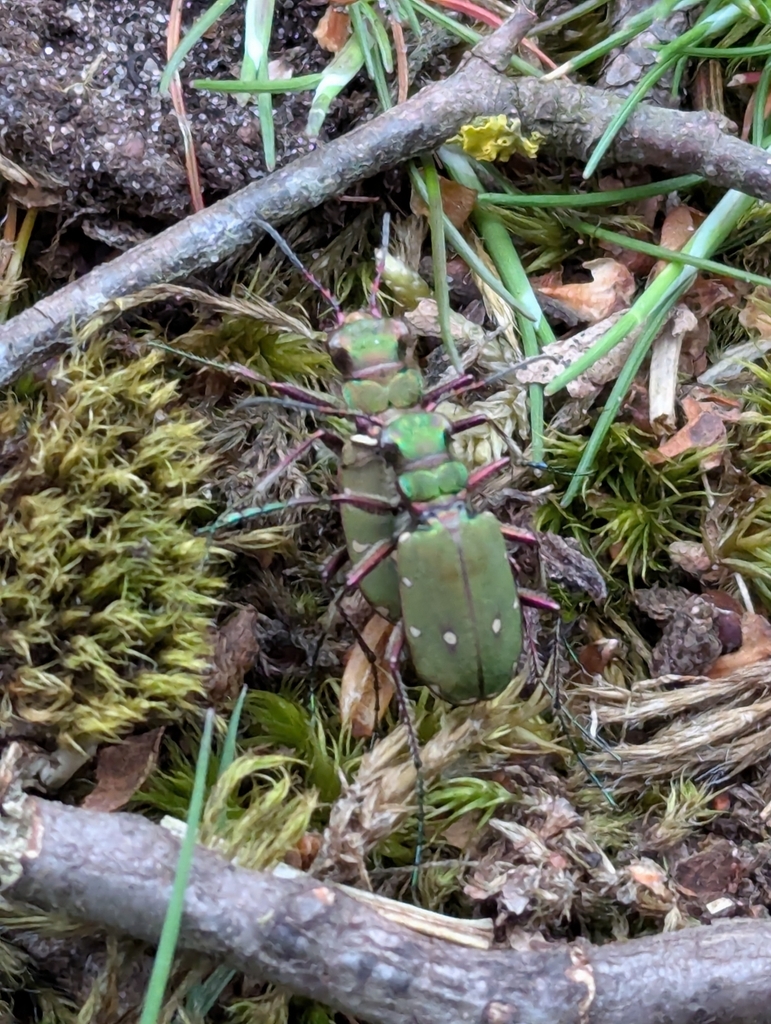
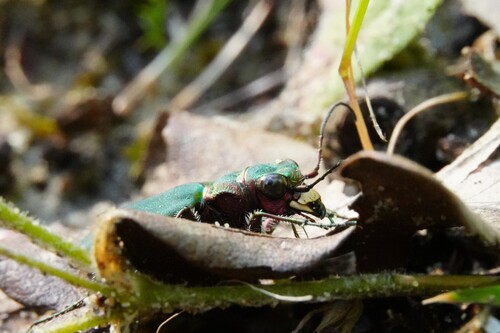
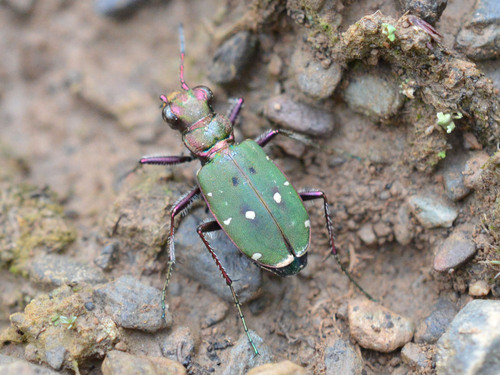
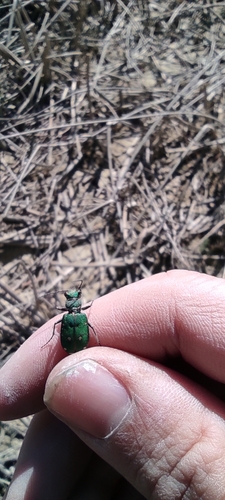
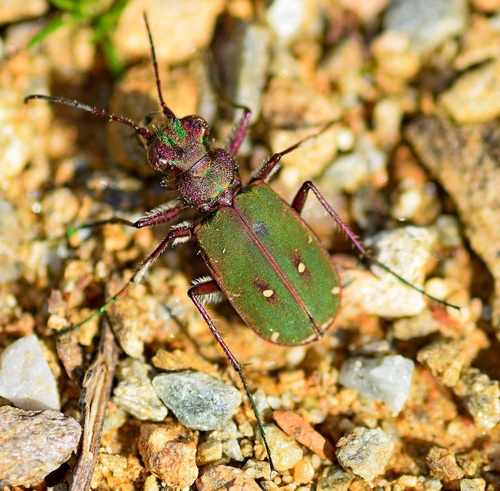
Adults are medium-sized beetles with a bright metallic green body; each elytron (wing cover) bears several small creamy-white or pale yellow spots and usually a small dark spot near the middle. Legs, the sides of the thorax and the mouthparts often have a coppery or purplish sheen, and the large curved jaws are pale. They have long legs and large bulging eyes suited for visual hunting. Larvae are pale, grub-like and sedentary, with a dark metallic head and pronotum, living in vertical tubular burrows with the head used to block the entrance while ambushing prey.
- Bright metallic green body with several small cream-coloured spots on each wing cover
- Long legs and large, prominent eyes for day hunting
- Active on sunny bare ground and paths, often running very fast when disturbed
- Size about 10-16 mm; the metallic green colour with pale spots, long legs and fast running are diagnostic
Lookalikes
Northern dune tiger beetle Cicindela hybrida
C. hybrida is bronze to purplish-brown rather than green, with wavy cream bands (lunules) on the wing covers, and favours sandy dunes and heaths.
Green ground beetle (Carabus spp.) Carabus spp.
Carabus ground beetles are generally larger, slower, mostly nocturnal and lack the cream spots, long legs and bulging eyes of Cicindela campestris.
↻Life cycle
Egg
Female lays single eggs in bare soil near suitable larval burrow sites. Eggs hatch in days to weeks depending on temperature.
Larva (grub)
Larvae build vertical tubular burrows in the ground and wait at the entrance to seize passing prey; they moult several times while living in the burrow and may remain as larvae for one or more years.
Pupa
When fully grown, the larva pupates in an enlarged chamber within its burrow and transforms into the adult beetle.
Adult
Adults emerge in spring or early summer, are active hunters by day, mate, and the females lay eggs to continue the cycle; adults typically live for weeks to months.
🍃Diet and predators
Young eat
Small arthropods (insects and other invertebrates) captured at the burrow entrance
Adults eat
Active hunters of flies, ants, spiders, and other small invertebrates on open ground
Predators of the young
Parasitic wasps, ground‑foraging birds, mammals and some predatory insects
Predators of adults
Birds, larger predatory insects, spiders and reptiles; adults rely on speed to escape
🌱Effect on plants and gardens
Does not feed on plants as an adult or larva; adults and larvae eat insects and other small arthropods, so they are beneficial for controlling pest insects.
📍Where and when to find it
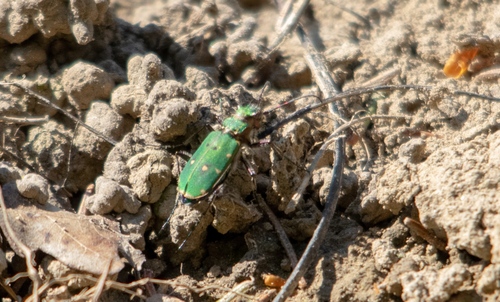
Search sunny bare ground, sandy paths, gravel areas, heath and coastal dunes; adults run on the surface, larvae are found at the mouths of vertical burrows in bare soil.
Best time
April to August on warm sunny days, especially mid morning to mid afternoon when temperatures are higher.
Observation tips
Approach slowly and keep the sun behind you for photos; use a fast shutter or video to capture movement — they run and fly quickly when disturbed.
✨Fun facts
- Tiger beetles are among the fastest running insects relative to body size and pursue prey visually.
- Larvae capture prey from the mouth of a vertical burrow, a hunting method unusual among beetles.
- Their bright metallic colour comes from microscopic surface structure as well as pigments, producing vivid greens and blues.
?Frequently asked questions
Are green tiger beetles dangerous?
No. They are not venomous. Adults can give a painful pinch with their jaws if handled roughly, but this is not dangerous.
Do green tiger beetles bite people?
They can bite (pinch) if grabbed, but bites are uncommon and cause only minor, short‑lived pain.
Why is a green tiger beetle in my garden?
They hunt on sunny bare patches and paths; if your garden has exposed soil, gravel or dry lawn patches it provides good hunting ground.
How do I get rid of green tiger beetles?
They are beneficial predators and not a pest. If you must discourage them, reduce bare sunny soil patches by planting groundcover or mulching; do not use broad insecticides which harm non‑target insects.
Where do green tiger beetle larvae live?
Larvae live in vertical tubular burrows in bare ground and wait at the entrance to ambush passing prey.
📷Photos of the green tiger beetle
More beetles
This guide was written with AI assistance and fact-checked, last updated 2026-10-10. Identification from photos is never certain: don't handle insects you can't identify, and get medical advice for bites, stings or allergic reactions. More about the green tiger beetle: iNaturalist, Wikipedia.