
Locust borer
Megacyllene robiniae · Longhorn beetles
A wasp-mimicking longhorn beetle whose larvae bore into black locust trees and can weaken or kill stressed trees.
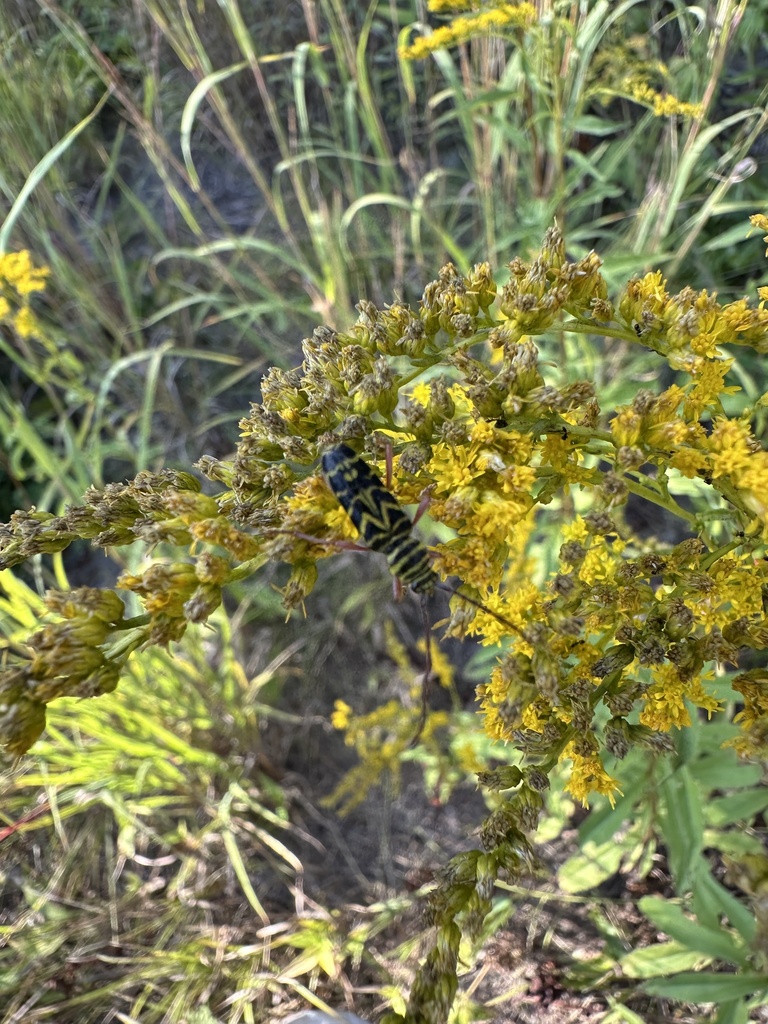
!Is the locust borer dangerous?
No. Adults are harmless to people. They do not have venom and rarely bite; a pinch from handling could cause minor mechanical discomfort but no medical risk. No known disease transmission.
Pets
Not toxic to pets. Pets might chew on insects but locust borers are not poisonous; avoid giving insects as treats to pets for choking/allergy risks.
📖Overview
Megacyllene robiniae is a medium-sized longhorn beetle (family Cerambycidae) best known for its yellow-and-black wasp-like banded adults and wood-boring larvae that attack black locust (Robinia pseudoacacia). Adults are most visible in late summer when they feed on pollen and mate; females lay eggs in wounds or crevices in the bark of black locust. Larval tunneling can girdle branches and trunks, contributing to decline especially in young, stressed or recently cut trees.
🔍How to identify a locust borer
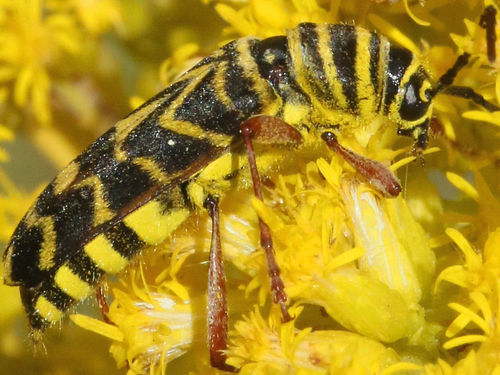
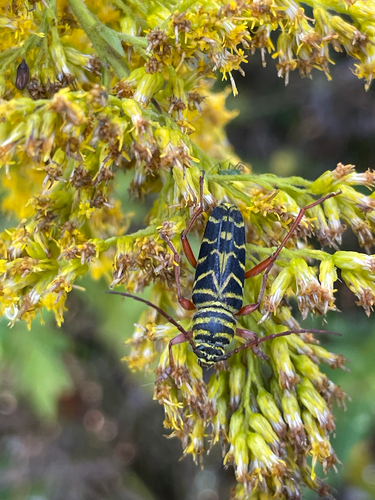
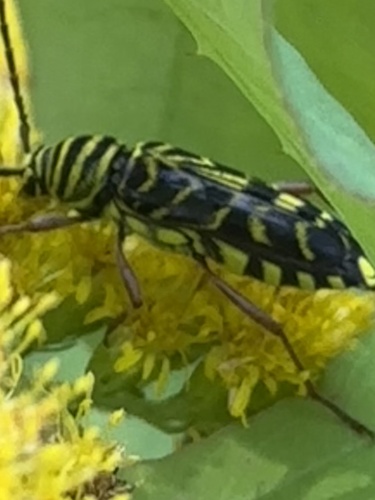
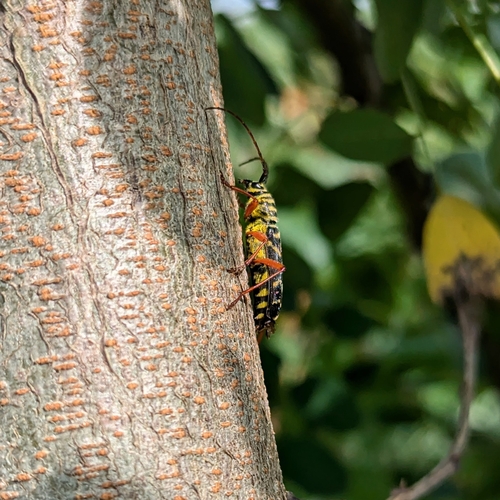
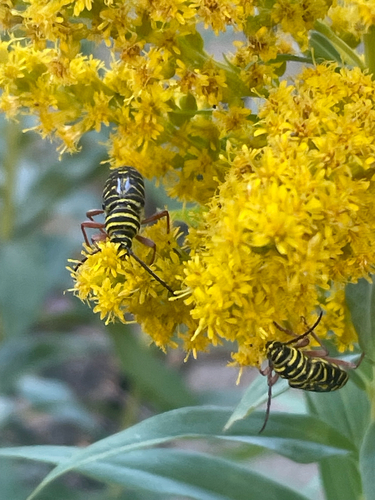
Adults are elongated beetles with long antennae typical of longhorns. The wing covers (elytra) show alternating black and bright yellow bands that resemble some social wasps; a yellow W-shaped band crosses the elytra, and the legs are reddish. Larvae are white, legless grubs with a tapered head, adapted for boring through sapwood and heartwood and creating galleries filled with frass.
- Black and bright yellow banded elytra forming wasp-like stripes across the back.
- Long antennae typical of longhorn beetles; adults 10-20 mm long.
- Adults active in late summer on flowers and on trunks of black locust trees.
- Presence of small round exit holes and powdery frass or galleries under bark indicates larval infestation.
Lookalikes
Hickory borer Megacyllene caryae
Nearly identical banding, but hickory borers develop in hickory and emerge in spring, whereas locust borers develop in black locust and are seen in late summer, often on goldenrod.
Wasp beetle Clytus arietis
Also a wasp-mimicking longhorn but smaller and found mainly in Europe; banding pattern and body shape differ and host plants are different.
↻Life cycle
Egg
Females lay eggs in bark crevices, wounds or around pruning cuts on black locust in late summer. Eggs hatch in days to weeks.
Larva (wood-borer)
Larvae tunnel into sapwood and heartwood, feeding and creating galleries filled with frass. Young larvae overwinter in the inner bark and bore deeper in spring; development usually takes one year.
Pupa
Larvae pupate within the wood in a pupal chamber; pupation occurs before the adult emerges, typically in mid to late summer.
Adult (wasp-mimic)
Adults emerge in late summer and are active for a few weeks, feeding on pollen and mate. They are day-flying and often seen on flowers and tree trunks.
🍃Diet and predators
Young eat
Wood (sapwood and heartwood) of black locust; larvae feed on inner bark and wood.
Adults eat
Pollen, nectar and sometimes tree sap or bark exudates; they are often seen on flowers and on host tree trunks.
Predators of the young
Woodpeckers, parasitic wasps and other wood-boring insect predators and parasitoids when accessible.
Predators of adults
Birds, predatory insects and spiders; their wasp-like coloration likely provides some predator deterrence (Batesian mimicry).
🌱Effect on plants and gardens
Larvae bore in trunks and large branches of black locust (Robinia pseudoacacia). Heavy infestations weaken or kill young or stressed trees, and tunneling can reduce timber value. Healthy mature trees are more tolerant but repeated attacks increase decline.
How to get rid of locust borers
Remove and destroy heavily infested, dying, or recently cut locust wood to reduce local populations. Prune out small infested branches and burn or chip the material so larvae cannot complete development. Maintain tree health with proper watering and pruning to reduce susceptibility. Targeted insecticide sprays (timed to adult flight) may protect high-value trees; consult a certified arborist or local extension service for specific products and application timing. Systemic insecticides can sometimes reduce larval survival but require professional guidance. Trapping with cut locust logs placed in sun can concentrate adults and larvae for removal.
📍Where and when to find it
Look for adults on flowers, on trunks and branches of black locust, and along sunny woodland edges. Inspect cut or wounded locust wood for exit holes and frass to find larvae.
Best time
Best observed in late summer (August-September) during warm daylight hours when adults are active.
Observation tips
Photograph dorsal view to show banding pattern. To find larvae, inspect recently cut locust logs for round exit holes and frass piles; wear gloves and protective eyewear when handling infested wood.
✨Fun facts
- Adults mimic yellow-and-black social wasps, which likely reduces predation.
- The species name robiniae refers to its close association with the black locust tree (Robinia).
- Adults are often found feeding on goldenrod flowers in late summer, where their wasp-like pattern blends in with real wasps visiting the same blooms.
?Frequently asked questions
Are locust borers dangerous?
No danger to people or pets from venom; the concern is damage to black locust trees from larvae boring in the wood.
Do locust borers bite or sting?
No. Adults do not sting and rarely bite; any contact causes only a minor pinch at most.
Why is a locust borer in my house?
Adults are daylight flyers and are usually found on flowers or on locust trunks rather than indoors. If you find one inside, it likely wandered in from nearby locust trees or was brought in on firewood.
How do I get rid of locust borers?
Remove and destroy infested wood, prune and dispose of damaged branches, maintain tree vigor, and consider timed insecticide treatments or consulting an arborist for high-value trees. Avoid moving locust firewood between sites.
Where do locust borers live?
They live wherever black locust trees grow — woodland edges, parks and urban plantings across eastern North America; larvae live inside the wood and adults on flowers and tree trunks.
📷Photos of the locust borer
More beetles
This guide was written with AI assistance and fact-checked, last updated 2026-10-10. Identification from photos is never certain: don't handle insects you can't identify, and get medical advice for bites, stings or allergic reactions. More about the locust borer: iNaturalist, Wikipedia.