
Pink spotted lady beetle
Coleomegilla maculata · Lady beetles
A small North American lady beetle that eats aphids and pollen and often appears in gardens and crops as a beneficial predator.
!Is the pink spotted lady beetle dangerous?
No. Not dangerous. Lady beetles do not have venom harmful to people. Some individuals can exude a small amount of yellow defensive fluid that may stain and rarely cause mild skin irritation or a minor allergic reaction in sensitive people.
Pets
Harmless to pets. Ingesting a few beetles is not known to be toxic, though dogs or cats that eat many could vomit or have mild gastrointestinal upset.
📖Overview
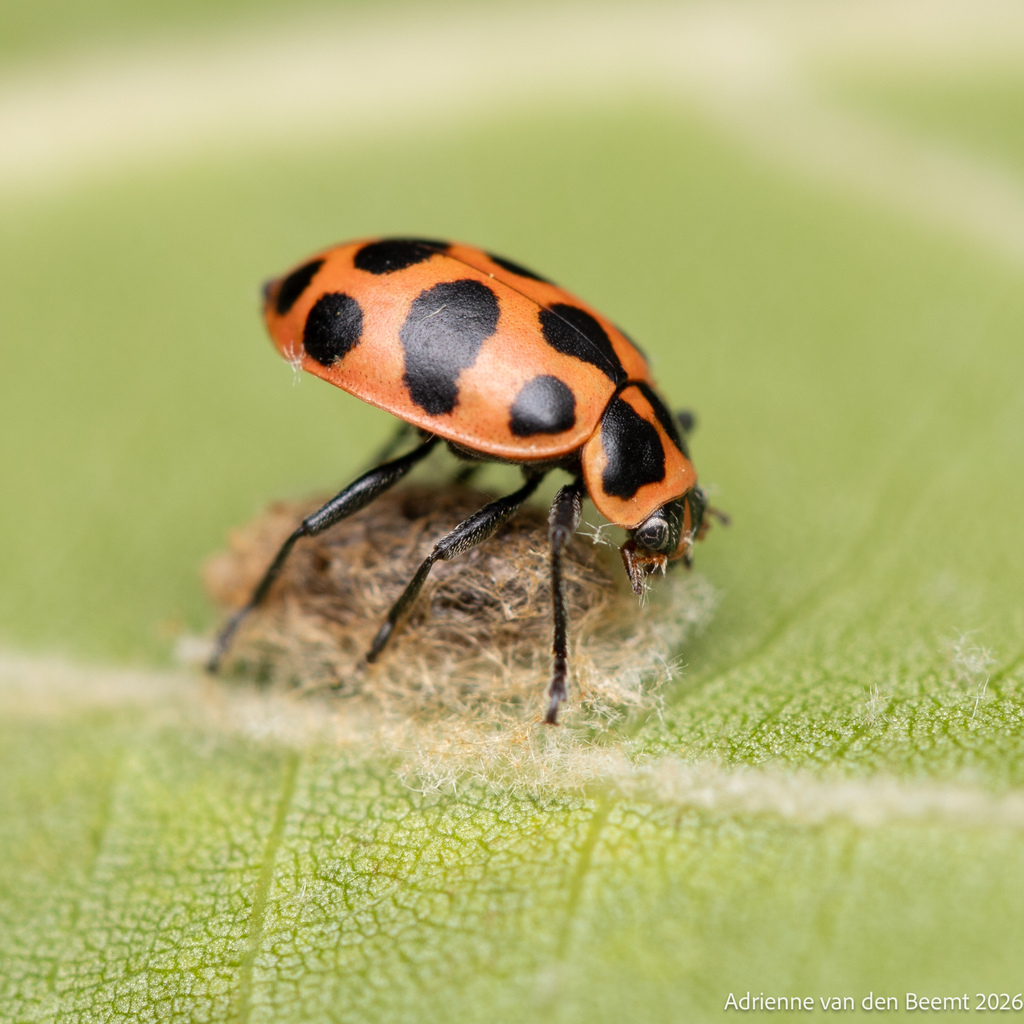
Coleomegilla maculata is a common North American lady beetle (Coccinellidae) notable for its pink to red, slightly elongate elytra with six black spots on each. It is an important biological control agent in agricultural and garden settings because both adults and larvae feed heavily on aphids, small soft-bodied insects and insect eggs, while adults also consume pollen and nectar. It occurs in a range of habitats from fields and orchards to gardens and roadsides. The ground colour ranges from pale pink to red, and spots are sometimes partly merged.
🔍How to identify a pink spotted lady beetle
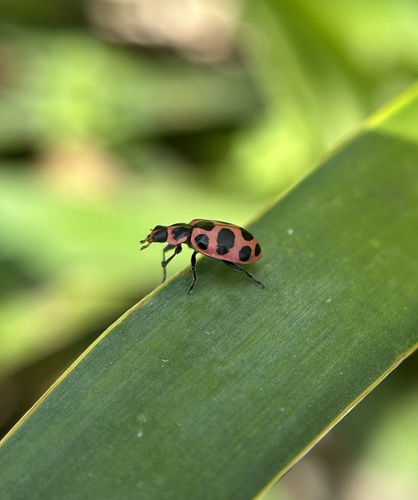
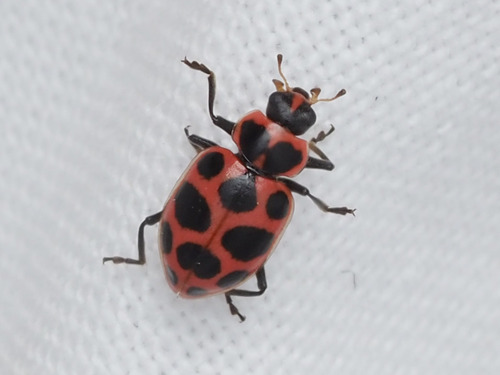
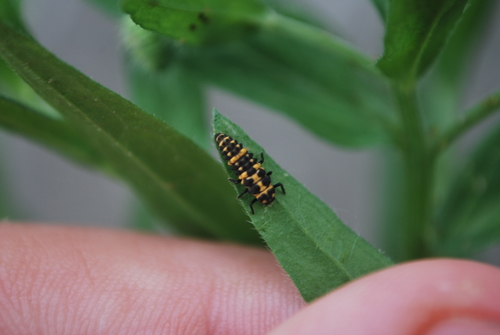
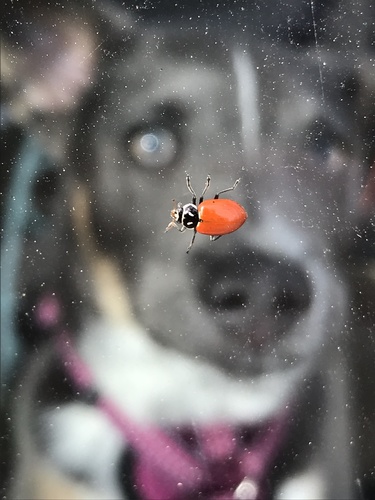
Adults are small, oval and somewhat elongate (less round than many lady beetles) with smooth elytra. Elytra are pink to red with six black spots on each (twelve in total), some of which may merge. The pronotum is pink to red with two large black spots. Legs and underside are dark. Larvae are elongated, alligator-like, dark gray to black with lighter markings and covered in small tubercles.
- Small (5-6 mm), oval, somewhat elongate beetle with pink to red elytra
- Six black spots on each elytron (twelve in total), sometimes partly merged
- Pink to red pronotum with two large black spots
- Larvae are elongated, dark and alligator-like (typical lady beetle larvae)
Lookalikes
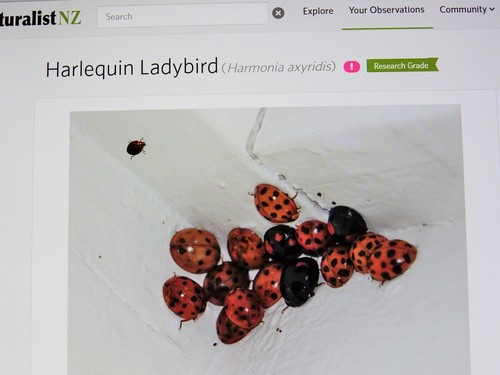
Asian lady beetle Harmonia axyridis
Often larger and more variable in colour and spot pattern; H. axyridis usually has a distinctive 'M' or 'W' shaped dark mark on the pronotum and can be more orange to red with variable spot numbers.
Seven-spotted lady beetle Coccinella septempunctata
Usually larger and more rounded with exactly seven spots (three on each elytron and one central) and a more uniform red background.
↻Life cycle
Egg
Yellow to orange oval eggs laid in clusters on leaves or near aphid colonies.
Larva
Elongated, alligator-like larvae that are active predators, feeding on aphids and other small pests.
Pupa
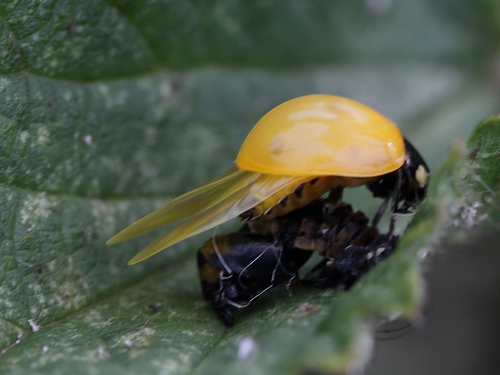
Immobile pupal stage attached to plant surfaces where metamorphosis to the adult occurs.
Adult
Winged beetle that continues predation and also visits flowers for pollen and nectar.
🍃Diet and predators
Young eat
Primarily aphids, small soft-bodied insects, and insect eggs
Adults eat
Aphids and other small pests, supplemented with pollen and nectar
Predators of the young
Spiders, predatory insects, ants and parasitoids
Predators of adults
Birds, spiders, larger predatory insects and some ants
🌱Effect on plants and gardens
Adults supplement their diet with pollen and nectar, which can aid pollination; the species reduces pest pressure by eating aphids, scale crawlers, mites and insect eggs.
📍Where and when to find it
Look on aphid-infested plants, flowers, crop foliage, and garden plants. Eggs and larvae are found near aphid colonies on leaves and stems.
Best time
Spring through early fall; active during warm daylight hours, especially late morning to afternoon.
Observation tips
Scan undersides of leaves where aphids feed. A close macro photo of the pronotum and elytra helps confirm identification; handle gently to avoid defensive fluid.
✨Fun facts
- Coleomegilla maculata adults eat pollen as well as aphids; pollen helps them survive when prey is scarce.
- They are used and encouraged in integrated pest management because both larvae and adults consume large numbers of aphids.
- Adults overwinter in dense aggregations in leaf litter or at the base of trees, often near field edges.
?Frequently asked questions
Are pink spotted lady beetles harmful to people?
No. They are not venomous or dangerous. They may exude a small defensive fluid that can stain or very rarely cause mild skin irritation in sensitive people.
Do pink spotted lady beetles bite?
They do not bite people for food. They can nibble if handled roughly, but this is very uncommon and not harmful.
Why are they in my house?
They rarely come indoors. Adults gather outdoors in leaf litter and sheltered spots to overwinter, and an occasional beetle may wander inside or be carried in on plants. They do not infest homes.
How do I get rid of them?
If you want to remove them, gently sweep or use a vacuum with a soft attachment (release outdoors if possible). Seal entry points and reduce outdoor lighting to lower accidental indoor entry. Avoid pesticides in gardens because this species is a beneficial predator.
Are they good for my garden?
Yes. They eat aphids and other pests and are considered beneficial for gardens and crops.
📷Photos of the pink spotted lady beetle

More beetles
This guide was written with AI assistance and fact-checked, last updated 2026-10-10. Identification from photos is never certain: don't handle insects you can't identify, and get medical advice for bites, stings or allergic reactions. More about the pink spotted lady beetle: iNaturalist, Wikipedia.