
Great green bush-cricket
Tettigonia viridissima · Bush-crickets
A large, bright green katydid of meadows and tall vegetation in Europe and western Asia; a noisy, mainly predatory insect that rarely harms people.

!Is the great green bush-cricket dangerous?
No. Not venomous. Rarely will bite if handled or trapped; the bite is mechanically painful but not medically significant. Clean wound and apply basic first aid if bitten (wash, apply antiseptic, bandage) and seek medical attention if signs of infection or unusual reaction occur.
Pets
Not toxic. A curious dog or cat might catch and chew one; this can cause minor mouth irritation or vomiting but is not poisonous. Monitor pets for distress.
📖Overview
Tettigonia viridissima is one of the largest bush-crickets in Europe, conspicuous for its vivid green colour and loud, sustained song produced by males. It inhabits grassy meadows, hedgerows, road verges and patchy scrub where tall herb vegetation is present. Adults are primarily active in summer and early autumn and are often seen by day as well as at night.
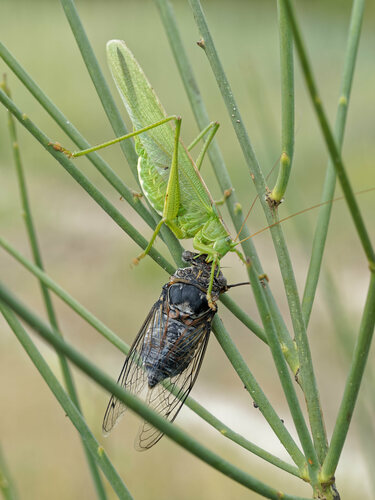
This species is an omnivorous predator: adults and late-instar nymphs capture and eat other insects (including grasshoppers, moths and larvae) but will also feed on flowers and soft plant tissue. They are not dangerous to people — they can deliver a sharp bite if handled roughly but have no venom. Populations are stable across much of their range, although they are sensitive to intensive mowing and habitat loss.
🔍How to identify a great green bush-cricket
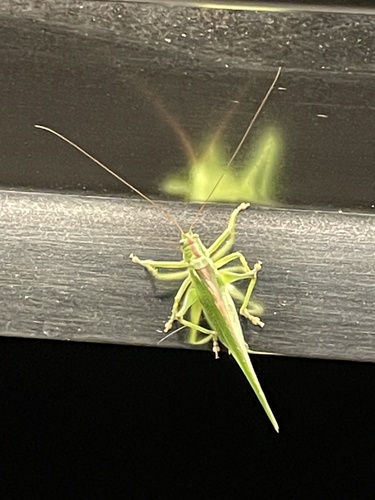
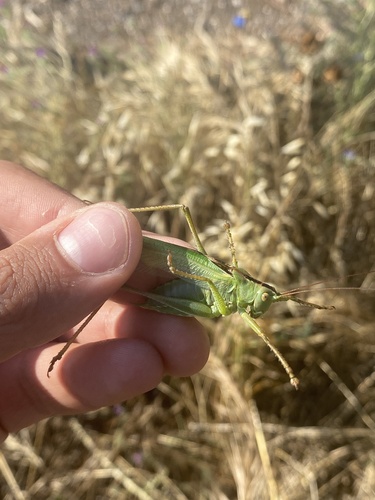
Adults are large and uniformly bright green with long, thread-like antennae much longer than the body. The body is robust with a slightly flattened dorsal profile. Wings are well developed in many individuals and cover most of the abdomen; in some populations wings may be shorter. Females have a prominent, curved sword-like ovipositor that projects beyond the tip of the abdomen. Legs are long and adapted for jumping; the hind femora are thick and may show faint darker markings. Males have a stridulatory apparatus on the forewings used to produce a loud, continuous trilling song.
- Very large bright green body with long filamentous antennae far exceeding body length
- Females have a long, curved ovipositor projecting beyond abdomen tip
- Males produce a loud continuous trilling song heard at dusk and night
- Found on tall grasses and herb stems rather than low-growing turf
Lookalikes
Upland green bush-cricket Tettigonia cantans
Very similar but usually a little smaller, with shorter wings that end around the tip of the female's ovipositor rather than well beyond it; mainly found in upland and cooler areas of central Europe.
Speckled bush-cricket Leptophyes punctatissima
Smaller (about 15 mm), often mottled with darker spots and with a shorter ovipositor in females; lacks the large size and continuous loud trill of T. viridissima.
↻Life cycle
Egg
Females lay eggs in soil or plant stems in late summer or autumn; eggs overwinter and usually hatch in spring after one or more winters.
Nymph
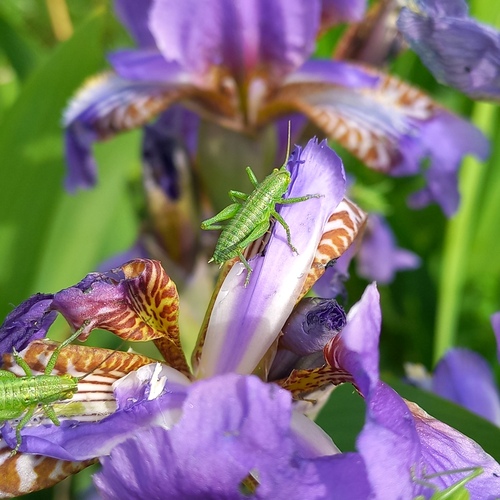
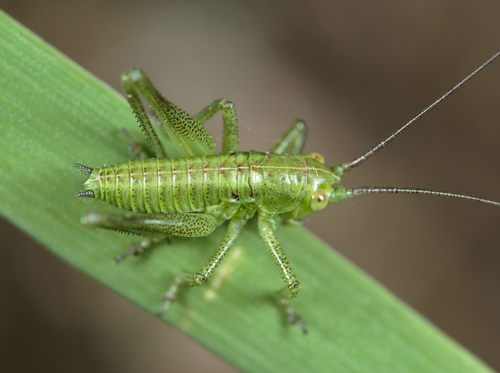
Several nymphal instars resemble small wingless adults and gradually develop wing buds over spring and early summer. Nymphs are active and predatory like adults.
Adult
Adults appear in mid to late summer, mate and the females deposit eggs in late summer to autumn. Adults die off in autumn.
🍃Diet and predators
Young eat
Predatory on small insects and other arthropods; will also nibble soft plant parts
Adults eat
Mainly carnivorous on larger insects (moths, grasshoppers, beetles) but also eat flowers, leaves and fruit.
Predators of the young
Birds, small mammals, spiders, predatory insects
Predators of adults
Birds, bats, small mammals and larger predatory insects; parasitic flies and wasps may attack eggs or nymphs.
🌱Effect on plants and gardens
Feeds mainly on insects but will take flowers and soft shoots; normally does not cause significant damage to crops or gardens.
📍Where and when to find it
Look on tall grasses, flowering stems and hedgerow shrubs. Nymphs occur lower in vegetation in spring; adults from mid-summer on higher stems.
Best time
Best observed from June to September; males sing most at dusk and through the night.
Observation tips
Stand quietly at the edge of a meadow at dusk and listen for the male's trilling song. Use a long-focus lens or approach slowly along vegetation stems to photograph without startling them.
✨Fun facts
- Male great green bush-crickets produce their loud song by rubbing veins on their forewings together (stridulation).
- Their long antennae are sensory organs used to detect habitat structure and other insects in dense vegetation.
- Although mainly predatory, they will eat fruit and flowers, so their diet is quite flexible.
?Frequently asked questions
Are great green bush-crickets dangerous?
No. They are not venomous and do not transmit disease. They can bite if handled roughly, causing a brief, mechanical pain only.
Do great green bush-crickets bite people?
Bites are uncommon and only occur when the insect is provoked or trapped. The bite is not poisonous but can be painful briefly.
Why is a great green bush-cricket in my house?
They sometimes enter houses from nearby tall vegetation, especially in late summer when adults move around seeking mates or shelter. They do not live long indoors.
How can I get rid of one in my home?
Gently capture it in a jar or cup and release it outdoors in tall vegetation. Avoid killing it; they are not pests and are useful predators in gardens.
Where does the great green bush-cricket live?
In grassy meadows, hedgerows, roadside verges and rough pasture across much of Europe and temperate parts of Asia where tall herb vegetation occurs.
📷Photos of the great green bush-cricket
More grasshoppers & crickets
Non-toxic
Non-toxic
Non-toxic
Irritating secretion
Non-toxic
Non-toxic
This guide was written with AI assistance and fact-checked, last updated 2026-10-10. Identification from photos is never certain: don't handle insects you can't identify, and get medical advice for bites, stings or allergic reactions. More about the great green bush-cricket: iNaturalist, Wikipedia.