
Great green bush-cricket vs Speckled bush-cricket
These two are easy to mix up. Here's how to tell a great green bush-cricket from a speckled bush-cricket, and whether either one bites or stings.

Great green bush-cricket
Tettigonia viridissima
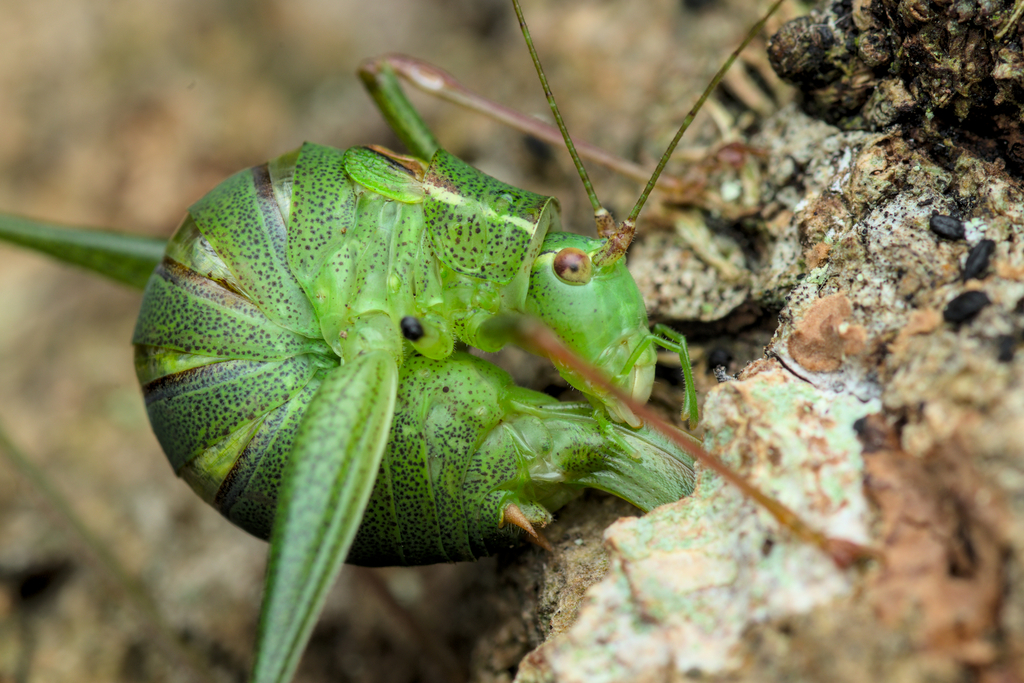
Speckled bush-cricket
Leptophyes punctatissima
≠The key differences
Smaller (about 15 mm), often mottled with darker spots and with a shorter ovipositor in females; lacks the large size and continuous loud trill of T. viridissima.
⚖︎Side by side
| Great green bush-cricket | Speckled bush-cricket | |
|---|---|---|
| To humans | Non-toxic | Non-toxic |
| Size | 28-42 mm body length (excluding ovipositor); females often larger than males | 10-18 mm body length (smaller males, larger females) |
| Colours | Bright green, Pale yellow, Brown (legs and markings) | Green, Dark brown speckles, Yellow-green highlights, Black (spots and eye) |
| Family | Tettigoniidae | Tettigoniidae |
| Habitat | Tall grassland, meadows, hedgerows, roadside verges, rough pasture and scrub with tall herb vegetation | Hedgerows, gardens, scrub, woodland edges and parks — on shrubs, nettles and low branches |
| Range | Widespread in Europe (including the UK in suitable habitats), extending into temperate Asia. Absent from the far north and from very dry Mediterranean sites in some regions. | Widespread in Europe, from the British Isles and western Europe across central Europe; common in temperate regions |
| Active | Late spring to early autumn; adults most visible in summer. Active by day and at night (males sing at dusk and night). | Nymphs from May; adults mainly from late July to November; active mostly at dusk and night, though often seen by day |
| Pest? | No | No |
🔍How to spot a great green bush-cricket
- Very large bright green body with long filamentous antennae far exceeding body length
- Females have a long, curved ovipositor projecting beyond abdomen tip
- Males produce a loud continuous trilling song heard at dusk and night
- Found on tall grasses and herb stems rather than low-growing turf
🔍How to spot a speckled bush-cricket
- Bright green body covered with numerous dark speckles (hence 'speckled')
- Very short or reduced wings — species is essentially flightless
- Female has a distinct curved ovipositor at the rear
- Long antennae noticeably longer than the body
?Frequently asked questions
What is the difference between a great green bush-cricket and a speckled bush-cricket?
Smaller (about 15 mm), often mottled with darker spots and with a shorter ovipositor in females; lacks the large size and continuous loud trill of T. viridissima.
Is a great green bush-cricket or a speckled bush-cricket more dangerous?
Great green bush-cricket: Non-toxic. Speckled bush-cricket: Non-toxic. Not venomous. Speckled bush-crickets are harmless to people.
Identification from photos is never certain: don't handle insects you can't identify, and get medical advice for bites, stings or allergic reactions.