
Green-striped grasshopper
Chortophaga viridifasciata · Short-horned grasshoppers
A common North American grassland grasshopper with a bright yellow stripe on a green body; harmless to people and usually a minor herbivore in fields and lawns.
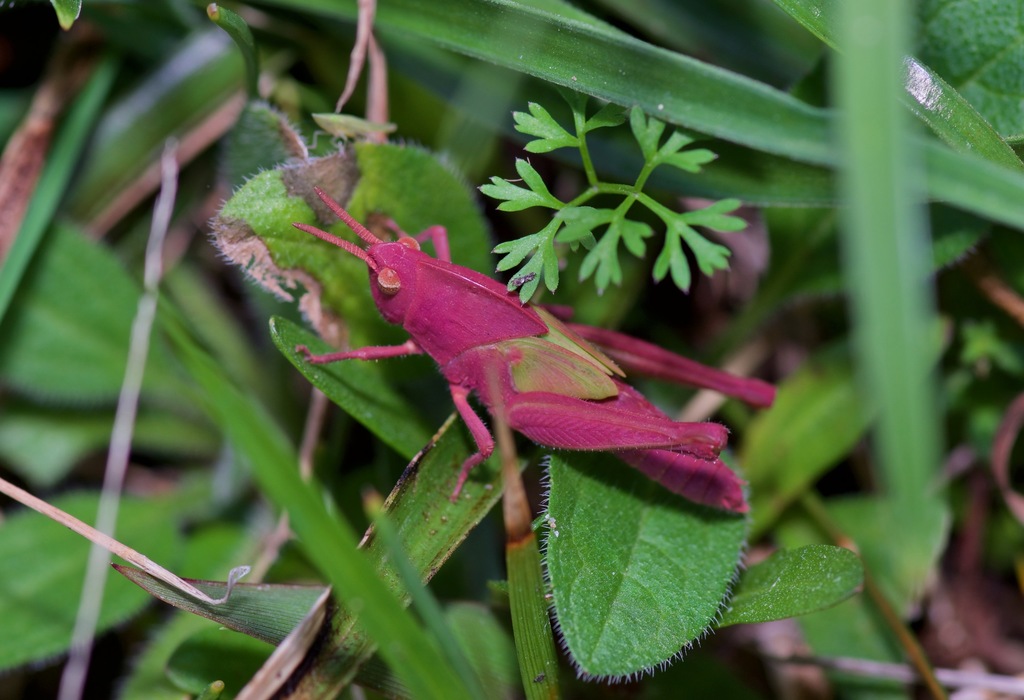
!Is the green-striped grasshopper dangerous?
No. Not dangerous. Green-striped grasshoppers do not have venom and do not sting. They can pinch with their mandibles if handled roughly, which may be slightly painful but not medically significant. Wash hands after handling to remove dirt or plant residues.
Pets
Generally not harmful to pets. Small pets might eat one, which is unlikely to cause illness; watch for vomiting if a pet ingests many insects. As with any wild insect, avoid letting pets eat large numbers.
📖Overview
Chortophaga viridifasciata is a medium-sized band-winged grasshopper found across much of eastern and central North America in grassy habitats, roadside edges and meadows. Unusually for a grasshopper, it overwinters as a nymph, so adults are among the first grasshoppers seen in spring and early summer; in the South there can be a second generation later in the year. They feed mainly on grasses and are recognised by their green or brown body, often with a green stripe along the folded wings. They are solitary to locally common; unlike some grasshopper species they rarely reach the population densities that cause large-scale crop damage.
🔍How to identify a green-striped grasshopper
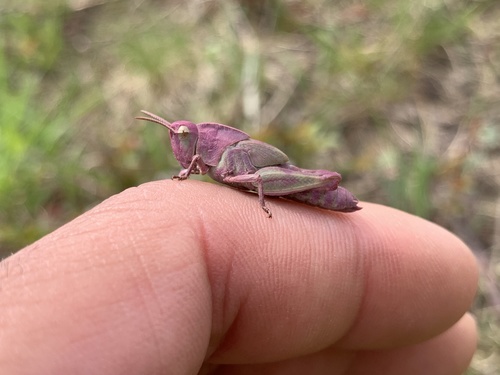
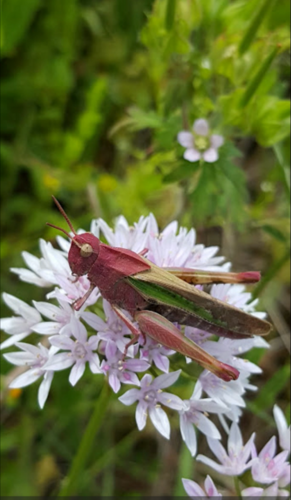
Adults come in a green form and a brown form: females are often green, males more often brown, and brown individuals frequently show a green stripe along the sides or top of the folded forewings (tegmina). The pronotum has a slight ridge on top. In flight the hindwings show a pale greenish-yellow base and a dark smoky band. Males are generally smaller and more slender than females. At rest the wings lie folded along the body, covering the abdomen.
- Look for a pale yellow to bright yellow longitudinal stripe along the side of the pronotum and wing area.
- Overall green body coloration; wings often show yellow at the base in flight.
- Size dimorphism: females noticeably larger and stouter than males.
- Found in open grassy habitats—standing and flying low over grasses.
Lookalikes
Differential grasshopper Melanoplus differentialis
Melanoplus differentialis is more robust, often has darker mottling and lacks the continuous bright lateral yellow stripe typical of C. viridifasciata.
Carolina grasshopper Dissosteira carolina
Larger, plain brown band-winged grasshopper with mostly black hindwings edged in pale yellow; never green, and adults are seen mainly in mid to late summer.
Southern green-striped grasshopper Chortophaga australior
Very similar close relative found in Florida and nearby coastal areas; separated mainly by range and subtle structural details.
↻Life cycle
Egg
Females lay egg pods in the soil, mainly in late spring and summer; eggs hatch the same season.
Nymph
Nymphs resemble adults but lack fully developed wings; they go through several molts while feeding on grasses, and late-stage nymphs overwinter.
Adult
Winged adults appear in early spring to early summer after the overwintering nymphs molt; they mate and the females lay eggs for the next generation.
🍃Diet and predators
Young eat
Grasses and various herbaceous plants
Adults eat
Grasses and broad-leaved plants; a generalist grassland herbivore
Predators of the young
Birds, spiders, predatory insects (mantids, robber flies), small mammals
Predators of adults
Birds, small mammals, predatory insects and parasitoids
🌱Effect on plants and gardens
Feeds on various grasses and forbs. Normally causes only localized, light feeding; not usually a major agricultural pest except in unusual local outbreaks.
📍Where and when to find it
Search grassy meadows, field edges, and roadside verges. Adults perch on grass stems and low vegetation; nymphs are found among grasses.
Best time
Best observed from April to July (later in the season in the South) on sunny days, during mid-morning to late afternoon when they are active.
Observation tips
Walk slowly through grass, watch and listen for short crackling flights, and photograph from a low angle to show the wing pattern. Use binoculars to avoid startling them.
✨Fun facts
- Unlike most North American grasshoppers, it spends the winter as a nymph, which is why adults appear so early in spring.
- Although called a 'locust' in some older sources, Chortophaga viridifasciata does not form the massive swarms associated with true migratory locusts.
- Males make a crackling sound in flight by snapping their hindwings (crepitation), a habit typical of band-winged grasshoppers.
?Frequently asked questions
Are green-striped grasshoppers dangerous to people?
No. They are non-venomous and do not sting. A defensive bite is rare and not harmful.
Do green-striped grasshoppers damage my lawn or garden?
Usually no. They feed on grasses and forbs but normally cause only light, localized feeding unless unusually numerous.
Why is there a grasshopper in my house?
They sometimes enter homes accidentally while moving through vegetation or seeking shelter, especially near doors or windows; they do not infest houses.
How can I get rid of grasshoppers in my yard?
Encourage natural predators (birds, beneficial insects), reduce tall weedy vegetation near crops, and use physical barriers or targeted insecticidal baits only if populations are causing real damage.
When can I see green-striped grasshoppers?
Adults are most often seen from early spring to early summer on warm, sunny days; in southern areas a second generation can appear later in the year.
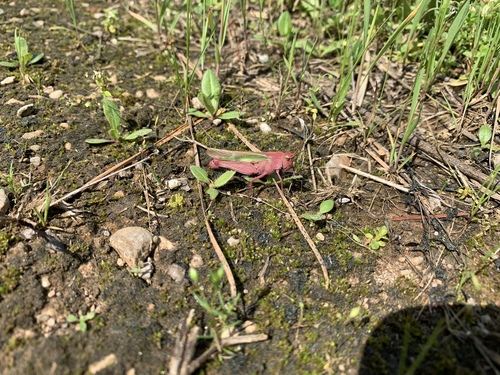
📷Photos of the green-striped grasshopper
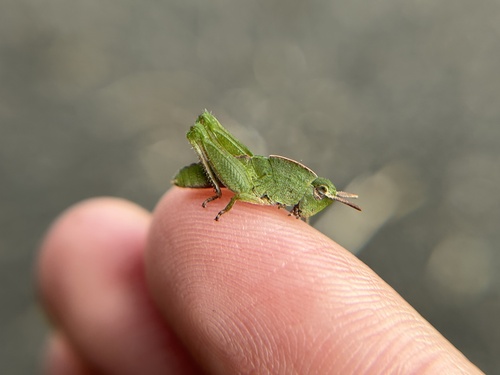
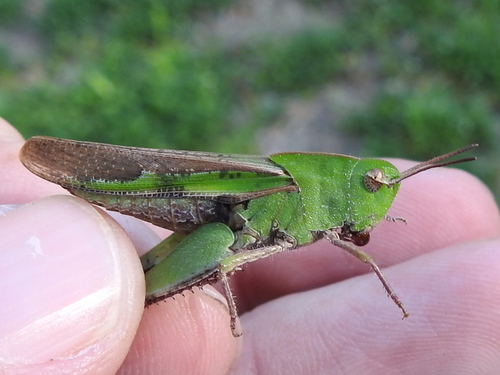
More grasshoppers & crickets
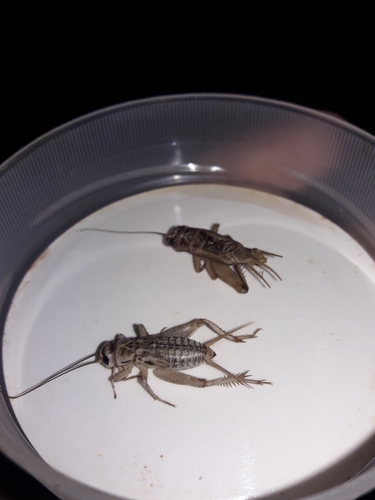
Non-toxic
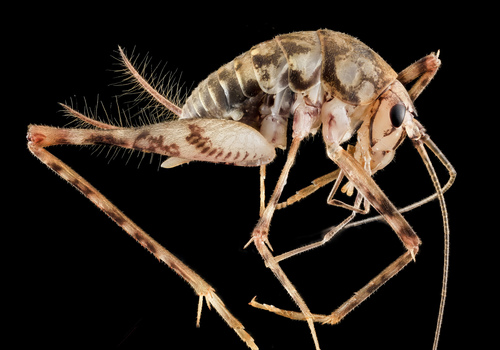
Non-toxic
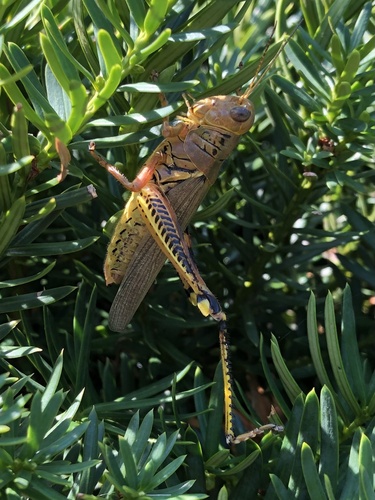
Non-toxic
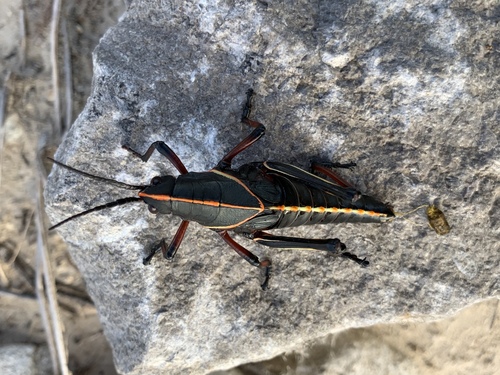
Irritating secretion
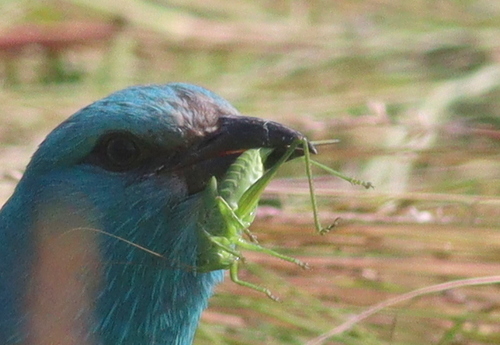
Non-toxic
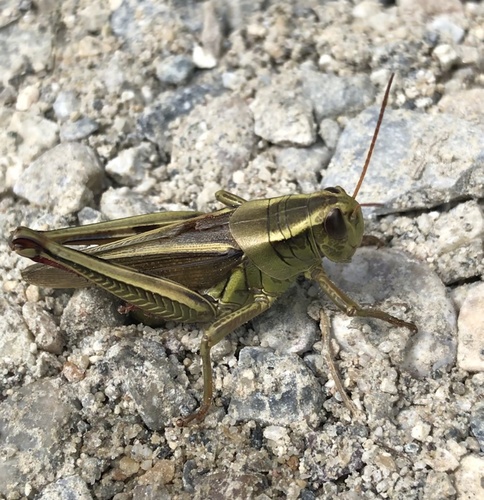
Non-toxic
This guide was written with AI assistance and fact-checked, last updated 2026-10-10. Identification from photos is never certain: don't handle insects you can't identify, and get medical advice for bites, stings or allergic reactions. More about the green-striped grasshopper: iNaturalist, Wikipedia.