
Differential grasshopper
Melanoplus differentialis · Short-horned grasshoppers
A common, fairly large grasshopper of North American fields and lawns that can defoliate grasses and crops in high numbers.
!Is the differential grasshopper dangerous?
No. Not dangerous to people. They do not have medically significant venom. Large individuals can give a pinch if handled carelessly, but bites are extremely rare and not harmful. Wash hands after handling to avoid minor skin irritation from plant residues.
Pets
Generally not toxic to dogs or cats if accidentally eaten, though eating many may cause mild stomach upset. Not a common source of serious pet poisoning.
📖Overview
Melanoplus differentialis is a widespread short-horned grasshopper found across much of the United States and northern Mexico. Adults are sturdy, relatively large grasshoppers that feed on a wide variety of grasses and broadleaf plants. In high densities they are an agricultural pest, especially for forage grasses, cereals and garden plants. They normally live in grasslands, roadsides, pastures and disturbed habitats and are most noticeable in summer.
They are diurnal and strong jumpers; adults can fly short distances. Populations develop from eggs laid in soil pods the previous year; nymphs hatch in spring and go through five instars before becoming winged adults in mid to late summer. Outbreaks may be locally severe but typically subside with natural predators and weather extremes.
🔍How to identify a differential grasshopper
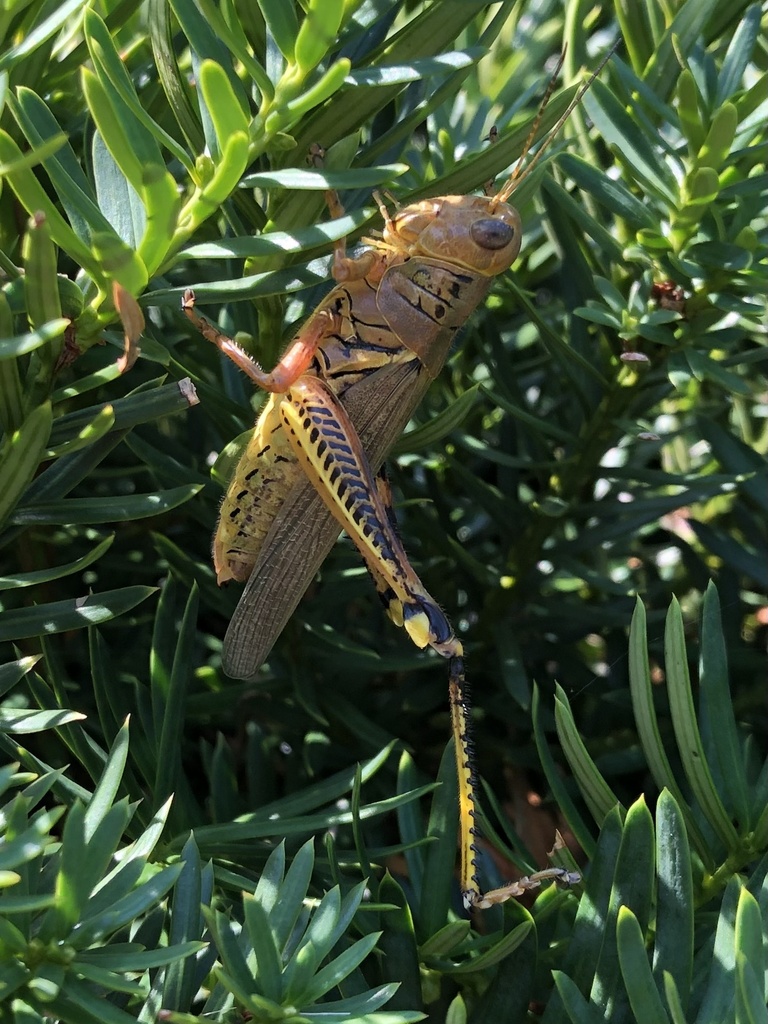
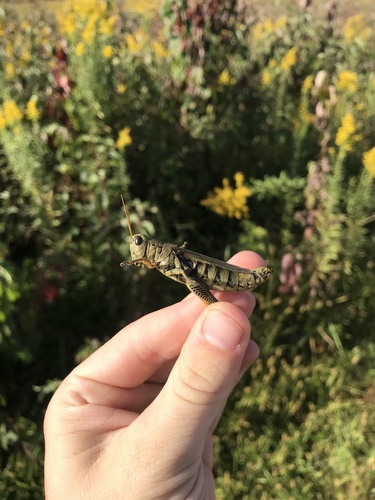
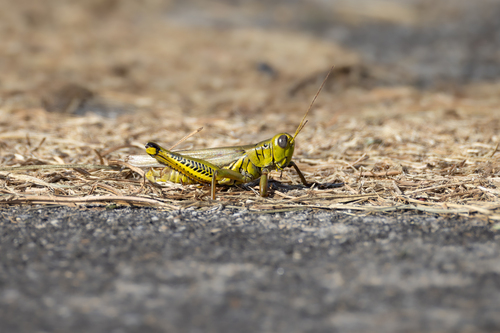
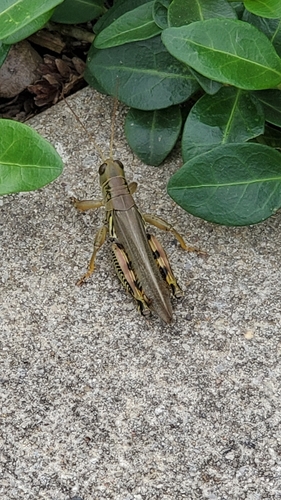
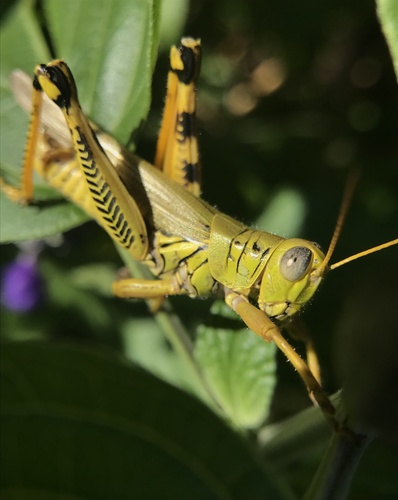
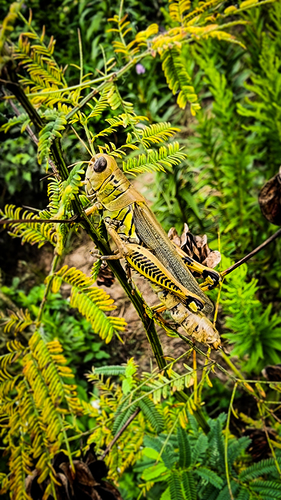
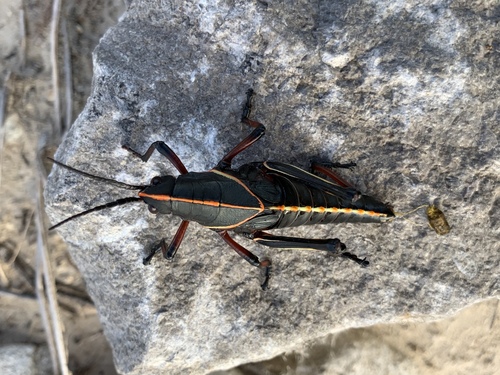
Adults are relatively large and heavy-bodied for grasshoppers. Typical coloration is olive-green to yellowish-brown and fairly smooth and shiny; older adults and some individuals are darker, and melanic (nearly black) forms occur. The hind femurs are yellow with distinctive black chevron (herringbone) markings, and the hind tibiae are yellow with black spines. Wings normally extend past the end of the abdomen in males and females; hind wings are clear to pale. Females are larger, with short egg-laying valves at the tip of the abdomen.
- Large, robust short-horned grasshopper with body length about 25-50 mm; females larger than males.
- Olive-green to yellowish-brown, fairly smooth and shiny body; older adults may be darker.
- Distinctive black chevron (herringbone) markings on the yellow hind femurs; hind tibiae yellow with black spines.
- Wings long in adults, reaching or extending beyond the abdomen; strong jumping hind legs.
Lookalikes
Migratory grasshopper Melanoplus sanguinipes
Migratory grasshopper is smaller (about 20-30 mm) and greyish-brown, with a dark band behind the eye and no black herringbone pattern on the hind femurs.
Two-striped grasshopper Melanoplus bivittatus
Two-striped grasshopper has two pale stripes running from the head along the back to the wing tips and a single dark stripe on the hind femur, instead of the black herringbone pattern of M. differentialis.
↻Life cycle
Egg (in soil pod)
Females deposit egg pods in late summer or autumn in loose soil; each pod contains multiple eggs that overwinter and hatch the following spring.
Nymph (grasshopper nymph)
Nymphs hatch in spring and pass through five growth stages (instars) over several weeks, resembling small, wingless adults.
Adult (winged)
Winged adults appear in mid to late summer, mate, and females lay eggs late in the season; adults die off with the arrival of cold weather.
🍃Diet and predators
Young eat
Mostly grasses and tender broadleaf plants; nymphs feed constantly and cause the most crop damage per body weight.
Adults eat
Grasses, cereal crops, legumes and a wide variety of garden plants and weeds; adults eat both leaves and reproductive parts.
Predators of the young
Birds, predatory insects (mantids, beetles), spiders and small mammals.
Predators of adults
Birds, small mammals, reptiles and predatory insects; parasitic flies and wasps may attack nymphs and adults.
🌱Effect on plants and gardens
Polyphagous: feeds on grasses, legumes, cereals and a variety of garden and field crops. Can skeletonize leaves and defoliate plants when population densities are high.
How to get rid of differential grasshoppers
Use integrated approaches: maintain healthy, competitive turf and vegetation to reduce egg-laying, remove heavy thatch, and encourage natural predators (birds, predatory insects). For severe infestations in crops or pastures, targeted insecticide treatments timed to early nymph stages are most effective; follow label instructions. For small garden outbreaks, hand‑removal into a container of soapy water or row covers can help. Avoid indiscriminate pesticide use to protect beneficial insects.
📍Where and when to find it
Look in grasses, along field edges, roadsides, pastures and lawns. Nymphs will be on vegetation near the ground; adults are often on taller grasses and plants.
Best time
Mid to late summer during warm, sunny daytime hours when they are most active.
Observation tips
Approach slowly and watch for sudden jumps. Photograph through a telephoto or use burst mode to capture quick movements; shallow, grassy backgrounds show them in habitat.
✨Fun facts
- The black chevron (herringbone) pattern on the yellow hind legs is one of the easiest ways to recognize this species.
- It belongs to the spur-throated grasshoppers (genus Melanoplus), named for a small peg-like spur between the front legs.
- Population outbreaks can be locally severe but are usually controlled naturally by predators, disease and weather.
?Frequently asked questions
Are differential grasshoppers dangerous?
No. They are not venomous or poisonous to people. They do not pose a health risk, though they can damage plants.
Do differential grasshoppers bite or sting?
Bites and stings are extremely rare. They may pinch if handled roughly, but this is harmless and not medically significant.
Why are differential grasshoppers in my yard?
They are attracted to lawns, gardens and fields that provide grasses and weeds to feed on. Warm, dry summers and nearby egg-laying sites in loose soil or grassy edges encourage local populations.
How can I get rid of differential grasshoppers?
Reduce habitat suitability by mowing and removing tall weeds, break up thatch and exposed soil where females lay eggs, encourage natural predators, use row covers for small gardens, and for heavy infestations consider targeted insecticide applications or professional pest control following label directions.
Where do differential grasshoppers live?
Open, grassy and weedy areas across much of the United States and northern Mexico: pastures, croplands, roadsides, lawns and meadows.
📷Photos of the differential grasshopper
More grasshoppers & crickets
This guide was written with AI assistance and fact-checked, last updated 2026-10-09. Identification from photos is never certain: don't handle insects you can't identify, and get medical advice for bites, stings or allergic reactions.