
Beautiful demoiselle
Calopteryx virgo · Broad-winged damselflies
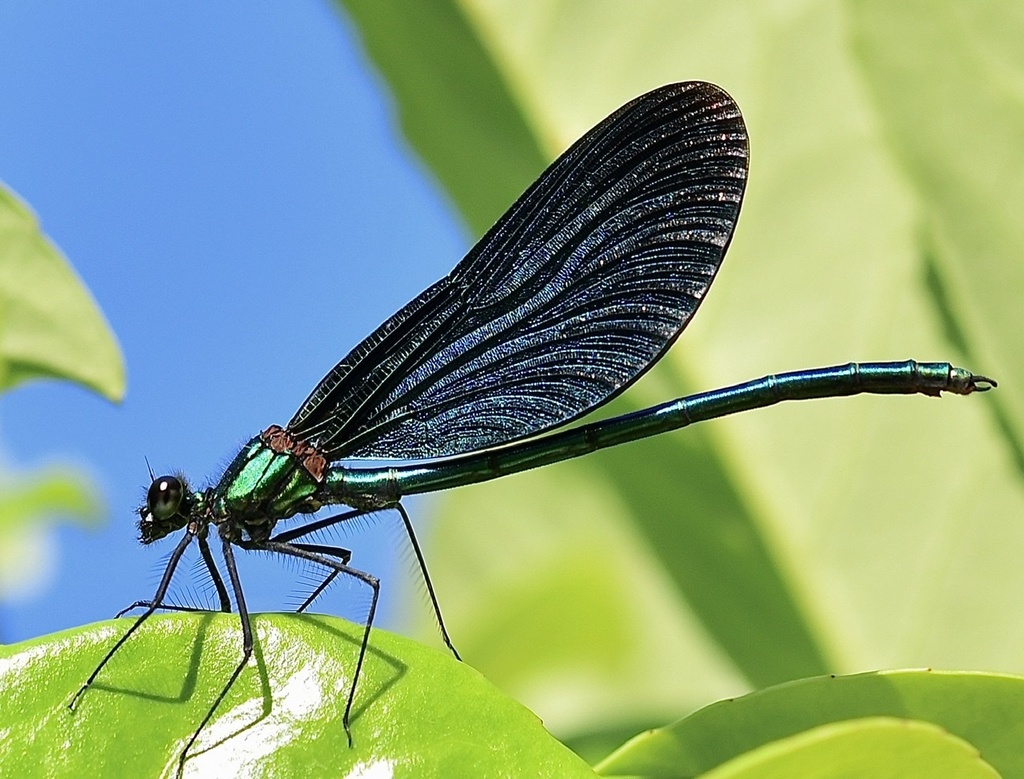
A large, metallic damselfly of shady slow-flowing streams; males show dark iridescent wings and vivid blue-green bodies, females are greener or brownish.
!Is the beautiful demoiselle dangerous?
No. Not dangerous. Adults do not have venom. They may nip if handled but bites are harmless and rare. No disease risk to humans.
Pets
Harmless to pets; too small to affect cats or dogs. Pets might catch individuals but there is no venom or toxin risk.
📖Overview
Calopteryx virgo is a striking broad-winged damselfly found along clean, cool, fast-flowing streams and small rivers. Males are highly territorial along stream margins and perform elaborate flight displays to court females and defend breeding sites. Larvae are aquatic predators that develop in stream beds for one to two years before emerging as adults. This species prefers shaded, unpolluted streams with sandy or gravelly beds with overhanging vegetation and is often one of the first large damselflies to appear in spring in parts of its range.
🔍How to identify a beautiful demoiselle
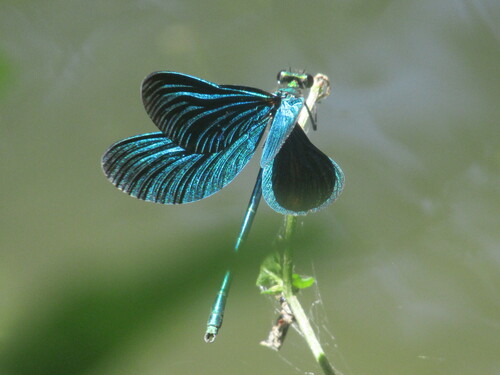
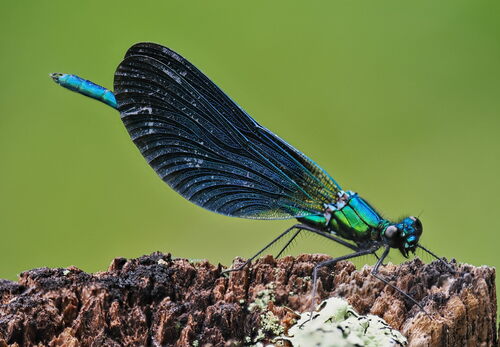
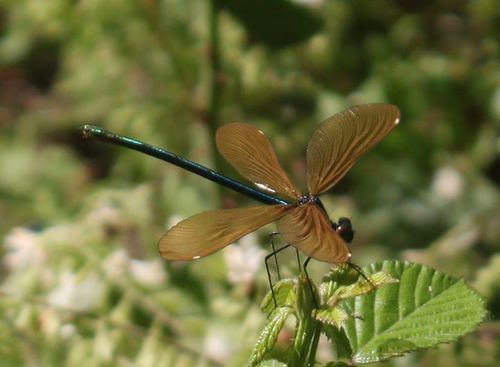
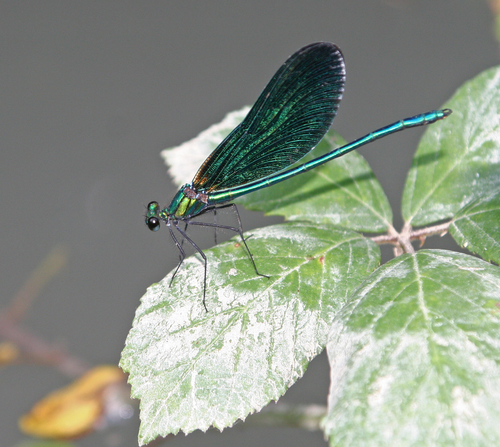
Adult males have a long slender metallic body that is vivid blue-green or violet-blue and broad wings that are dark brownish-blue almost to the base, appearing blue-violet in good light. Females have a metallic green to bronze body and translucent smoky-brown wings with a white spot (pseudopterostigma) near each wingtip. Both sexes are larger and more robust than many other damselflies, with long legs and the characteristic slender abdomen of Odonata.
- Males: metallic blue-green body with broad, uniformly dark iridescent wings (often blue-violet in sunlight).
- Females: metallic green body with translucent smoky-brown wings and a white spot near each wingtip.
- Large size for a damselfly and broad wings (family Calopterygidae) compared with narrow-winged damselflies.
- Frequent presence along shaded, fast-flowing streams with overhanging vegetation.
Lookalikes
Banded demoiselle Calopteryx splendens
Male C. splendens has a clear wing base with a dark band near the tip; male C. virgo has wings that are broadly and more uniformly dark. Body coloration and habitat overlap but wing pattern distinguishes them.
Ebony jewelwing Calopteryx maculata
Native to North America and entirely dark-winged in males; range does not overlap with C. virgo, so geographic location separates them.
↻Life cycle
Egg
Females lay eggs in submerged plant stems or soft submerged debris; eggs hatch into aquatic larvae.
Nymph (nymph)
Aquatic, predatory nymphs live among sediment and vegetation for one to two years, moulting multiple times as they grow.
Adult (imago)
Adults emerge from water, expand their wings and fly; adults hunt small flying insects and engage in territorial and courtship behaviour.
🍃Diet and predators
Young eat
Aquatic invertebrates and small aquatic animals, caught by ambush or active hunting.
Adults eat
Small flying insects such as midges, mosquitos, flies and other small diptera.
Predators of the young
Fish, aquatic beetles, amphibians and larger aquatic predators.
Predators of adults
Birds, larger dragonflies, spiders and insectivorous bats.
🌱Effect on plants and gardens
Adults visit vegetation to perch and hunt flying insects; they do not harm plants and are not crop pests. By preying on small flying insects they can be beneficial.
📍Where and when to find it
Adults perch on overhanging vegetation beside streams and rivers; larvae are found among submerged plants, detritus and sediments in the same water bodies.
Best time
April to August in much of Europe; warm, calm daylight hours are best for observing courtship and territorial displays.
Observation tips
Approach slowly and keep low contrast; photograph males side-on to capture wing iridescence. Look in shaded stretches of stream with dense bankside plants.
✨Fun facts
- Males perform conspicuous fluttering displays above water to attract females and defend territories.
- Larvae are important predators in stream ecosystems and can indicate good water quality.
?Frequently asked questions
Are Beautiful demoiselles dangerous?
No. They are harmless to humans and do not bite or sting in any medically significant way.
Do Beautiful demoiselles bite?
They can give a tiny nip if handled roughly, but bites are rare, mild and not harmful.
Why is a Beautiful demoiselle near my garden pond?
They are attracted to clean, shaded, flowing water where they feed and breed. They may visit gardens beside streams, but still garden ponds are rarely suitable for breeding.
How can I encourage Beautiful demoiselles to breed in my pond?
They breed in flowing streams, so a garden pond is rarely enough. If a stream runs through your land, keep the water clean, leave bankside plants and some shade from overhanging trees, and avoid pesticides.
How do I get rid of Beautiful demoiselles?
They are beneficial predators and usually desirable. If you must deter them, reduce suitable habitat by removing dense marginal vegetation or adding fish that eat larvae, but this harms biodiversity and is not recommended.
Where do Beautiful demoiselles live?
Along clean, shaded, fast-flowing streams and small rivers with overhanging vegetation across much of Europe, North Africa and parts of western Asia.
📷Photos of the beautiful demoiselle
More dragonflies & damselflies
This guide was written with AI assistance and fact-checked, last updated 2026-10-10. Identification from photos is never certain: don't handle insects you can't identify, and get medical advice for bites, stings or allergic reactions. More about the beautiful demoiselle: iNaturalist, Wikipedia.