
Banded demoiselle
Calopteryx splendens · Broad-winged damselflies
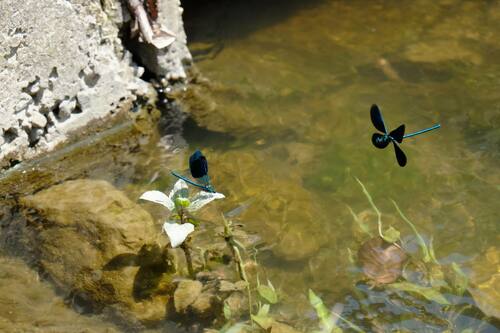
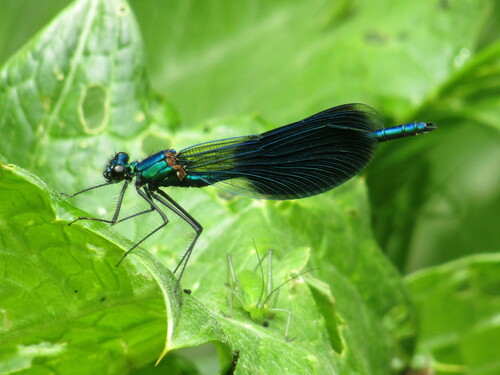
A metallic blue-green damselfly (male) with a distinctive dark band across each wing; found along slow-flowing rivers and streams across Europe and western Asia.
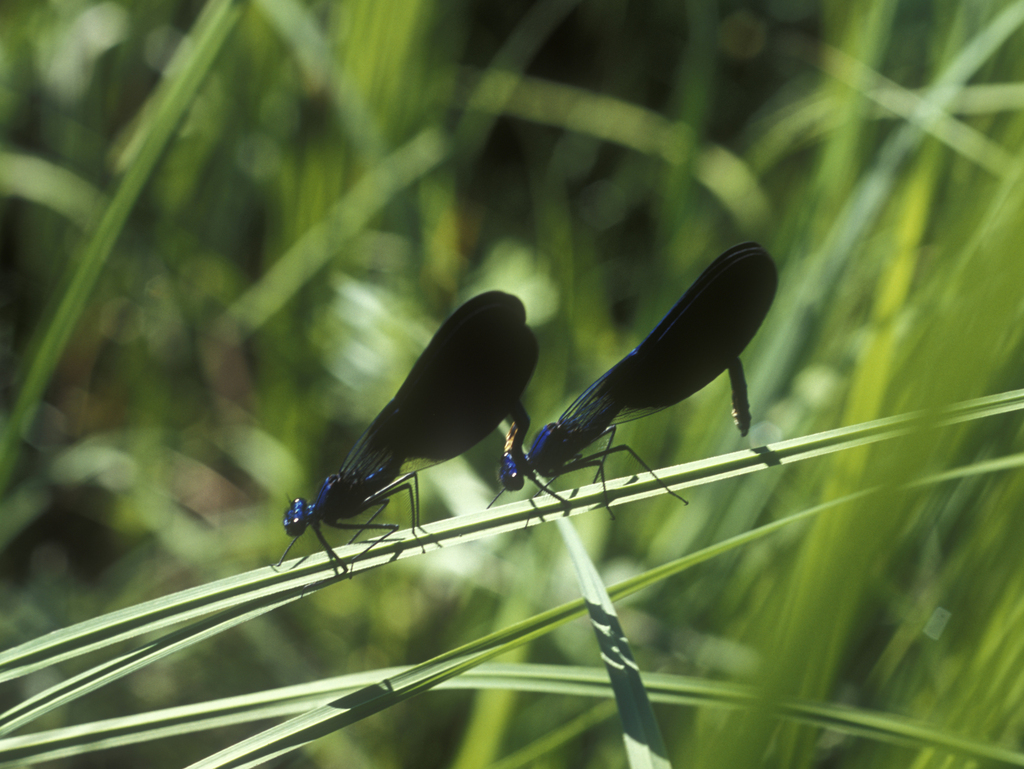
!Is the banded demoiselle dangerous?
No. Banded demoiselles do not sting. They can nibble with mouthparts if handled but are harmless to people. No venom or significant medical risk; wash hands if you have handled aquatic plants or water to avoid minor contamination.
Pets
Not dangerous to pets. They are small and would only be eaten accidentally; they do not carry diseases of concern to pets.
📖Overview
Calopteryx splendens is a large, colourful damselfly in the family Calopterygidae. Males are metallic blue-green with a broad, dark band across the middle of each wing; females are metallic green and have translucent greenish wings without a dark band. They live and breed along slow-flowing rivers, streams and canals with plenty of aquatic vegetation. Adults are aerial predators of small flying insects; larvae are aquatic predators that live among submerged plants and sediments. They are common in much of Europe and parts of western Asia and are active in the warmer months.
🔍How to identify a banded demoiselle
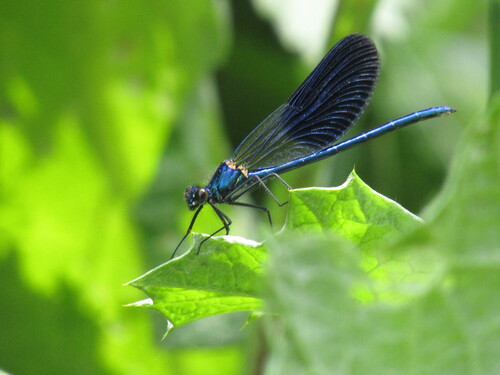
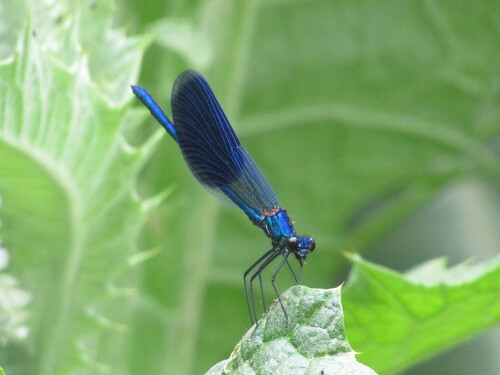
Male banded demoiselles have a glossy metallic blue-green or turquoise body with a distinct broad, opaque dark band across the centre of each wing. The wing band usually leaves the wing bases and tips clear. Females are metallic green to bronze-green with translucent greenish-tinted wings that lack the dark band and carry a small white spot (pseudopterostigma) near each wingtip. Both sexes have long, broad wings compared with narrow-winged damselflies, and the body is relatively robust for a damselfly.
- Males: metallic blue-green body with a broad, continuous dark band across the middle of each wing, leaving clearer tips.
- Females: metallic green body with translucent greenish wings, no dark band, and a small white spot near each wingtip.
- Broad wings held closed above the body at rest (typical damselfly posture) and larger, more robust form compared with narrow-winged damselflies.
Lookalikes
Beautiful demoiselle Calopteryx virgo
Male C. virgo usually has darker, more extensive wing coloration often covering most of the wing and a darker, bluer body; habitat often in shadier, faster-flowing streams. C. splendens usually has clearer wing tips and a slightly different wing band shape.
Western demoiselle Calopteryx xanthostoma
Closely related; the male wing band extends right to the wingtip, whereas in C. splendens the tip is usually clear. Found mainly in Iberia, southern France and Italy.
Emerald damselfly Lestes sponsa
Lestes spp. are slimmer, have clear wings and a different resting posture (often partly open); they lack the broad dark wing band of Calopteryx.
↻Life cycle
Egg
Females lay eggs in or on aquatic plants and submerged stems; eggs develop over days to weeks depending on temperature.
Nymph (nymph)
Aquatic nymphs live among submerged vegetation and detritus for many months, preying on other small aquatic invertebrates; they usually overwinter as larvae.
Adult (imago)
Emergence from the final larval moult produces the winged adult. Adults fly, feed, defend territories, and mate; they live for several weeks to a few months.
🍃Diet and predators
Young eat
Small aquatic invertebrates such as insect larvae, crustaceans and other microfauna.
Adults eat
Small flying insects: midges, mosquitos, mayflies and other soft-bodied insects caught in flight.
Predators of the young
Fish, aquatic beetles, larger aquatic predators and some amphibians.
Predators of adults
Birds, spiders, larger dragonflies and other aerial predators; they may also be preyed on by bats at dusk.
🌱Effect on plants and gardens
Larvae live among submerged and marginal plants but do not damage vegetation in a way that concerns gardeners; adults perch on stems and hunt near vegetation.
📍Where and when to find it
Adults: perching on emergent stems, low vegetation and overhanging branches beside slow rivers and streams. Larvae: among submerged plants and detritus in the same water bodies.
Best time
Best from late spring to late summer, during warm sunny weather and mid-morning to late afternoon when they are active.
Observation tips
Approach slowly and photograph from the bank or a hide; use a telephoto lens or macro to capture wing band details. Watching territorial males along stretches of stream is a reliable way to find them.
✨Fun facts
- Males perform conspicuous aerial displays and territory patrols to attract females and chase rivals.
- The wing band is used in courtship and male-male interactions; its size and darkness can affect success in contests.
- Larvae can spend a year or more underwater before emerging as adults.
?Frequently asked questions
Are banded demoiselles harmful to people?
No. They do not sting and are harmless. They are beneficial predators of nuisance insects like midges.
Do banded demoiselles bite?
They have mouthparts capable of a small nip, but they do not bite people as a defensive behaviour and bites are extremely rare and harmless.
Why are banded demoiselles in my garden?
If you have slow-flowing water, ponds or streams with plants nearby, the habitat is suitable for breeding and hunting, so adults will visit and perch on vegetation.
How can I encourage banded demoiselles?
Provide or restore slow-flowing water with areas of submerged and marginal plants, maintain unpolluted water, and leave vegetation along banks for perching and emergence.
How do I tell a male from a female?
Males are metallic blue-green with a solid dark wing band; females are metallic green with translucent greenish wings and a small white spot near each wingtip.
When can I see banded demoiselles?
Look on warm, sunny days from late spring to late summer (roughly April to September in much of Europe), especially near suitable water bodies.
📷Photos of the banded demoiselle
More dragonflies & damselflies
This guide was written with AI assistance and fact-checked, last updated 2026-10-10. Identification from photos is never certain: don't handle insects you can't identify, and get medical advice for bites, stings or allergic reactions. More about the banded demoiselle: iNaturalist, Wikipedia.