
Banded demoiselle vs Beautiful demoiselle
These two are easy to mix up. Here's how to tell a banded demoiselle from a beautiful demoiselle, and whether either one bites or stings.
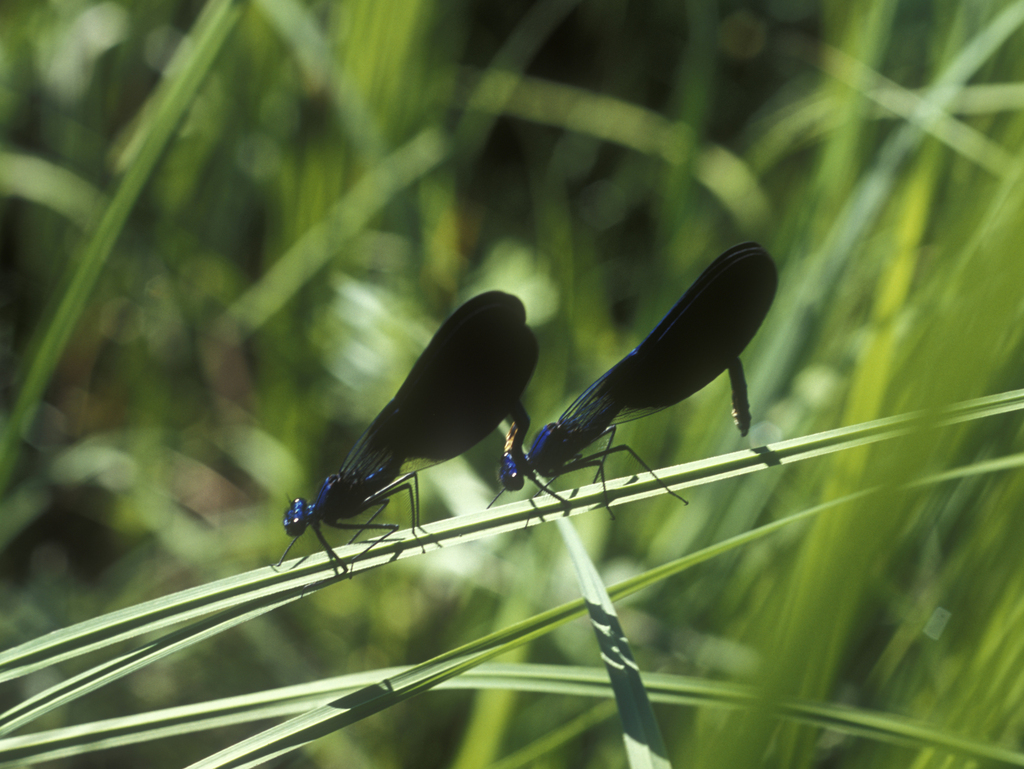
Banded demoiselle
Calopteryx splendens
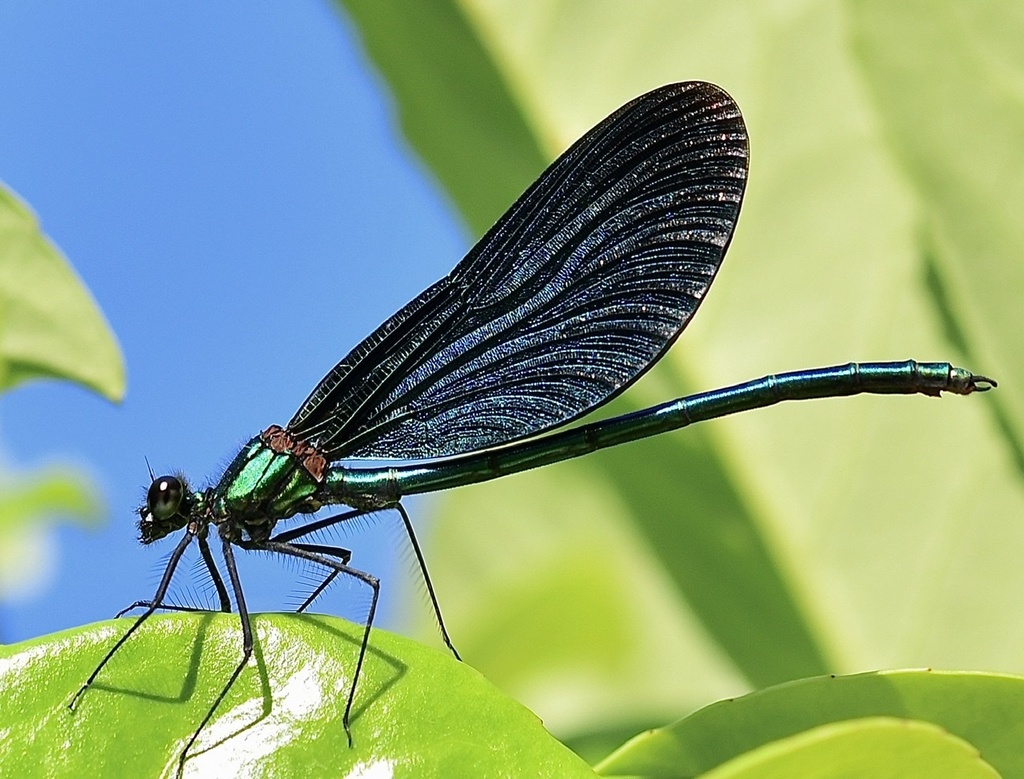
Beautiful demoiselle
Calopteryx virgo
≠The key differences
Male C. virgo usually has darker, more extensive wing coloration often covering most of the wing and a darker, bluer body; habitat often in shadier, faster-flowing streams. C. splendens usually has clearer wing tips and a slightly different wing band shape.
Male C. splendens has a clear wing base with a dark band near the tip; male C. virgo has wings that are broadly and more uniformly dark. Body coloration and habitat overlap but wing pattern distinguishes them.
⚖︎Side by side
| Banded demoiselle | Beautiful demoiselle | |
|---|---|---|
| To humans | Non-toxic | Non-toxic |
| Size | Body length 45-48 mm, wingspan about 60-70 mm | Body length 45-50 mm; wingspan 60-80 mm |
| Colours | Metallic blue-green, Dark wing band (blackish), Olive-brown (female), Pale wing patch (female) | Iridescent blue-green, Deep metallic green, Dark wing (blue-violet to black), Brown (female wings) |
| Family | Calopterygidae | Calopterygidae |
| Habitat | Slow-flowing rivers, streams, canals and their vegetated margins; prefers waters with submerged and marginal plants. | Shady, clean, fast-flowing streams and small rivers with sandy or gravelly beds, marginal vegetation and overhanging shrubs or trees. |
| Range | Widespread across Europe and into western Asia; absent from the far north and some Mediterranean islands where conditions are unsuitable. | Widespread in much of Europe, North Africa and parts of western Asia; locally common where suitable habitat exists. |
| Active | Spring and summer, typically April to September depending on latitude; adults are diurnal and most active in sunny weather. | Spring and summer (often April to August depending on latitude); active in daylight, especially on warm, calm weather. |
| Pest? | No | No |
🔍How to spot a banded demoiselle
- Males: metallic blue-green body with a broad, continuous dark band across the middle of each wing, leaving clearer tips.
- Females: metallic green body with translucent greenish wings, no dark band, and a small white spot near each wingtip.
- Broad wings held closed above the body at rest (typical damselfly posture) and larger, more robust form compared with narrow-winged damselflies.
🔍How to spot a beautiful demoiselle
- Males: metallic blue-green body with broad, uniformly dark iridescent wings (often blue-violet in sunlight).
- Females: metallic green body with translucent smoky-brown wings and a white spot near each wingtip.
- Large size for a damselfly and broad wings (family Calopterygidae) compared with narrow-winged damselflies.
- Frequent presence along shaded, fast-flowing streams with overhanging vegetation.
?Frequently asked questions
What is the difference between a banded demoiselle and a beautiful demoiselle?
Male C. virgo usually has darker, more extensive wing coloration often covering most of the wing and a darker, bluer body; habitat often in shadier, faster-flowing streams. C. splendens usually has clearer wing tips and a slightly different wing band shape. Male C. splendens has a clear wing base with a dark band near the tip; male C. virgo has wings that are broadly and more uniformly dark. Body coloration and habitat overlap but wing pattern distinguishes them.
Is a banded demoiselle or a beautiful demoiselle more dangerous?
Banded demoiselle: Non-toxic. Beautiful demoiselle: Non-toxic. Banded demoiselles do not sting. Not dangerous.
Identification from photos is never certain: don't handle insects you can't identify, and get medical advice for bites, stings or allergic reactions.