
Four-spotted chaser
Libellula quadrimaculata · Chasers and skimmers
A widespread Holarctic dragonfly recognizable by a dark spot at each wing node and a stocky body; common at still water and ponds.
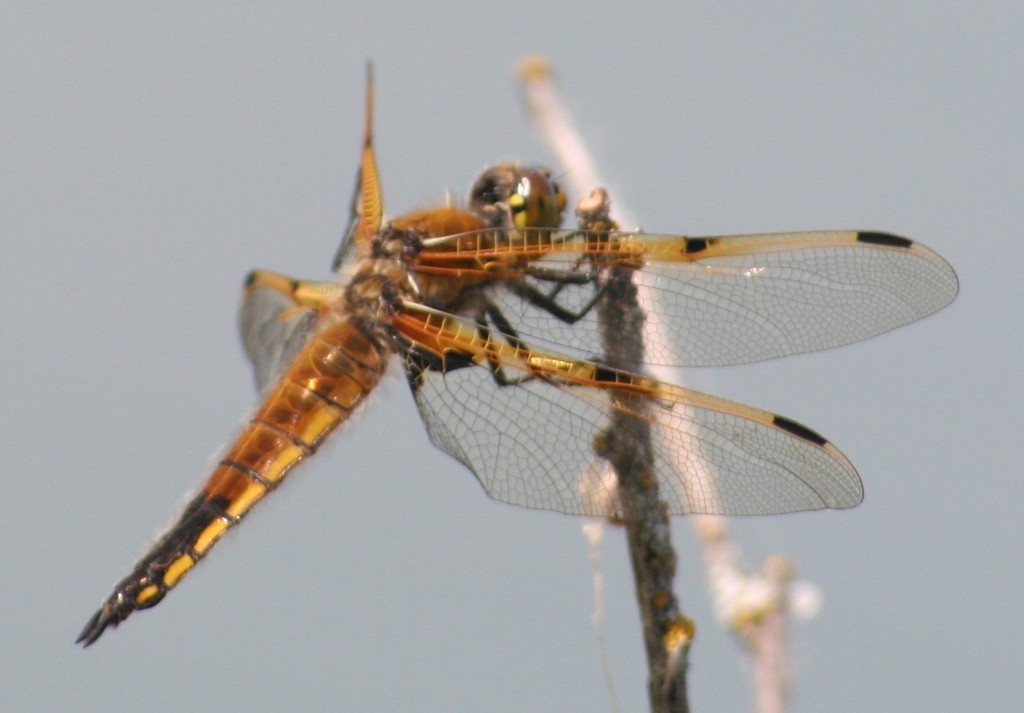
!Is the four-spotted chaser dangerous?
No. Four-spotted chasers are not dangerous to people. They do not have venom and will not seek to bite; if handled roughly they can give a harmless nip with their mouthparts but this is very rare. No special first aid is needed beyond cleaning and treating any minor pinch or scrape.
Pets
Harmless to pets. Dogs or cats might chase or attempt to eat a dragonfly, which could cause minor gastrointestinal upset if swallowed but is generally not toxic.
📖Overview
Libellula quadrimaculata is a medium-sized dragonfly found across much of Europe, Asia and northern North America. It breeds in still or slow-moving waters with emergent vegetation and is often one of the first dragonflies seen in spring and early summer in cooler regions. Adults are strong, agile fliers that hunt small flying insects near water and perching sites. Both sexes commonly perch with wings held flat.
The species is ecologically important as a predator of nuisance insects (midges, mosquitoes) and as prey for birds and fish. It is widespread and generally common where suitable wetlands occur; there are no major global conservation concerns for this species, though local wetland loss can reduce populations.
🔍How to identify a four-spotted chaser
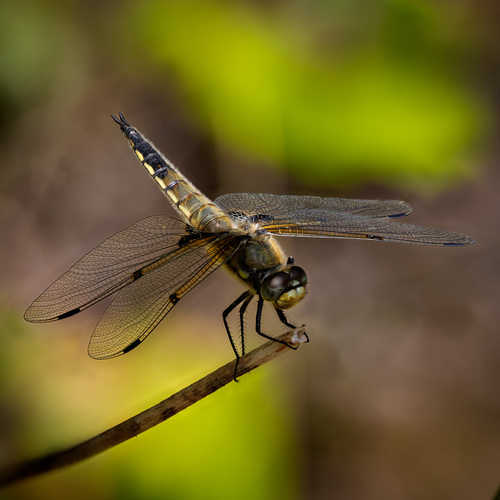
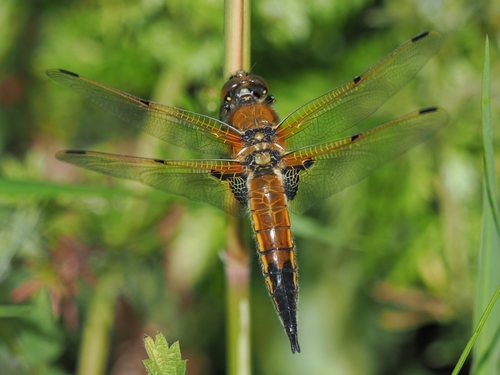
Adults have a stout, tapering abdomen and a relatively broad, hairy thorax. The most distinctive mark is a dark spot at the nodus (mid-point of the leading edge) of each wing, giving the species its common name "four-spotted". The hindwings also have a dark triangular patch at the base, and the wing bases and leading-edge veins are often tinged amber. The body is olive-brown to amber-brown with yellowish sides and a black tip to the abdomen. Males and females look very similar and neither develops a blue powdery coating. Eyes meet at the top of the head.
- Look for a dark spot at the nodus (mid-point) of each wing — four spots total (one on each wing).
- Stocky dragonfly with a dark triangular patch at the base of each hindwing in addition to the nodal spots.
- Olive-brown body with yellow sides and a black-tipped abdomen; males and females look alike.
- Perches flat with wings outstretched on emergent vegetation or bare stems near still water.
Lookalikes
Broad-bodied chaser Libellula depressa
Broad-bodied chaser has a much broader, flattened abdomen (powder blue in males, yellow-brown in females), dark patches at the base of all four wings and no spots at the nodus.
Scarce chaser Libellula fulva
Males develop a powder-blue abdomen and both sexes have dark wing tips rather than nodal spots; it lives mainly along slow rivers in Europe.
Yellow-winged darter Sympetrum flaveolum
Smaller and slimmer, with red (males) or yellow-brown abdomen and large saffron patches at the wing bases; it lacks the four dark nodal spots of L. quadrimaculata.
↻Life cycle
Egg
Laid in or just above water among emergent vegetation or on plant stems; eggs hatch into aquatic larvae (nymphs).
Nymph (aquatic)
Cryptic aquatic predators that live among vegetation and sediment, feeding on small aquatic invertebrates; they grow over months to years and undergo multiple molts.
Adult (dragonfly)
Terrestrial, winged predators that emerge from the water, mate, and the female lays eggs back in the water; adults hunt flying insects and live for weeks to months.
🍃Diet and predators
Young eat
Aquatic invertebrates such as insect larvae, small crustaceans and other tiny prey
Adults eat
Flying insects including midges, mosquitoes, flies and small moths
Predators of the young
Fish, amphibians, aquatic insects such as larger beetles and dragonfly nymphs
Predators of adults
Birds, larger dragonflies, spiders and insectivorous bats
🌱Effect on plants and gardens
Adults do not damage plants; larvae live among submerged vegetation and detritus and do not harm aquatic plants in any meaningful way.
📍Where and when to find it
Adults: perch on emergent stems, reeds and low vegetation near ponds, marshes and slow ditches. Nymphs: in submerged vegetation, among detritus and mud in the same water bodies.
Best time
Spring to late summer; sunny, warm afternoons are best for seeing adults. In cool climates they appear earlier in the season.
Observation tips
Approach slowly and photograph from a low angle to include the wing nodal spots. Early season sightings may be of freshly emerged adults with paler colors.
✨Fun facts
- The "four spots" refer specifically to the dark patches at the nodus of each wing, a reliable field mark.
- In some northern populations adults can be among the earliest dragonflies on the wing in spring, sometimes appearing when few other species are active.
- Larvae are sit-and-wait predators and can take advantage of cold-water conditions that slow down some competitors.
?Frequently asked questions
Do four-spotted chaser dragonflies bite?
They do not bite people except very rarely if handled roughly; their mouthparts are for catching insect prey and are not a medical concern.
Are four-spotted chasers dangerous or venomous?
No. They are non-venomous and harmless to humans.
Why is a four-spotted chaser in my garden?
If you have a pond, marshy area, or even a damp garden with standing water nearby, it provides breeding habitat and hunting grounds for this species.
How can I attract more four-spotted chasers?
Provide or restore still or slow-moving water with emergent and marginal vegetation, avoid heavy pesticide use, and create sunny perches near the water.
How do I get rid of them from my pond?
They are beneficial predators; removal is not recommended. If you must reduce dragonfly numbers, reducing suitable vegetation or improving water flow will make the site less attractive, but remember this also harms other wildlife.
Where do four-spotted chasers lay eggs?
Females typically oviposit in or on the surface of still water, often near emergent plants or on stems; eggs hatch into aquatic nymphs.
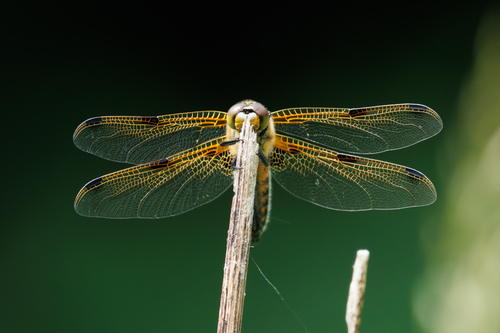
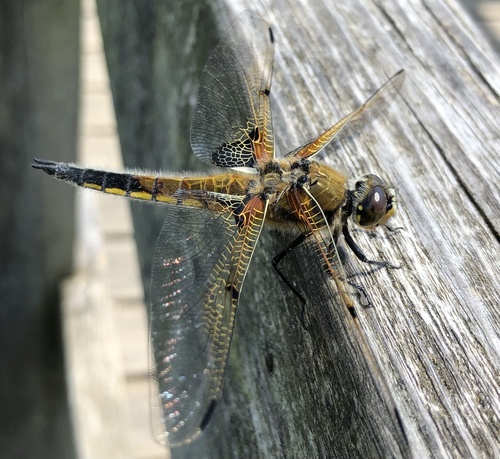
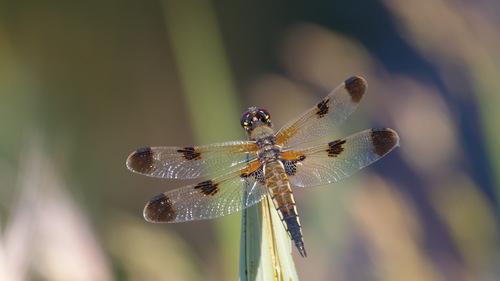
📷Photos of the four-spotted chaser
More dragonflies & damselflies
This guide was written with AI assistance and fact-checked, last updated 2026-10-10. Identification from photos is never certain: don't handle insects you can't identify, and get medical advice for bites, stings or allergic reactions. More about the four-spotted chaser: iNaturalist, Wikipedia.